It's no surprise that many people turn to yoga or Pilates for relief. Both are low-impact, accessible, and well-regarded for supporting spinal health. But they work differently — and choosing the wrong one for your specific condition can slow your recovery or, in some cases, make things worse.
This guide breaks down exactly how each practice addresses back pain, which conditions each is better suited for, and how to make an informed choice based on your situation.
Key Takeaways
- Yoga targets flexibility, stress reduction, and full-body mobility; Pilates focuses on deep core stabilization and spinal alignment
- Pilates tends to be more effective for structural issues like disc herniations or spinal instability
- Yoga may have an edge when back pain is driven by stress, tension, or restricted range of motion
- For chronic or condition-specific back pain, qualified instruction often matters more than the practice itself
Yoga vs. Pilates for Back Pain: Quick Comparison
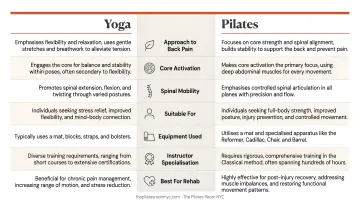
Both practices are low-impact and evidence-supported, with room to adapt to a wide range of bodies and conditions. Understanding where they differ helps you choose the approach that fits your specific back pain situation.
| Category | Yoga | Pilates |
|---|---|---|
| Primary Focus | Flexibility, balance, stress reduction, mind-body awareness | Deep core strengthening, spinal stabilization, postural alignment |
| Equipment | Mat, blocks, straps | Mat or Reformer/Cadillac (spring resistance adds support) |
| Best Suited For | Muscle tension, stress-related pain, general mobility | Core weakness, postural imbalances, disc issues, post-injury rehab |
| Breathing | Pranayama — calms the nervous system | Diaphragmatic — activates deep core muscles |
| Mind-Body Component | Strong — includes meditation and mindfulness | Present — intentional movement, but primarily physical |
What Is Yoga for Back Pain?
Yoga is an ancient Indian mind-body practice that combines physical postures (asanas), breathwork (pranayama), and meditation. These three elements work together to address both the physical and psychological dimensions of back pain.
Physically, yoga benefits the back by:
- Stretching the posterior chain — hamstrings, hip flexors, and paraspinal muscles that pull the spine out of alignment when tight
- Improving spinal range of motion through controlled extension, flexion, and rotation
- Reducing cortisol-driven muscle tension that can amplify pain signals
The mind-body component is relevant here. A 2023 review published in PMC describes yoga as interacting with pain responses, stress regulation, and autonomic pathways — meaning it can address the nervous system dimension of chronic pain, not just the muscular one.
Yoga Styles Best Suited for Back Pain
Not all yoga is created equal when back pain is involved. Three styles have the strongest case:
- Hatha yoga — slower-paced, alignment-focused, and accessible for beginners; forms the basis of most back-pain trial evidence
- Iyengar yoga — uses props (blocks, bolsters, straps) for precise alignment; has direct RCT evidence showing significant improvement in pain and disability after 16 weeks in chronic low back pain sufferers
- Restorative yoga — passive, prop-supported postures held for several minutes; designed to release chronic tension and calm the nervous system
A 2022 Cochrane review of 21 trials and 2,223 participants found yoga produced small but real improvements in function and pain for chronic non-specific low back pain compared to no exercise. That's a consistent signal across a large body of research — not a cure, but a genuine tool.
That said, yoga isn't appropriate for every back condition without modification:
- Deep forward folds can aggravate spinal stenosis
- Aggressive backbends are problematic with disc herniations
- Harvard Health advises avoiding yoga with a herniated disc or spinal fracture until medically cleared
Working with a qualified instructor who understands your condition is non-negotiable.
What Is Pilates for Back Pain?
Pilates is a structured movement methodology developed by Joseph Pilates in the early 20th century, built around six principles: concentration, control, centering, flow, precision, and breathing. This framework makes it particularly well-suited to rehabilitative back care.
The Core-Spine Connection
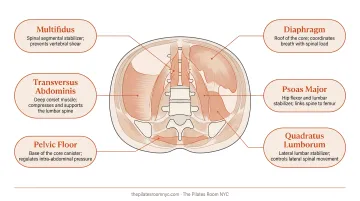
The concept of the "powerhouse" sits at the heart of Pilates. This isn't just about surface-level abdominal strength — it targets the deep stabilizers that protect the lumbar spine:
- Transversus abdominis — the deepest abdominal layer, which acts like a corset around the spine
- Lumbar multifidus — small muscles running along the vertebrae that control segmental stability
- Pelvic floor and diaphragm — complete the inner core unit
A 2023 systematic review confirmed that Pilates may improve activation of these muscles in people with chronic low back pain — precisely the muscles that tend to atrophy and become dysfunctional in back pain sufferers.
Postural Alignment and Neutral Spine
Pilates trains the body to move from a neutral spine position, which directly counters the postural patterns driving chronic back pain in desk workers: anterior pelvic tilt, forward head posture, and rounded shoulders. Every exercise is built around maintaining this alignment under load — which is very different from passive stretching.
Mat vs. Reformer Pilates
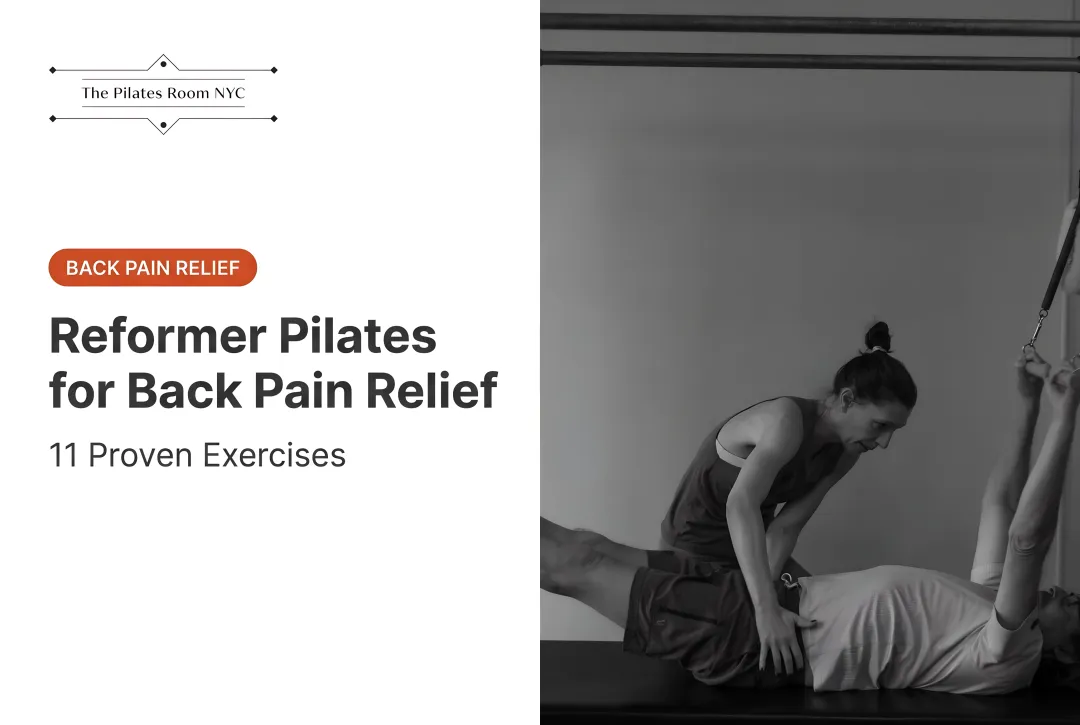
Both deliver results. A 2017 RCT comparing 98 patients over 12 weeks found that both mat and equipment-based Pilates improved pain, function, and transversus abdominis activation in chronic low back pain. The Reformer's spring resistance offers an additional advantage for back pain specifically — it allows controlled loading of muscles with less compressive force than bodyweight-only work, which can be particularly valuable during early rehabilitation.
Classical Pilates and Back Pain Rehabilitation
Classical Pilates — rooted in Joseph Pilates' original sequencing — builds balanced musculature from the ground up, reinforcing movement patterns that protect the spine over the long term.
At The Pilates Room NYC, several instructors were trained directly under Romana Kryzanowska or through her lineage. Studio owner Alison Johnson received her Classical Pilates certification in 1998 through The Pilates Guild, training under Romana Kryzanowska and Bob Liekens. Pamela Pardi studied under Romana at the Original Pilates Studio beginning in 1988 and was appointed Level 3 instructor trainer in Romana's Pilates program in 2004.
The studio also has Enja Schenck (MS Sport Science, CSCS), whose work integrates Classical Pilates with Postural Restoration Institute principles — a combination particularly relevant for clients managing postural asymmetries and chronic lumbar pain. That credential depth translates directly to sessions tailored to each client's specific physical condition.
Yoga vs. Pilates: Which Is Better for Your Back?
Neither practice is universally superior. The right choice depends on what's actually causing your pain.
Chronic Non-Specific Lower Back Pain
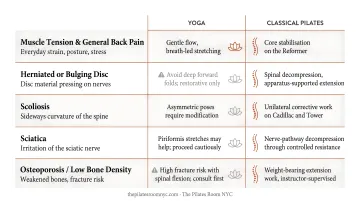
Both practices have systematic review support for this condition. The Cochrane evidence base gives yoga a slight edge when pain is tied to stress and tension; Pilates ranks favorably in network meta-analyses comparing exercise types for pain and disability. Either can work — and the quality of instruction matters more than which practice you choose.
Herniated or Bulging Disc
Pilates is generally the safer starting point. Its emphasis on neutral-spine mechanics and deep core activation avoids the excessive flexion and extension that can aggravate disc herniations. Rehabilitation protocols for lumbar disc herniation call for exactly what Pilates targets: neutral spine positioning and recruitment of the transversus abdominis and multifidus (deep core stabilizing muscles).
Until the disc is stable, these yoga movements need to be avoided or carefully modified:
- Forward folds and seated flexion poses
- Deep backbends (Wheel, Cobra variations)
- Unsupported twists that load the lumbar spine
Spinal Instability or Spondylolisthesis
Pilates is the stronger choice here. A 1997 Spine RCT involving 44 patients with spondylolysis or spondylolisthesis found that specific stabilizing exercises targeting deep abdominal muscles and the lumbar multifidus significantly reduced pain and disability, with benefits maintained at 30-month follow-up — precisely the mechanism Pilates targets. Dynamic yoga transitions and unsupported balance poses introduce shear forces that raise risk for unstable spines, making careful selection essential if yoga is preferred.
Stress-Driven or Tension-Related Back Pain
If stress and anxiety are significant contributors to your back pain — and research confirms they often are — yoga's mind-body framework offers something Pilates alone cannot. Pranayama, meditation, and the relaxation response directly address the autonomic nervous system's role in pain amplification.
Osteoporosis or Bone Density Concerns
Both can be adapted safely, but both require careful modification. Key movements to avoid:
- Pilates: Roll-ups and loaded spinal flexion
- Yoga: Deep forward folds, strong twists, and unsupported balance poses that risk falls
Osteoporosis Canada advises limiting repetitive bending, twisting all the way around, and bending fully forward for people at high fracture risk. Research hasn't shown either practice to significantly improve bone mineral density in adult women — so the goal is safe, beneficial movement, not density gains.
Working with an instructor experienced in osteoporosis is non-negotiable in this case.
Conclusion
The decision framework is straightforward: choose yoga if your back pain is tied to stiffness, poor flexibility, or a stress-driven nervous system response. Choose Pilates if the root cause is core weakness, postural dysfunction, or a structural diagnosis like disc herniation or spinal instability.
Many people benefit from elements of both — though not simultaneously when managing active pain. Start with the practice that matches your diagnosis, build stability, then consider layering in the other once you're ready.
That said, the most important variable isn't which practice you choose. It's whether the person guiding you understands your specific condition and can adapt the work to match it.
For New Yorkers seeking expert-guided Pilates for back pain recovery, The Pilates Room NYC offers private sessions addressing chronic lower back pain, disc issues, osteoporosis management, and post-surgical recovery. Instructors hold Classical Pilates certifications alongside credentials in sport science, postural restoration, and strength conditioning — and every session is adapted to your body's current state from day one.
New clients receive 15% off their first one-on-one session. Fill out the new client form at The Pilates Room NYC or call 212-206-1827 to get started.
Frequently Asked Questions
Is Pilates good for L4 and L5?
Pilates can be beneficial for L4-L5 issues — including disc herniations and degenerative changes — because it strengthens the deep stabilizing muscles surrounding the lumbar spine. Sessions need to be individually adapted by a qualified instructor to avoid loading the disc or irritating the nerve.
Can people with Ehlers-Danlos syndrome do Pilates?
Yes, but the focus must shift from flexibility to controlled stability and strength. End-range stretching and hypermobility exercises should be avoided. An instructor experienced in hypermobility conditions is essential — both to prevent joint injury and to build the neuromuscular control that EDS undermines.
Can I do yoga or Pilates with a herniated disc?
Both can be appropriate with the right modifications. Pilates is generally the safer starting point given its neutral spine emphasis and controlled loading. Yoga should avoid deep forward folds and extreme backbends until the disc has stabilized and you've received medical clearance.
How often should I do Pilates for back pain relief?
Aim for 2–3 sessions per week over 6–12 weeks — that's the range where most people see meaningful improvement. Private sessions are preferable at first to ensure proper form, safe progression, and adaptation to your specific condition.
Is yoga or Pilates better for sciatica?
It depends on the cause. Pilates is generally preferred when sciatica stems from lumbar instability or disc compression. Gentle yoga stretches — like modified pigeon pose — may help relieve piriformis-related sciatic pain. Get a diagnosis first — the right approach differs significantly depending on the underlying cause.
Which is better for lower back pain: yoga or Pilates?
For most cases, Pilates tends to build the core strength and spinal stability needed for lasting relief. Yoga may be more effective when lower back pain is compounded by stress, poor flexibility, or generalized muscle tension. If you're dealing with a structural issue or a specific diagnosis, Pilates is typically the more grounded place to begin.