It's a reasonable thing to wonder. Both trace back to Joseph Pilates' original system, but they feel different, cost differently, and serve different purposes at different stages of a practice. Choosing the wrong starting point doesn't ruin anything — but it can mean slower progress, unnecessary expense, or missing out on benefits your body actually needs.
This guide breaks down how each method works, what each does best, and how to choose based on your fitness level, goals, budget, and any health considerations.
Key Takeaways
- Mat Pilates uses bodyweight resistance; the Reformer uses adjustable spring tension that can assist or challenge movement.
- Mat work demands fully independent core activation, with no equipment to compensate for gaps in strength.
- Mat is more affordable and accessible; Reformer requires studio access at a higher per-session cost.
- Most instructors recommend starting on the mat to build body awareness before moving to equipment.
- Prenatal clients, those in rehab, and seniors should choose based on individual needs with a qualified instructor's guidance.
Mat vs Reformer Pilates: Quick Comparison
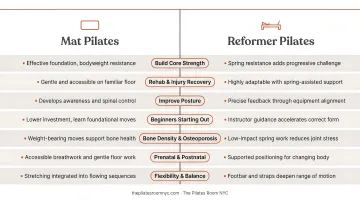
| Factor | Mat Pilates | Reformer Pilates |
|---|---|---|
| Resistance source | Bodyweight and gravity | Adjustable springs and straps |
| Core demand | Fully independent stabilization | Machine assists or increases challenge |
| Cost | Lower; home-friendly | Higher; studio required |
| Learning curve | More intuitive for beginners | Requires orientation and ideally private instruction |
| Best use case | Core foundation, posture, flexibility | Progressive resistance, rehab, wider movement variety |
What Is Mat Pilates?
Mat Pilates is the original format Joseph Pilates developed: a floor-based practice using bodyweight as the primary resistance. Props like resistance bands, a Pilates ring, or a small ball can supplement the work, but the mat is the only equipment required. This is not stretching — every classical mat exercise demands precise muscular control, and nothing is passive.
Joseph Pilates codified this work in his 1945 book Return to Life Through Contrology, laying out 34 exercises in a progressive sequence. Each movement builds on the last, teaching coordination and control in a specific order — and that order is what creates the physical demand.
The Core Demand
The defining challenge of mat work is that there is no machine to assist or catch you. Every exercise requires you to recruit deep stabilizing muscles — particularly the transversus abdominis and oblique internus — entirely on your own. A 2011 study published in Manual Therapy found that an 8-week mat Pilates program significantly increased transversus abdominis thickness, from 3.7mm to 4.7mm, in healthy participants (P = 0.007). That's measurable core adaptation from mat work alone.
Key Benefits of Mat Pilates
- Builds genuine core strength and stability from the inside out
- Improves posture by retraining how muscles support the spine
- Increases flexibility, particularly in the hamstrings and back
- Develops body awareness that transfers to every other movement you do
- Reduces injury risk over time through better movement mechanics
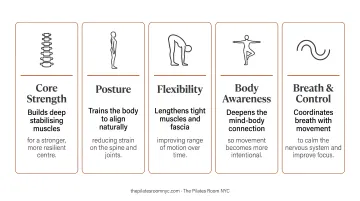
Accessibility matters here too. A mat goes anywhere — home, hotel room, park — which makes it easier to build a consistent practice without depending on studio access.
Who Mat Pilates Is Best For
- Beginners building their first Pilates foundation
- Anyone seeking effective training at low cost
- Healthy individuals focused on core conditioning, posture, and flexibility
- Seniors working on balance and fall prevention, ideally with instructor guidance
- Prenatal and postnatal clients when sessions are appropriately modified by a qualified instructor
What Is Reformer Pilates?
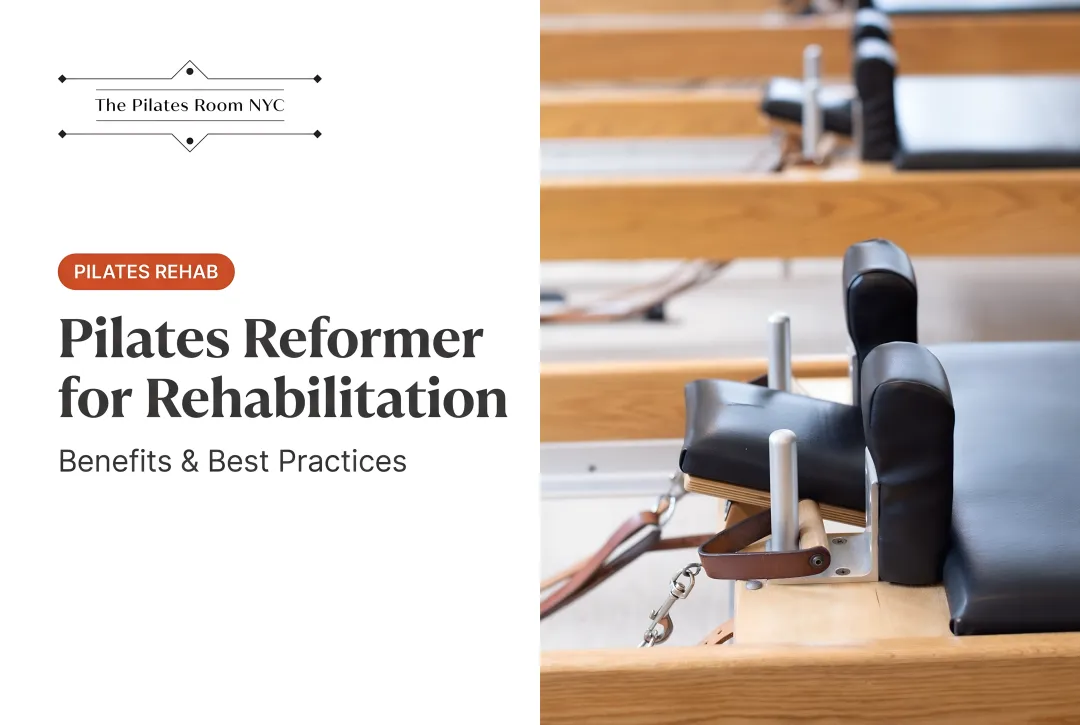
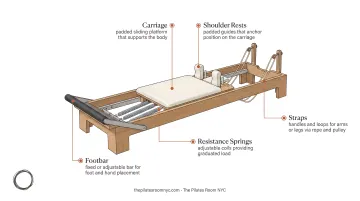
The Reformer is a spring-loaded apparatus consisting of a sliding carriage, adjustable springs for resistance, a footbar, and hand straps. It enables exercises from lying, seated, kneeling, and standing positions — the range of exercises is considerably broader than what a mat alone can offer.
The historical origin story places Joseph Pilates using bed springs to rehabilitate patients unable to walk. Today's modern Reformer preserves that same principle: spring resistance that works in two directions.
How the Springs Work
That two-directional resistance is what makes the Reformer so adaptable. Springs can be set to:
- Assist a movement — helpful for clients with limited mobility, recovering from injury, or learning a new exercise pattern
- Resist a movement — adding load that goes well beyond what bodyweight alone provides
That adjustability makes the Reformer genuinely versatile across very different populations. The same machine that supports a post-surgical patient in early recovery can challenge a seasoned athlete in a way mat work cannot replicate.
Key Benefits of Reformer Pilates
- Progressive resistance training that develops strength beyond bodyweight capacity
- A broader range of exercises spanning upper body, lower body, and full-body integration
- Moving-carriage challenges that demand greater balance and dynamic stability
- Accessible for clients who cannot easily get up and down from the floor
Research backs the equipment-based advantage: a study published in Cureus (2022) found measurable improvements in physical parameters following a Reformer-based Pilates program.
The rehabilitation evidence is particularly strong. A 2006 study in the Journal of Orthopaedic and Sports Physical Therapy found a 4-week equipment-based Pilates program reduced pain and functional disability in chronic low back pain patients — with benefits maintained at 12 months.
Who Reformer Pilates Is Best For
- Those with a Pilates foundation looking to progress into resistance-based training
- Athletes incorporating Pilates as low-impact cross-training
- Clients working through injury or post-surgical recovery
- Anyone who struggles with getting up and down from the floor
- Osteoporosis patients, where spring-assisted loading can safely build bone-protective strength
Mat vs Reformer Pilates: Which Is Better for You?
Neither method is universally superior. The right choice depends on who you are, where you are in your movement journey, and what you need from your practice. In the classical Pilates tradition, mat and Reformer work are designed as complementary practices — not competing ones.
If You're New to Pilates
Most experienced instructors recommend starting on the mat. The reason is straightforward: mat work teaches you to control your own body first. The core awareness, muscle engagement patterns, and movement precision you develop on the mat become the foundation that makes Reformer work more effective — and safer — when you get there.
At The Pilates Room NYC, new clients are directed into private sessions first, where an instructor assesses strength and flexibility to establish a baseline and builds from there. The studio integrates both mat and Reformer work from the start rather than separating them. Their small group sessions include work on the Reformer, Tower, and mat within a single class — which reflects how classical Pilates was always intended to be practiced.
Choosing Based on Your Goals
| Your primary goal | Better starting point |
|---|---|
| Core strength and stability | Mat |
| Posture correction | Either (mat often more accessible) |
| Progressive strength beyond bodyweight | Reformer |
| Flexibility and body awareness | Mat |
| Injury rehabilitation | Reformer (for assistance and control) |
| Low-cost consistent practice | Mat |
| Athletic cross-training | Reformer |
Special Health Considerations
For clients managing injuries, recovering from surgery, navigating osteoporosis, or in prenatal/postnatal stages, neither format is automatically right or wrong. Work with both a healthcare provider and a qualified Pilates instructor to decide.
At The Pilates Room NYC, instructors are matched to clients based on specific needs and experience. Owner Alison Johnson — certified under Romana Kryzanowska with 26 years of teaching — regularly works with clients across all of these conditions. Sessions are tailored to where each client is physically, mentally, and emotionally on any given day.
The Case for Doing Both
Incorporating both formats produces a more complete practice than either method alone. Mat work builds independent body control and proprioceptive awareness. Reformer work adds load, variety, and range that bodyweight training can't replicate. For those with the budget and access, alternating between the two is worth it.
Conclusion
Both mat and Reformer Pilates are effective — rooted in the same classical system, capable of building real strength and body awareness. The question isn't which is superior. It's which format fits your body, your goals, and your current circumstances.
What matters more than the equipment is the quality of instruction. A skilled Pilates instructor — one who can read your body, understand your history, and adapt the work session by session — is what makes either format genuinely effective.
For those in New York City, The Pilates Room NYC in Chelsea offers classical Pilates instruction from instructors with 15 to 35 years of experience, with sessions tailored to your individual needs whether you're recovering from injury, returning after years away, or deepening a practice you've had for decades.
Frequently Asked Questions
Which is better, Pilates mat or Reformer?
Neither is objectively better — the right choice depends on your goals, fitness level, and health considerations. Mat excels for core foundation, accessibility, and consistent low-cost practice. The Reformer offers progressive resistance, a wider movement range, and specific rehabilitation advantages. Most people benefit from both.
Should beginners start with mat or Reformer Pilates?
Most experienced instructors recommend starting on the mat to build core awareness and foundational movement patterns before adding the Reformer's complexity. That said, many studios — including The Pilates Room NYC — integrate both from the first session when working privately with an instructor.
Can I do both mat and Reformer Pilates?
Yes, and many practitioners do. In the classical Pilates tradition, the two are complementary: mat builds independent body control and foundational strength, while the Reformer adds resistance, variety, and movement options beyond bodyweight. Combining both produces the most complete practice.
Is Pilates good for high cortisol?
Some research suggests Pilates may support autonomic regulation — a 2021 study found 12 weeks of training significantly improved heart rate variability. Direct cortisol evidence is limited and mixed, though, so Pilates alone shouldn't be treated as a reliable cortisol intervention.
Is Pilates good for Ehlers-Danlos syndrome?
Pilates can be beneficial for hypermobility conditions like EDS when carefully adapted, with emphasis on stability and controlled movement rather than stretching end ranges. Ehlers-Danlos Support UK references Pilates in its exercise guidance for hypermobile EDS, and working with an instructor who understands hypermobility is essential for safe, effective practice.
How do I know which type of Pilates is right for my injury or condition?
Consult both your healthcare provider and a certified, experienced Pilates instructor who can assess your specific condition. A good instructor will adapt mat work, Reformer work, or a combination to what your body needs — and knows when to refer back to a medical professional.