If you've searched this topic, you're likely wrestling with at least one of these questions: What exactly is the Tower apparatus? How does it differ from the Reformer? And is it something you can do as a beginner, or if you're managing an injury or health condition?
This guide answers all of it. You'll find a clear breakdown of the apparatus itself, where it sits within the classical Pilates system, its key benefits, how it compares to Reformer and mat work, and who it suits best.
Key Takeaways
- The Tower is a fixed vertical frame with spring-loaded attachments — not a moving carriage like the Reformer
- It originates from Joseph Pilates' Cadillac and is a core piece of the classical apparatus system
- Spring resistance is adjustable, making Tower work accessible from beginner to advanced practitioners
- Benefits include core strength, spinal mobility, posture correction, and low-impact joint-friendly training
- Classical Pilates integrates Tower, Reformer, and mat work — they complement rather than compete with each other
What Is Tower Pilates? Understanding the Apparatus
Tower Pilates is work performed on a fixed vertical frame — either wall-mounted or attached to the end of a Reformer bed — equipped with spring-loaded attachments and a padded mat. Unlike the Reformer, there is no moving carriage. The client works on a stationary surface while the springs create resistance and feedback through bars, handles, and straps.
Manufacturer documentation from Balanced Body and Gratz Pilates both confirm this as the defining feature of the Tower or Wall Unit: a compact, stationary frame using adjustable springs for Pilates exercises.
Anatomy of the Tower Unit
Each attachment serves a specific function:
- Push-through bar — swings on springs from above; used for exercises like the teaser, roll-up, and arm work; challenges the body against the spring's pull
- Roll-down bar — assists spinal articulation; guides the spine through sequential segmental movement during roll-downs and standing work
- Arm springs — attach directly to the hands or wrists; create resistance for pulling and pressing movements targeting the upper body and core
- Leg springs — clip to the feet or ankles; used for hip, glute, and abdominal exercises performed supine or prone
- Padded mat — replaces the Reformer carriage; provides a fixed, cushioned surface for lying, seated, and kneeling work
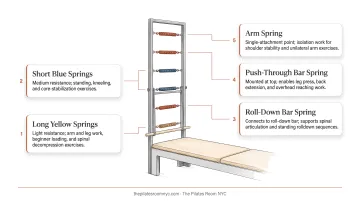
The spring mechanics differ from the Reformer in one key respect. On the Reformer, springs attach below a moving carriage. On the Tower, springs attach directly to the body from the frame above or beside you.
For limb-spring work specifically, this means the working arm or leg moves freely against the spring's pull rather than being grounded through a footbar. That shift in resistance angle changes both the range of motion and which muscles are doing the work.
Tower Pilates and the Classical Pilates System
The Tower — also called a Wall Unit — is Cadillac-inspired. Gratz, one of the original Pilates equipment manufacturers, describes their Studio Wall Unit as bringing "Cadillac-inspired functionality" into space-conscious studio environments. The Cadillac itself belongs to Joseph Pilates' original apparatus lineage, with Gratz placing it among apparatus created in the 1920s alongside the Reformer and Wunda Chair.
The Tower condenses the Cadillac's spring components onto one vertical end, allowing multiple units in a group class setting without requiring the full four-poster frame.
Within the classical system — which includes the Reformer, Cadillac/Tower, Wunda Chair, Ladder Barrel, and mat — the Tower is not a standalone option. It's one component of a comprehensive practice. The classical view holds that each apparatus develops different qualities: strength, mobility, and body awareness each get trained differently depending on the apparatus. At studios like The Pilates Room NYC in Manhattan's Chelsea neighborhood, small group sessions and private sessions are structured to incorporate Reformer, Tower, and mat work together, reflecting exactly that principle.
The Benefits of Tower Pilates
Full-Body Strength and Core Development
The spring attachments on the Tower create direct resistance to the working muscles across the entire body , including but extending well beyond the core. The effort required to keep spring movement smooth and controlled (rather than jerky or rushed) is itself the challenge. That sustained control builds muscular endurance and coordination simultaneously.
What classical Pilates calls the "powerhouse" — the deep stabilizing muscles from the base of the ribs to the top of the pelvis — is trained continuously throughout Tower work. Improving this trunk stability makes everyday movements like lifting, reaching, and rotating safer on the joints and more efficient in practice.
A 2025 review of Pilates-based core stabilization training found improvements in deep stabilizing muscle function, including muscle thickness, contraction timing, and contraction ratios — evidence that Tower work produces measurable structural changes, not just perceived improvement.
Spinal Mobility and Posture
The push-through bar and roll-down bar guide the spine through ranges of motion that mat work alone rarely achieves. For people with thoracic stiffness from desk work or tech neck, the spring-assisted support makes exercises like the roll-up or spine stretch more accessible — and more effective. The spring doesn't do the work for you; it gives you enough assistance to find the movement, then asks you to control it.
A 2024 systematic review examined Pilates effects on body posture and supports posture-related benefits from consistent practice. The proprioceptive feedback from the Tower springs plays a large role in that: spring resistance makes imbalances immediately apparent. A weaker shoulder, limited thoracic rotation, or uneven hip engagement shows up in the first session, giving instructor and client something concrete to work from.
Low-Impact and Joint-Friendly Training
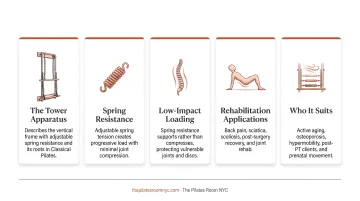
Resistance comes from springs, not loaded weights. Spring tension can be increased or decreased to support or challenge the client, making Tower Pilates appropriate across a wide range of physical conditions.
This is particularly relevant for:
- People recovering from injuries or surgery
- Those managing joint conditions like osteoarthritis
- Clients returning to exercise after illness or pregnancy
- Older adults building balance and functional mobility
A 2025 meta-analysis covering 8 RCTs and 322 participants with knee osteoarthritis found Pilates may be an effective rehabilitation option, particularly for reducing pain versus no intervention — though always in conjunction with appropriate medical guidance.
Mind-Body Connection
Tower work is slow and precise by nature. You cannot rush through it — the springs won't cooperate if you do. That sustained focus on controlling movement cultivates genuine present-moment attention: the kind that's difficult to access in faster, higher-intensity training.
Research on Pilates more broadly supports benefits for stress, anxiety, and depression. The controlled, lower-intensity nature of Tower work makes it especially well-suited for programs where managing the body's cumulative stress load is part of the goal, not just a secondary consideration.
Tower Pilates vs. Reformer vs. Mat Pilates
Tower vs. Reformer: Key Mechanical Differences
| Feature | Tower | Reformer |
|---|---|---|
| Frame orientation | Vertical, fixed | Horizontal, moving carriage |
| Carriage | None (stationary mat) | Sliding carriage (~41 inches travel) |
| Spring attachment | From frame directly to body | Below the carriage |
| Resistance direction | Vertical/angular pull on the body | Horizontal push/pull via carriage |
| Primary application | Spinal articulation, open-chain limb work | Full-body closed-chain and open-chain work |
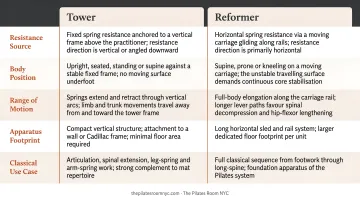
Neither is superior. Each creates distinct resistance angles and ranges of motion, targeting muscles differently — even when the exercise looks identical on both pieces of equipment.
What Tower Does Differently
The Tower's angle of pull makes it particularly effective for:
- Spinal articulation exercises (roll-downs, spine stretch, teaser variations)
- Assisted stretches with spring support
- Upper body pressing and pulling work
- Supine hip and abdominal exercises with leg springs
Exercises like bridging, feet-in-straps, and the teaser feel distinctly different on the Tower. Doing the same movement on both apparatus often gives practitioners new insight — the Tower reveals what the Reformer can compensate for, and vice versa.
Tower vs. Mat Pilates
Mat Pilates uses bodyweight as primary resistance, occasionally supplemented with props like bands or rings. Tower Pilates adds spring resistance to many of the same foundational movements.
For beginners, the springs can assist a movement pattern that bodyweight alone makes impossible — making the Tower more accessible early on. For advanced practitioners, working against spring resistance adds a genuine challenge that mat work doesn't replicate.
The Classical View: All Three Work Together
Classical instructors don't position Tower, Reformer, and mat as competing choices. They're designed to work together. At The Pilates Room NYC, private, duet, and small group sessions all incorporate access to multiple apparatus — reflecting the classical principle that a well-rounded practice draws from all three.
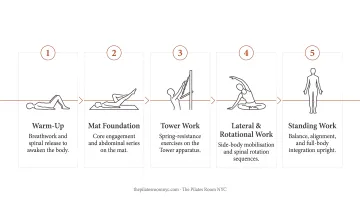
A Tower class typically progresses from mat warm-up through lying, seated, and standing exercises, moving from horizontal to vertical as the body warms and engagement deepens.
What to Expect in a Tower Pilates Class
Class Structure and Duration
A Tower session at most classical studios runs around 55–60 minutes. The general structure:
- Mat warm-up — establishes core connection and prepares the spine
- Supine Tower work — leg springs, arm springs, bridging variations
- Prone work — back extension, hip work
- Seated and kneeling work — push-through bar exercises, arm spring sequences
- Standing work — balance, alignment, proprioception
The Experience of the Springs
First-timers should expect a learning curve. Clipping in and out of foot loops and arm straps takes a session or two to feel natural.
The spring feedback is immediate and honest — if one side is stronger or tighter, you'll feel it within the first few exercises. That's actually the value: the body registers that information and begins to self-correct.
Skill Level and Modifications
Tower exercises are genuinely adaptable — not just in theory. Spring resistance adjusts to match the client, and work can be done in any position:
- Lying (supine or prone)
- Seated or kneeling
- Standing
That said, having a qualified instructor guide the setup, cueing, and spring selection is especially important for first-timers. The apparatus gives you a lot of feedback; an experienced instructor helps you interpret it correctly.
Who Is Tower Pilates Good For?
Tower Pilates works across a wide range of bodies and goals. The apparatus's adjustable resistance, supported mat surface, and spring-based feedback make it adaptable in ways that floor exercise or free weights simply aren't.
It's particularly well-suited for:
- Athletes cross-training — Runners, swimmers, dancers, and strength athletes benefit from the Tower's emphasis on spinal alignment, proprioception, and single-limb stability. A 2025 RCT on soccer players found Reformer Pilates improved agility, hop performance, and passing accuracy over 8 weeks, pointing to real cross-training value from apparatus work.
- Injury recovery and special populations — Adjustable resistance and a supportive mat make the Tower a practical option for people recovering from injuries, managing osteoporosis, navigating pre- or postnatal movement, or working through cancer treatment recovery. Clinical research backs Pilates for pregnancy-related back and pelvic pain, older adult balance, and supervised cancer recovery programming.
- Desk workers and stress responders — The Tower's slow, controlled movement and focus on spinal articulation directly address the mechanics of tech neck and postural dysfunction, without loading the nervous system further.
That said, the apparatus is only part of the equation. Instructor experience and matching matter just as much as the equipment itself. At The Pilates Room NYC, instructors are paired with clients based on individual needs and goals. Owner Alison Johnson has taught for 26 years across autoimmune conditions, cancer treatment recovery, injury rehab, prenatal and postnatal work, and seniors. The broader instructor team brings specialized depth across those same areas.
Frequently Asked Questions
What is the difference between Pilates Reformer and Tower?
The Reformer uses a horizontal sliding carriage with springs fixed below it, creating resistance as the carriage moves. The Tower is a fixed vertical frame where springs attach directly to the body, changing the direction of resistance and the range of motion available. Neither is superior — they work differently and complement each other within a classical practice.
Is Tower Pilates good for beginners?
Yes, with guidance. Spring resistance can be adjusted to support or challenge any level, and exercises can be performed lying, seated, or standing depending on what the client needs. Having a qualified instructor manage the setup and cueing is especially valuable for first-timers who are learning how to work with spring feedback.
Can Pilates help a torn meniscus?
Pilates — including Tower work — can support low-impact strength building and alignment around the knee joint as part of a clinician-approved rehabilitation plan. It does not heal a torn meniscus. Anyone with a knee injury should consult their physician before starting and work with an experienced instructor who can adapt the practice accordingly.
Is Tower Pilates the same as Cadillac Pilates?
They share the same spring components and perform largely the same exercises. The Cadillac is a full four-poster frame, while the Tower condenses those components onto one vertical end — more space-efficient for group class settings. The main difference is that the full Cadillac allows hanging and gymnastic movements not possible on the Tower; for most practitioners, the Tower provides all the practical benefits of Cadillac work.
How often should I practice Tower Pilates to see results?
Two to three sessions per week gives beginners enough frequency to build familiarity with the method and begin feeling changes in strength and posture. Combining Tower with Reformer and mat work delivers the most complete results — most people notice meaningful improvements within several weeks of consistent practice.
Can Tower Pilates improve my posture?
Posture improvement is one of the Tower's clearest benefits. Spring feedback sharpens proprioception, the exercises retrain how the body supports itself, and spinal articulation work gradually makes good alignment feel natural rather than effortful. It's particularly valuable for people dealing with desk-related tension or tech neck.