Pilates is frequently recommended for sciatica — and for good reason. But outcomes vary widely depending on which exercises you choose, how you perform them, and whether someone qualified is watching your form. The wrong movement done incorrectly can aggravate the nerve rather than calm it.
This article covers why Pilates works for sciatica, the safest exercises to try, what to skip during a flare-up, and the principles that determine whether your practice helps or hurts.
Key Takeaways
- Pilates builds the core and pelvic stability that reduces pressure on the lumbar spine and sciatic nerve
- The right exercise depends on your sciatica's cause and current irritability level
- Pain-free, controlled movement is the rule; pushing through nerve pain makes things worse
- Full roll-ups, double leg lifts, and aggressive forward bends are off-limits during flare-ups
- An injury-experienced instructor adjusts every movement to your body, in real time
What Is Sciatica and Why Does Movement Matter?
Sciatica is not a diagnosis — it's a symptom. The NHS defines it as irritation or compression of the sciatic nerve, which runs from the lower back through the glutes and down to the feet. Common causes include:
- Herniated disc — the most common cause in people under 40, per the AAOS
- Spinal stenosis — narrowing of the spinal canal that compresses nerve roots
- Piriformis syndrome — entrapment of the sciatic nerve by the piriformis muscle
- Bone spurs — bony overgrowths that press against nerve tissue
- Facet joint arthropathy — arthritic joint changes or cysts that can compress nearby spinal nerves
Each of these causes responds differently to treatment — but one principle holds across all of them: keeping the body moving matters.
Why Staying Active Matters
Rest feels logical when pain is severe. Prolonged inactivity, though, stiffens the spine, reduces circulation, and weakens the stabilizing muscles that protect the nerve in the first place. The NHS recommends continuing normal activities as much as possible and performing regular exercises for sciatica — not waiting it out on the couch.
Where Pilates Fits In
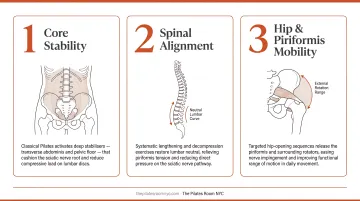
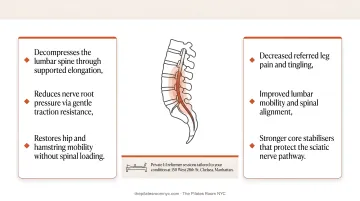
Pilates addresses several of sciatica's underlying contributors at once:
- Trains the transversus abdominis, multifidus, pelvic floor, and diaphragm to pre-activate before movement — reducing lumbar load through core and pelvic stability
- Keeps the spine in neutral alignment, minimizing compressive stress on intervertebral discs and nerve roots
- Moves hip and lumbar tissues gently along the nerve pathway, building soft tissue mobility without high-impact stress
A 2022 randomized controlled trial found that clinical Pilates improved pain, function, quality of life, and psychological outcomes in people with symptomatic lumbar disc herniation — one of the most common drivers of sciatic nerve compression.
Pilates Exercises for Sciatica Pain Relief
The exercises below target lumbar stabilization, hip mobility, and sciatic nerve decompression — working together to reduce irritation at the source. That said, these movements require attention: stop immediately if any exercise increases or radiates pain. If your sciatica is severe, newly onset, or accompanied by leg weakness, consult a physician before beginning.
Pelvic Tilts
Pelvic tilts engage the deep abdominals and gently mobilize the lumbar spine through a small, controlled range — relieving lower back tension without loading the sciatic nerve.
How to do it:
- Lie on your back, knees bent, feet flat on the mat
- Exhale and gently press your lower back into the mat by drawing the navel in
- Inhale and return to neutral — no forcing, just a small rocking motion
Aim for 8–10 repetitions. Subtle and releasing — if you're muscling through it, ease back.
Glute Bridge
The glute bridge strengthens the glutes, hamstrings, and core simultaneously — improving pelvic stability and correcting the muscle imbalances that often contribute to sciatic nerve irritation.
How to do it:
- Lie on your back, knees bent, feet hip-width apart
- Engage your abdominals and glutes, then press through your feet to lift the hips
- Create a straight line from knees to shoulders, hold briefly, then lower with control
8–10 repetitions. You should feel this in the glutes and hamstrings — not the lower back.
Dead Bug and Femur Arcs
This movement trains pelvic stability and hip-spine dissociation — the ability to move a leg independently of the pelvis. That skill directly reduces mechanical load on the lumbar spine and sciatic nerve during daily movement.
How to do it:
- Lie on your back, knees bent, feet flat
- Exhale and float one knee to tabletop (90 degrees), keeping the pelvis completely still
- Hold briefly, then lower with control; alternate sides
Complete 6–8 repetitions per side. As this becomes comfortable, progress to femur arcs: lower the foot toward the floor while maintaining tabletop alignment, then return — all without any pelvic shift.
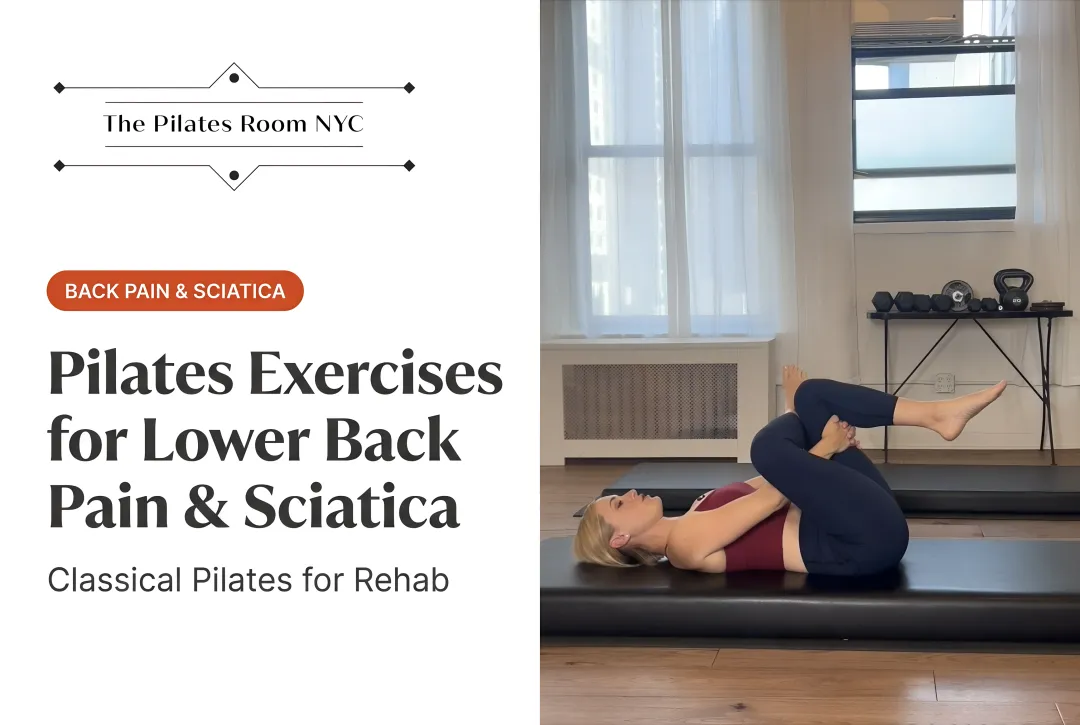
Figure Four Stretch
This stretch targets the piriformis and deep hip rotators. When these muscles are tight, they can compress the sciatic nerve directly — making this one of the most effective moves for piriformis-related sciatica.
How to do it:
- Lie on your back, knees bent
- Cross one ankle over the opposite knee
- Gently draw both thighs toward your chest until you feel a deep stretch in the glute
- Hold 20–30 seconds; rock gently side to side
Expect a deep, releasing sensation — not sharp or electric pain. If lying down is uncomfortable, this stretch works just as well seated in a chair.
Sciatic Nerve Mobilization
This exercise gently moves the sciatic nerve through its pathway to reduce adhesion and improve neural mobility. A 2023 systematic review found neural mobilization reduced pain and disability in lumbar radiculopathy populations.
How to do it:
- Lie on your back, one knee pulled to the chest
- Slowly extend that knee toward the ceiling with a pointed foot until you feel a gentle stretch
- Flex the toes, then bend the knee back in; repeat in a slow pumping motion
- 6 repetitions per side
Don't force it. If the movement provokes sharp, radiating pain, stop immediately. This exercise is best suited to mild-to-moderate sciatica — skip it during acute flare-ups.
Pilates Exercises to Avoid with Sciatica
There's no single "avoid" list that applies to every person — sciatica presentations vary too much for that. Several exercises are consistently problematic, though:
| Exercise | Why It's Risky |
|---|---|
| Full roll-ups | Aggressive spinal flexion increases intradiscal pressure |
| Double leg lifts | Overloads the lumbar spine; hip flexors dominate if core is insufficient |
| Deep forward bends | Compresses the posterior disc and loads the nerve under stretch |
| Loaded twisting | High shear forces on lumbar segments already under stress |
| Jumping / high-impact variations | Contraindicated during any active sciatic flare-up |
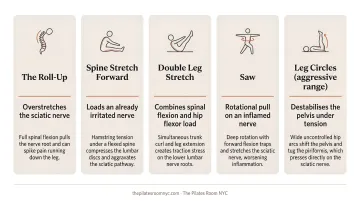
If a movement peripheralizes your symptoms — meaning pain moves further down the leg rather than staying local — stop. That's your clearest signal the exercise isn't appropriate right now.
Pain severity also shapes what's reasonable. When even small movements provoke significant radiating pain, most end-range positions should be avoided entirely and professional guidance becomes essential.
When symptoms are mild and stable, many of the same movements can provide genuine relief. Either way, your body's response in the 24 hours after exercise is your most reliable guide.
That 24-hour window matters more than how you feel mid-session. The "no pain, no gain" mindset has no place in nerve pain management.
Key Principles for Practicing Pilates Safely with Sciatica
Neutral Spine Is Non-Negotiable
Classical Pilates positions the spine in its natural three-curve alignment, reducing stress on intervertebral discs and nerve roots. Many sciatica sufferers habitually flatten or over-arch the lower back — often without realizing it. One of Pilates' core contributions is developing the proprioceptive awareness to maintain neutral alignment not just during sessions, but during daily activities like sitting at a desk or carrying groceries.
Breathing Drives Deep Stabilization
In classical Pilates, the exhale activates the transversus abdominis, pelvic floor, and multifidus before movement begins. This means the spine is supported before any load is introduced — a key distinction from casual stretching or general gym exercise. StatPearls notes that this coordinated pre-activation is central to lumbar segment control and load management.
Progression Follows Symptoms, Not a Calendar
Nerve tissue heals more slowly than muscle. Practical starting guidelines:
- Begin with 2–3 sessions per week, keeping sessions to 20–30 minutes
- Assess how your body responds in the 24 hours after each session
- Only increase difficulty when current exercises feel comfortable and pain-free
- If symptoms worsen after a session, reduce load or frequency before progressing
Private Instruction Changes the Risk Profile
Self-guided YouTube workouts and group reformer classes cannot monitor your form, adjust spring resistance in real time, or catch the compensations that develop when nerve pain alters movement patterns. At The Pilates Room NYC, private sessions are led by injury-experienced instructors with up to 30 years of teaching experience, and each session is adapted to the client's specific sciatica presentation, pain level, and movement habits.
Instructor Enja Schenck (MS, CSCS) brings Postural Restoration Institute training that is directly relevant to posture, asymmetry management, and post-rehab progressions. No session follows a rigid template: instructors assess what the body needs that day and adjust accordingly.
When to Work with a Professional Pilates Instructor
Seek medical attention immediately — before any exercise — if your sciatica includes:
- Weakness or numbness in both legs
- Numbness around the genitals or anus (saddle anesthesia)
- Difficulty starting urination or loss of bladder/bowel control
- Symptoms that are rapidly worsening
These are red flags for cauda equina syndrome, which requires urgent surgical evaluation.
For everyone else managing sciatica, the real decision is whether to exercise alone. Some situations call clearly for one-on-one guidance rather than self-directed movement:
- Home workouts that consistently aggravate symptoms
- Newly onset sciatica without a clear cause
- Sciatica that developed after a specific injury
- Pain that has plateaued despite completing physical therapy
A group reformer class — even a small one — cannot account for individual nerve irritability, your specific spinal loading tolerance, or the subtle compensations that develop around pain. A knowledgeable instructor identifies contributing imbalances and designs work that addresses the cause, not just the symptom.
The Pilates Room NYC specializes in private sessions for clients managing sciatica and injury recovery, with instructors matched to each person based on their specific condition and goals. Sessions are adapted to your current stage of recovery — whether you're working through acute flare-ups or rebuilding after physical therapy. New clients receive 15% off their first private session with code INTRO.
Frequently Asked Questions
Can I do Pilates if I have sciatica?
Yes — Pilates is generally safe and beneficial for sciatica when exercise selection is appropriate. Start gently, avoid movements that provoke or increase symptoms, and consult a physician if pain is severe, newly onset, or accompanied by neurological changes before beginning any program.
Is Pilates the best exercise for sciatica?
Pilates works particularly well for sciatica because it addresses the underlying contributors — weak core support, poor spinal alignment, tight hip rotators — rather than masking symptoms. It also pairs well with physical therapy for a more complete approach.
What Pilates exercises should I avoid with sciatica?
The most commonly problematic exercises are full roll-ups, double leg lifts, aggressive forward bends, and loaded twisting movements. The right answer depends on your specific irritability level and the cause of your sciatica — what aggravates one person may help another.
Is Reformer Pilates good for sciatica?
Reformer Pilates can be particularly helpful because the spring resistance system makes movements more accessible and adjustable. It should be done in a one-on-one setting with an instructor experienced in managing injuries — not in a group fitness format where form cannot be individually monitored.
How often should I do Pilates for sciatica?
Start with 2–3 sessions per week, keeping sessions short (20–30 minutes). Monitor how symptoms respond in the 24 hours after each session. Consistency over several weeks matters more than session length or frequency.
Should I see a doctor before starting Pilates for sciatica?
Yes, especially if the sciatica is new, severe, or accompanied by leg weakness or bladder and bowel changes. A diagnosis identifies the underlying cause and allows an instructor to design a safer, more targeted program.