The consequences compound over time. A cross-sectional study of 99 office workers found that 80.81% had work-related musculoskeletal disorders, with the neck, lower back, and shoulders most affected. Low back pain alone currently affects an estimated 619 million people globally.
What most people try first — sitting up straighter, buying an ergonomic chair, stretching at the end of the day — addresses the symptom, not the cause. Posture problems are muscular imbalance problems. They require targeted strengthening and mobility work to actually change.
This guide covers 7 classical Pilates exercises that target the specific muscles behind poor posture. No equipment needed — just a mat and consistent practice.
Key Takeaways
- Poor posture stems from muscular imbalances, not bad habits alone — targeted strengthening corrects it at the source
- Pilates trains deep stabilizers (transverse abdominis, multifidus) that support spinal alignment without conscious effort
- All 7 exercises target the full spine and can be done on a mat — no equipment needed
- Research on Pilates-based posture training consistently points to measurable improvement within 8–16 weeks of regular practice
- Working with an instructor accelerates results — particularly for one-sided imbalances, injury history, or specific health conditions
What Poor Posture Actually Does to Your Body
Poor posture isn't just aesthetic. Each misalignment sets off a chain reaction that taxes muscles, joints, and nerves simultaneously.
The most common patterns and their effects:
- Rounded upper back (kyphosis): Compresses the chest cavity, restricts breathing, and strains the thoracic extensors — which then weaken further from disuse
- Forward head posture: A 2014 biomechanical model found that a head angled at just 30 degrees places roughly 40 lbs of force on the cervical spine — compared to 10–12 lbs in neutral
- Weakened glutes and tight hip flexors: Destabilize the lumbar spine, contributing to the lower back pain that affects most office workers
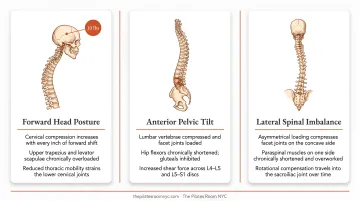
What all three patterns share: they're not just about how you look standing still. They reflect muscular imbalances that accumulate over time — and that's what makes them correctable.
Good posture isn't about rigidly holding yourself upright. It's about having the muscular capacity to move freely through different positions without fatigue or pain. A body with balanced musculature naturally settles into good alignment — it doesn't have to force it. Stretching alone can release tension temporarily, but without building the underlying strength, that relief doesn't last. That's the core argument for Pilates over passive flexibility work.
Why Pilates Works for Posture Correction
Most exercise programs train the muscles you can see. Pilates specifically targets the ones doing the structural work underneath — the transverse abdominis, multifidus, and pelvic floor muscles that form the body's internal scaffold.
Research on transversus abdominis and multifidus function shows these deep stabilizers are critical for dynamic lumbar stability — and that the multifidus doesn't automatically recover after injury or prolonged disuse without specific retraining. Classical Pilates provides exactly that retraining.
How Breath Changes the Equation
Pilates integrates breath with every movement, building body awareness in the process. Practitioners learn to feel when they've collapsed into poor alignment — and correct it reflexively, without thinking. Over time, that awareness carries into daily life: sitting, walking, standing in line.
That precision matters most for asymmetrical patterns — the left-right imbalances that standard exercise programs tend to miss entirely. At The Pilates Room NYC, instructor Enja Schenck (MS, CSCS) addresses exactly these patterns by integrating Postural Restoration Institute principles into her classical Pilates work.
Mat Pilates Is Enough
None of the above requires expensive equipment. A 2024 systematic review on Pilates and body posture confirmed favorable effects on postural outcomes across multiple studies — and the 7 exercises below are all mat-based. No Reformer required to see real results.
7 Essential Pilates Exercises for Posture Correction
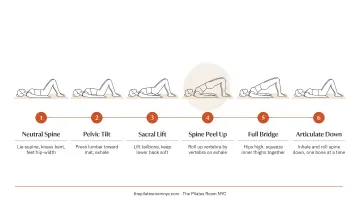
1. Pelvic Tilt
What it does: Establishes awareness of neutral spine — the foundational alignment position in classical Pilates. Loading the spine in any other exercise without this awareness risks reinforcing the same compensatory patterns you're trying to correct.
How to do it:
- Lie on your back, knees bent, feet flat on the mat
- Rock the pelvis gently: first toward the mat (anterior tilt), then toward your navel (posterior tilt)
- Find the middle position where the natural lumbar curve is maintained
- Cue: Picture a clock face on your abdomen — 12 o'clock at the navel, 6 o'clock at the pubic bone. Find the balanced 3-and-9-o'clock position
- Repeat 8–10 times
2. Shoulder Bridge
What it does: Directly counters the weakening effects of prolonged sitting by strengthening the posterior chain — glutes, hamstrings, and spinal extensors. Also promotes thoracic and lumbar mobility through spinal articulation.
How to do it:
- Start in the pelvic tilt position — back, knees bent, feet flat
- Press through the feet and slowly roll the spine off the mat, one vertebra at a time
- Pause at the top: knee, hip, and shoulder should form a straight diagonal line
- Roll back down sequentially, vertebra by vertebra
- Cue: Don't hinge at the hips — this should be a sequential peel, not a lift
- Repeat 5–8 times
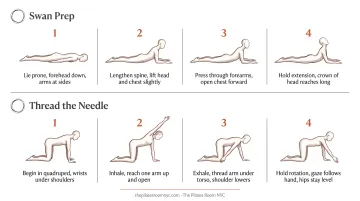
3. Swan Prep (Back Extension)
What it does: Directly counters forward rounding by strengthening the thoracic extensors and opening the chest. The Swan teaches the spine to lengthen and extend rather than compress — something that hours of sitting actively work against.
How to do it:
- Lie face down, hands placed under shoulders, elbows close to the ribs
- On an exhale, lengthen through the crown of the head and lift the chest off the mat using your back muscles — not by pushing with the hands
- Keep the neck long, chin slightly tucked
- Lower with control
- Cue: Lead with the sternum, not the chin
- Repeat 5–6 times
4. Swimming
Why it matters: Trains the full posterior chain — back extensors, glutes, shoulder stabilizers, and deep spinal muscles — while challenging spinal elongation under load. It builds the endurance to hold a tall spine throughout the workday.
How to do it:
- Lie face down, arms and legs extended
- Lift the chest, arms, and legs slightly off the mat simultaneously
- Alternate lifting the opposite arm and leg in a small, controlled flutter
- Breathe in for 5 counts, out for 5 counts
- Cue: Reach long in both directions rather than lifting high — length over height
- Perform 2–3 sets of 10–20 pulses
5. Thread the Needle
What it does: Improves thoracic rotation and scapular mobility — areas that desk workers typically lose mobility in first. It targets the rhomboids and mid-trapezius, muscles that switch off when the head drifts forward.
How to do it:
- Start on all-fours, wrists under shoulders, knees under hips
- Extend one arm toward the ceiling, rotating the chest to follow
- Thread that arm underneath the torso, allowing the shoulder to drop toward the mat
- Hold for a breath, then return
- Repeat on the other side
- Cue: Keep the hips square throughout the rotation — only the thoracic spine rotates
- Perform 5 reps per side
6. Spine Stretch Forward
What it does: Releases tension in the posterior chain — hamstrings and paraspinals — while teaching the spine to lengthen when bending forward, rather than simply hinge and compress. It also reinforces the abdominal connection that should initiate all forward movement.
How to do it:
- Sit tall, legs extended hip-width apart, feet flexed, arms reaching forward at shoulder height
- On an exhale, scoop the abdominals in and round the spine forward from the crown of the head — as though curving around a large ball
- Inhale to return to a tall seated position
- Cue: The movement originates from the core, not the hips
- Repeat 5–8 times
7. Plank (Quadruped to Full Plank)
The posture payoff: Builds the full-body stability that sustains upright posture all day. It simultaneously trains the transverse abdominis, shoulder stabilizers, and spinal extensors — the same three systems that fail first when posture collapses under fatigue.
How to do it:
- Start on all-fours, then step feet back one at a time into a full plank
- Wrists under shoulders, body in one straight line from head to heel
- Draw the abdominals up, press the floor away, keep the neck long
- Hold for 20–30 seconds, building toward 1 minute
- Beginners: hold the quadruped (knee hover) version instead
- Cue: Avoid hiking the hips or letting the lower back sag — both break the alignment you're training
- Repeat 2–3 times
How to Make These Exercises a Habit
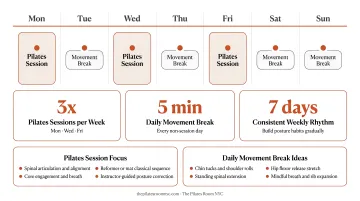
Seven exercises practiced once rarely produce lasting change. The research on Pilates and posture is clear on this: most studies that showed meaningful postural improvement ran for 8–16 weeks, with sessions 3–4 times per week.
A practical starting framework:
- 3–4 sessions per week as a complete 15–20 minute routine
- Shorter daily doses work too — Swan Prep and Thread the Needle take 5 minutes and make an effective midday desk break
- Movement breaks every 30–45 minutes during sedentary work reinforce session gains — a CDC workplace study found sit-stand interventions reduced upper back and neck pain by 54%
Pair the exercises with these daily adjustments:
- Monitor at eye level to reduce cervical load
- Feet flat on the floor when seated
- Brief walks or standing periods throughout the workday
When to Work with an Instructor
If pain persists, worsens, or you're managing a specific condition — scoliosis, hypermobility, post-surgical recovery — these exercises need professional adaptation, not a one-size-fits-all sequence. A qualified Pilates instructor assesses how your individual body actually moves, not how a generalized sequence assumes it does.
At The Pilates Room NYC in Chelsea, instructors are matched to clients based on their specific focus and teaching style — so whether you're a desk worker building baseline posture habits or managing scoliosis or post-surgical recovery, you work with someone whose expertise fits your situation.
Conclusion
Correcting posture through Pilates is a process of rebuilding muscular strength and body awareness — not a quick fix, but a genuinely achievable one. These 7 exercises address the most common postural imbalances at their root: the deep stabilizers that support the spine, the posterior chain weakened by sitting, the thoracic mobility lost to screens, and the core endurance that keeps you tall past noon.
With consistent practice, those gains compound. People typically notice reduced tension in the neck and shoulders first, then steadier balance, then — gradually — a body that holds itself up without the afternoon slump.
If you're in the New York City area and want expert guidance tailored to your specific body, The Pilates Room NYC at 150 West 28th Street offers private sessions from $125, small group classes at $50 per person, and apprentice sessions at $80 — all rooted in classical Pilates instruction. Reach out at info@thepilatesroomnyc.com or call 212-206-1827 to find the right fit for your goals and schedule.
Frequently Asked Questions
Frequently Asked Questions
Can Pilates fix bad posture?
Pilates can significantly improve posture by strengthening the deep stabilizing muscles and correcting the muscular imbalances that drive poor alignment. Meaningful correction takes consistent practice over weeks and months — stretching or ergonomic furniture alone won't get you there.
How long does it take to see posture improvements from Pilates?
Many people feel taller and less hunched after just a few sessions. Visible, structural changes typically appear after 8–16 weeks of consistent practice at 3–4 sessions per week, based on the research literature on Pilates posture interventions.
Can beginners do these Pilates exercises for posture correction?
All 7 exercises are beginner-friendly. Modifications — such as a bent-knee Spine Stretch or knee-hover Plank — make them accessible at any fitness level. Proper alignment from the start is far more valuable than rushing into advanced variations.
How often should I do Pilates exercises for posture correction?
Three to four sessions per week is an effective starting point. Even short daily sessions of 10–15 minutes focused on movements like Swan Prep and Pelvic Tilt reinforce postural habits between full workouts.
Can people with Ehlers-Danlos syndrome do Pilates?
Pilates can benefit hypermobility conditions like EDS by building the joint-stabilizing strength that reduces instability-related pain. EDS UK guidelines specifically name basic mat Pilates as an option for core strength and motor control. Work with an instructor experienced in hypermobility to avoid overstretching and joint strain.
Can Pilates help a torn meniscus?
Pilates is not a treatment for a torn meniscus, but many posture-focused exercises — particularly supine and non-weight-bearing movements — can be safely adapted with medical clearance and qualified instructor guidance. Avoid loaded twisting and deep knee flexion until your clinician explicitly clears them.