Introduction
According to CDC surveillance data, 53.2 million U.S. adults — roughly 1 in 5 — live with diagnosed arthritis. Of those, an estimated 25.7 million report arthritis-attributable activity limitations. That's a lot of people being told to "stay active" with no clear picture of what that actually means when bending your knee or getting out of a chair is already painful.
There's a specific frustration that comes with arthritis advice: you're told to keep moving, then left to figure out what that means at 7am when your hands won't close properly or your hip locks up on the stairs. Generic guidance doesn't bridge that gap.
This guide takes a different approach. Drawing on physical therapy principles and current research, it explains specifically why Pilates is well-suited to arthritis management and how the type of arthritis you have should shape your practice.
You'll find concrete guidance on which exercises help — and which to avoid — organized by affected joint, so you can move with more confidence and less guesswork.
Key Takeaways
- Pilates is low-impact and joint-friendly: controlled movement stimulates synovial fluid production, reducing stiffness without high-impact stress
- Osteoarthritis and inflammatory arthritis (like RA) require different pacing strategies, especially on flare days
- Which joints are affected determines which exercises to prioritize and which to modify or avoid entirely
- Working with an instructor experienced in joint conditions is the most important factor in practicing Pilates safely
Why Pilates Is One of the Best Exercises for Arthritis
Movement Lubricates Your Joints
Arthritic joints stiffen when you stop moving — and that's not just a feeling. Research confirms that flexion and extension exercises stimulate synovial fluid release into the joint cavity. Synovial fluid is the joint's natural lubricant; it reduces friction between cartilage surfaces and delivers nutrients to the tissue. When you sit still for extended periods, that lubrication diminishes. A separate study found that daily sedentary behavior directly predicted pain levels and negative affect in people with knee OA.
The practical takeaway: gentle, consistent movement isn't just acceptable for arthritis — it's protective. The question is what kind of movement, and at what intensity.
Stronger Muscles = Less Load on Joints
One of Pilates's clearest benefits for arthritis is what it does around the joint, not to it. Research consistently links muscular weakness, malalignment, and proprioception deficits with worse osteoarthritis symptoms and function. The American College of Rheumatology notes that strengthening exercises can reduce OA symptoms, improve joint movement, and increase coordination.
Pilates targets exactly the muscles that protect high-risk joints:
- Knees — quadriceps, hamstrings, and hip abductors reduce tibiofemoral compression
- Hips — hip stabilizers and glutes reduce shear forces across the joint
- Spine — deep spinal extensors and transverse abdominis support lumbar load distribution
The more those surrounding muscles contribute, the less mechanical stress lands directly on damaged cartilage.
Posture and Alignment Matter More Than Most People Realize
Poor posture increases compressive load on arthritic joints — not just in the spine, but downstream at the hips and knees. Research links gait and postural alignment directly to hip and knee OA progression. Pilates builds that awareness methodically, training spinal alignment and body mechanics across dozens of exercises — so the benefits show up in how you walk, stand, and sit, not just on the mat.
Balance, Proprioception, and Fall Risk
That same postural control translates directly into fall prevention — a serious concern for adults with joint disease. A 2024 randomized clinical trial in 54 older adults with knee OA found that proprioceptive exercise significantly improved pain, balance, and fall-risk measures compared with conventional exercise. Pilates builds exactly this kind of body awareness — teaching you how your body moves in space, catching problematic patterns before they cause pain, and building the stability that reduces fall risk over time.
OA vs. Inflammatory Arthritis: Why the Distinction Matters
"Arthritis" covers more than 100 different conditions. For Pilates purposes, the two most important categories are:
- Osteoarthritis (OA) — cartilage wear-and-tear, most common in knees, hips, and spine; symptoms worsen with overuse and often improve with gentle movement
- Inflammatory arthritis — includes rheumatoid arthritis (RA), psoriatic arthritis, and gout; immune-mediated, characterized by systemic inflammation and episodic flares
How Flares Affect Your Pilates Practice
A flare is a period of increased inflammation and symptom intensity in inflammatory arthritis. Joints become more swollen, painful, and sensitive during flares, which can last days to weeks. Pushing through a flare the way you'd push through normal muscle soreness can worsen symptoms and extend recovery time.
Adjusting Your Practice by Type
| Arthritis Type | Typical Pattern | Session Approach |
|---|---|---|
| Osteoarthritis | Morning stiffness, improves with movement | Longer warm-up; gradual range progression |
| RA / Inflammatory | Flares with systemic fatigue | Monitor energy; reduce intensity on high-symptom days |
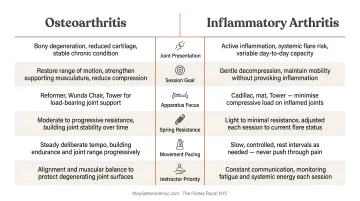
The Arthritis Foundation suggests that on flare days, splitting activity into three 10-minute sessions rather than one 30-minute block is a practical way to stay moving without aggravating inflammation.
Both OA and inflammatory arthritis benefit from physician clearance before beginning a Pilates program.
Arthritis-Friendly Pilates Exercises by Joint
The most commonly affected joints in arthritis are the knees, hips, lumbar spine, and hands/wrists. Here's how Pilates addresses each.
Knees and Hips
Modified Bridge — Lie on your back, knees bent, feet flat. Press through the feet to lift the pelvis. This strengthens the glutes and hamstrings without compressive load through the knee joint. Keep the range small if hip flexion is painful.
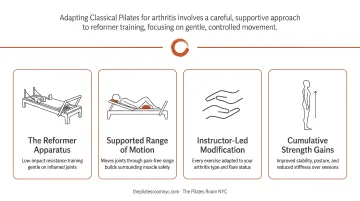
Reformer Footwork — Lying supine with feet on the footbar, press out and return through parallel, heel, and V-shape positions. The spring system allows a leg-press pattern in a fully supported position — something traditional squats can't offer for those with knee or hip OA. Spring tension and footbar height adjust to keep movement within a comfortable range.
Spine
Supported Spinal Articulation — Seated or supine roll-down movements mobilize the vertebrae one at a time, promoting circulation and reducing stiffness. For acute lumbar symptoms, reduce the range and add a prop — a rolled towel or wedge under the pelvis makes the movement safer.
Prone Back Extension — Lying face-down, lifting the head and chest without straining the neck targets the deep spinal extensors with minimal load. Forehead-on-hands positioning and a shorter range work well for lumbar arthritis or disc involvement.
Hands, Wrists, and Upper Body
Hand and wrist arthritis creates real barriers in Pilates. Weight-bearing positions — planks, long stretch on the reformer — can be painful or impossible during flares.
Practical modifications:
- Shift to forearm-bearing positions instead of full wrist extension
- Use padding or grip pads under the wrists to reduce joint stress
- Wrap the bar with a towel to soften grip and reduce finger compression
- Substitute upper-body exercises entirely with leg or core-focused work on high-symptom days
What to Avoid — and How to Modify During Flares
Movement Categories to Approach with Caution
- High-impact activities — running, jumping, and repetitive twisting increase joint load without the controlled, supported movement Pilates provides
- Deep knee flexion under load — full squats, deep lunges, and child's pose with a full knee bend place significant compressive force on the knee joint; the deeper and heavier the load, the greater the compression
- End-range joint compression — any position that drives a joint to its limit without muscular support around it
The general principle: sharp, joint-localized pain is a stop signal, not a push-through signal. Muscle fatigue during an exercise is normal; pain at the joint surface during or after exercise is not.
A Simple Pain Scale Framework
Use a 0–10 scale during sessions:
- 0–3: Comfortable working range — appropriate for most sessions
- 4–5: Monitor carefully; continue only if pain doesn't increase with movement
- 6+: Stop, modify, or skip the exercise entirely
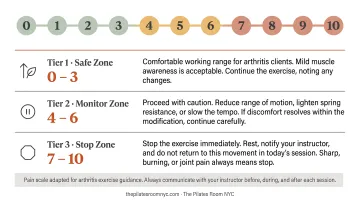
You should finish a session feeling worked — not worse than when you started.
Flare-Up Protocol
During an inflammatory flare, the entire session goal shifts from strengthening to gentle maintenance:
- Focus on breathing exercises and very small range-of-motion movements
- Shorten session length and reduce resistance
- Skip any exercise that increases local joint pain
- Try not to stop moving altogether for extended periods. Prolonged inactivity increases stiffness and accelerates muscle loss, which makes returning to regular sessions harder.
How to Start Pilates for Arthritis Safely
Step 1: Get Medical Clearance
Before your first session, talk to your physician. This is especially important if you have inflammatory arthritis and are managing medications like DMARDs or biologics, or if you've had joint surgery. Tell your doctor you're planning to start Pilates and ask whether there are any specific movements or loads to avoid given your current condition.
Step 2: Choose Private or Semi-Private Sessions First
Group classes move too quickly for arthritis beginners. In a group setting, instructors can't assess your movement patterns, modify for your specific joints, or catch compensations before they cause pain.
Private sessions change that. At The Pilates Room NYC in Chelsea/NoMad, instructors conduct an on-the-spot assessment during your first session (evaluating strength, flexibility, and movement quality) and build the session specifically around your body and condition.
The studio's senior instructors bring 15–35 years of experience working with clients managing autoimmune disorders, arthritis, and joint rehabilitation. Owner Alison Johnson developed her approach around these populations over 26 years of teaching. With the full classical apparatus — Reformer, Tower, Cadillac, Wunda Chair, and mat — sessions can flex around whatever your joints can safely handle that day.
Step 3: Match Frequency to Recovery Capacity
The CDC recommends adults with arthritis aim for at least 150 minutes of moderate-intensity activity per week. If that feels like too much, any amount is better than none.
For Pilates specifically, start with 2 sessions per week with a rest day between. Monitor how your joints feel in the 24–48 hours after each session — not just during it. Some mild muscle fatigue is expected; increased joint pain the following day is a sign to reduce load or range in the next session.
Step 4: Tell Your Instructor Everything Relevant
A good instructor will ask. If they don't, volunteer this information:
- Which joints are affected and on which side
- What movements or positions are currently off-limits
- What a typical good day looks like versus a difficult one
- Whether you manage an inflammatory type that can flare
- Any relevant surgical history or current medications
This isn't about limiting what you can do — it's about building a session that actually helps.
Frequently Asked Questions
What is the best exercise for arthritis?
Low-impact, controlled movement is consistently recommended — walking, swimming, cycling, and Pilates all fit this category. The best exercise is the one you'll do consistently without causing joint pain. Pilates tends to stand out for combining strength, flexibility, and body awareness in a single practice.
Which is better for arthritis, Pilates or yoga?
Both can help. Pilates tends to prioritize joint-supportive muscle strengthening and spinal alignment; yoga emphasizes flexibility and static holds that some arthritic joints find challenging. The right choice depends on which joints are affected and your personal preference — many people find both useful at different times.
What exercises should I avoid with arthritis?
High-impact activities (running, jumping), deep joint flexion under load, and exercises causing sharp or lingering joint pain are the main categories. "Avoiding" doesn't always mean eliminating — often it means modifying range of motion, load, or position with guidance from an experienced instructor.
Can Pilates help with rheumatoid arthritis as well as osteoarthritis?
Yes — research on RA suggests adding Pilates to routine treatment may enhance rehabilitation outcomes. Inflammatory arthritis does require extra flare management: intensity should drop during flares, and physician clearance is essential for both RA and osteoarthritis.
How often should I do Pilates if I have arthritis?
Two to three sessions per week is a practical starting point, with rest days between to monitor joint response. Shorter, consistent sessions tend to produce better results than infrequent high-effort workouts — consistency matters more than intensity.
Is reformer Pilates better than mat Pilates for arthritis?
The reformer's spring resistance system allows joint-protective movement with adjustable load and range of motion, offloading the spine in ways mat work cannot match. That said, mat Pilates with appropriate props is effective — particularly for beginners building a foundation before moving to apparatus.