
Frequency matters here more than in most exercise modalities — but not because you need to grind. It matters because Pilates is a skill. You're training your nervous system to find muscles it has largely ignored, coordinating breath with movement, and learning to feel your spine in ways most people never have. That kind of learning requires repetition, but it also requires recovery.
Start too infrequently and the patterns don't stick. Push too hard too soon and you accumulate fatigue faster than you build skill. The gap between those two extremes is where real progress lives.
This guide breaks down exactly where beginners should start, how to adjust based on your goals, and the signals your body sends when you've got the balance right — or wrong.
Key Takeaways
- 2–3 sessions per week is the evidence-backed starting point for most beginners
- Consistency beats intensity: two focused sessions per week outperform five rushed ones
- Frequency should reflect your goals, fitness history, and what else you're training
- Watch for overtraining signals: persistent soreness, dropping energy, or dreading your next session
- Most beginners feel a difference within 10 sessions; visible changes emerge around sessions 20–30
Why Session Frequency Directly Affects Your Pilates Progress
Pilates is not a workout you can coast through on muscle memory. Every session asks you to concentrate — on breath, on precise positioning, on recruiting stabilizers you've probably never consciously used before. That's what makes frequency so consequential.
Pilates as Neuromuscular Skill
Research published in Healthcare explicitly frames Pilates as a practice that trains motor control and neuromuscular trunk stabilization. A separate study found that people with Pilates experience showed significantly greater activation of the transversus abdominis and internal oblique muscles compared to those without — meaning the deep stabilizers that protect your spine only respond that way after repeated, consistent training.
You can't shortcut the repetition. Showing up once a week means your nervous system is essentially re-orienting from scratch each time. The coordination you built in Tuesday's session starts to fade before you're back the following Tuesday.
The 10/20/30 Framework
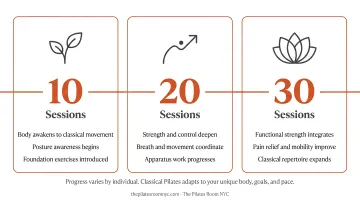
Joseph Pilates is widely credited with saying: "In 10 sessions you'll feel the difference, in 20 you'll see the difference, in 30 you'll have a whole new body." It's repeated by instructors everywhere, and the underlying logic holds up. A 2022 study of 45 women doing mat Pilates found that 2 sessions per week over 12 weeks produced a 31.5% improvement in core strength and 13.5% improvement in lower-limb strength. That's roughly 24 sessions — squarely in the 20–30 range.
Treat it as a useful landmark, not a guarantee. Your results depend on the quality of your sessions and how consistently you show up.
Quality Over Volume
A beginner who attends two focused, well-executed sessions will progress faster than someone rushing through five with poor alignment and shallow breathing. This is one area where Pilates genuinely differs from cardio or strength training.
Each movement is built around six foundational principles: concentration, control, centering, flow, precision, and breath. All six require full attention every session. Volume without quality produces habits that are harder to correct later.
How Often Should Beginners Do Pilates? Your Starting Point
The core recommendation: 2–3 sessions per week.
Pilates Anytime recommends beginners start with at least 2 mat sessions per week, and two peer-reviewed trials — including the 2022 strength study mentioned above — used exactly this frequency with measurable results. Healthline's medically reviewed beginner guide suggests starting even more conservatively at 1–2 sessions per week if you're new to exercise entirely.
Here's how that plays out across your first few months:
Weeks 1–4: Orientation Phase
Two sessions per week is the right call here. Your body is learning to move in unfamiliar ways — recruiting muscles that haven't been asked to work consciously before. The work will feel surprisingly difficult despite looking subtle. That's normal.
Don't worry about comparing your progress to anyone else in the studio. Focus entirely on:
- Understanding the six Pilates principles
- Learning to breathe with movement (not against it)
- Finding your center and maintaining it through exercises
- Listening to your instructor's cues rather than pushing through them
At The Pilates Room NYC, the first session always begins with an assessment — instructors evaluate your strength and flexibility to establish a baseline before developing exercises tailored specifically to you. That baseline shapes everything: which exercises you start with, which to avoid, and how quickly you progress.
Weeks 5–12: Building Consistency
Once your first month is behind you, moving to 3 sessions per week makes sense for most people. Your body has adapted to the initial demands, foundational movements feel more familiar, and you're starting to carry the work between sessions instead of resetting each visit.
By this stage, you'll likely notice:
- Improved posture awareness during everyday activities
- Better breathing patterns under exertion
- Noticeably less soreness after sessions than in the first few weeks
- Moments where movements start to feel intuitive rather than labored
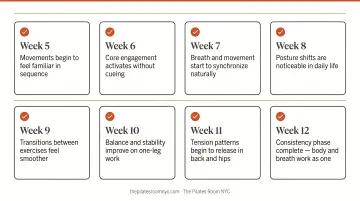
When those shifts appear consistently, the foundation is solid enough to build on.
Beyond Month 3
After 2–3 months of consistent practice, evaluate whether your current schedule still challenges you. If sessions feel too easy, recovery is quick, and foundational movements feel entirely automatic, it may be time to either increase frequency or work with your instructor to progress the difficulty.
Adjusting Frequency Based on Goals and Other Training
There's no single right answer that applies to every beginner. What you're trying to achieve — and what else you're doing during the week — changes the calculation.
For General Fitness and Well-Being
2–3 sessions per week delivers meaningful results for most people focused on posture improvement, stress reduction, and overall health. If you're already active (running, yoga, recreational sports), Pilates slots in well as a complement without requiring dramatic schedule changes.
Common goals this frequency supports:
- Improved posture and spinal alignment
- Reduced stress and better body awareness
- Core stability that carries over to other activities
For Injury Recovery or Rehabilitation
Start conservatively: 1–2 gentle sessions per week, prioritizing pain-free, controlled movement above all else. The Pilates Room NYC works with clients navigating injury recovery, and the studio's approach requires medical clearance before beginning — your doctor or physical therapist should be part of the conversation before you set a frequency target.
More sessions are not better here. One well-executed session with an experienced instructor who can observe your compensations and modify in real time is worth three sessions where you're guessing at what's appropriate.
For Strength, Toning, and Athletic Cross-Training
Athletes or fitness-focused beginners can aim for 3 Pilates sessions per week after a few weeks of foundational work. The popular 3-2-1 framework (3 strength sessions, 2 Pilates, 1 cardio) works well as a practical weekly structure, though it originated as a social media training method rather than classical Pilates doctrine.
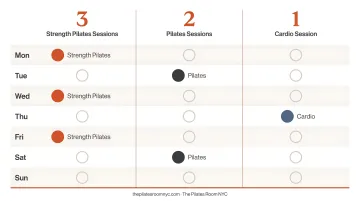
One scheduling note that matters: avoid pairing Pilates and heavy strength training on consecutive days targeting the same muscle groups. Both modalities load the deep stabilizers and posterior chain. Back-to-back loading without recovery produces fatigue, not adaptation.
Signs You're Ready to Increase — and When to Pull Back
Ready to Add a Session
- Sessions feel sustainable, not draining
- Core engagement and spinal alignment happen without conscious effort
- You're recovered between sessions with no lingering soreness
- You find yourself wanting more work, not dreading it
Signs to Pull Back
- Soreness that doesn't resolve between sessions
- Feeling depleted rather than energized after class
- Reduced range of motion or increasing tightness week-over-week
- A growing sense of reluctance before sessions
That growing reluctance before sessions is worth taking seriously. It often signals accumulated fatigue before physical symptoms become obvious.
Pilates is low-impact, but that doesn't mean it's effortless. You're activating deep stabilizers that are underused in most people's lives, and those muscles need recovery time to consolidate the adaptations you're building. Pulling back when the signals appear isn't a setback — it's how smart training works.
Building a Consistent Beginner Pilates Routine
The most important factor in your progress isn't how many sessions you squeeze into a week — it's whether you keep showing up over months, not weeks. A sustainable 2-session-per-week practice maintained for six months delivers far greater results than an ambitious 5-sessions-per-week plan abandoned after three.
Practical scheduling tips:
- Space sessions with at least one rest or active recovery day between them (Monday/Wednesday/Friday works well for a 3x schedule)
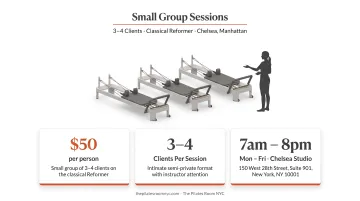
- If cost is a factor, consider mixing private sessions with small group classes — The Pilates Room NYC's small group sessions (3–4 people) run $50/session, and apprentice sessions with instructors-in-training offer private instruction at $80/session
- Keep a simple movement journal — even a sentence after each session about how your body felt helps you track patterns over time
Why Instructor Guidance Matters Most in the Beginning
Self-guided mat work has real value, but it can't replicate what a qualified instructor sees in your body. An experienced teacher will:
- Spot compensations before they become habits
- Adjust movements in real time when your form breaks down
- Tailor each session to where you are that day, rather than where a generic program expects you to be
At The Pilates Room NYC, the client-centered philosophy means every session is shaped by your physical, mental, and emotional state on that particular day. Instructors adapt the work to meet you where you are, which matters most in the first few months when your body is still learning what Pilates asks of it.
New clients can use the code INTRO for 15% off their first one-on-one session — a straightforward way to get an initial assessment and experience what a well-structured beginner session feels like.
Frequently Asked Questions
What is the 3-2-1 Pilates rule?
The 3-2-1 method is a cross-training split — 3 strength sessions, 2 Pilates sessions, and 1 cardio session per week. It originated as a social media training format, not classical Pilates methodology. Beginners may find the volume too demanding; build up gradually and adjust based on recovery.
Can beginners do Pilates every day?
Technically possible for experienced practitioners who vary intensity, but not recommended for beginners. Starting at 2–3 sessions per week with rest days built in gives your body time to adapt to new movement demands and consolidate the neuromuscular learning that makes Pilates effective.
How long does it take to see results from Pilates as a beginner?
Most beginners notice improved body awareness, posture, and core engagement within the first 10 sessions. Visible physical changes typically emerge around sessions 20–30 with consistent practice of 2–3 times per week — roughly 2–3 months in.
Does Pilates help lower cortisol?
Studies show inconsistent results. A 2023 study found decreased serum cortisol in women with multiple sclerosis after an 8-week tele-Pilates program, while a 2024 study of cancer survivors found no significant change. Pilates' emphasis on breathwork and concentration does activate the parasympathetic nervous system, which may support stress regulation over time.
Which is better for arthritis, yoga or Pilates?
Both are low-impact and can benefit people with arthritis. Pilates tends to emphasize core stability and joint support more directly, which many find helpful. Discuss your specific condition with a healthcare provider before starting to determine the better fit.
Is Pilates good for Ehlers-Danlos syndrome?
Pilates can be beneficial for EDS by building muscular support around hypermobile joints — but it must be approached carefully, with modifications to avoid overstretching or end-range loading. Work with an experienced instructor who understands hypermobility, and always coordinate with your healthcare team before starting.