The catch: not all Pilates is created equal when back pain or sciatica is involved. Some exercises help. Others make things measurably worse. The difference usually comes down to understanding your specific condition, respecting the neutral spine principle, and choosing movements that build stability without overloading the nerve.
This article covers the exercises that have the strongest rehabilitation support, the ones to avoid, and the principles that determine whether Pilates becomes part of your recovery or a setback.
Key Takeaways
- Pilates builds core strength that supports the spine and reduces pressure on the sciatic nerve
- Neutral spine — not the pelvic tuck — is the correct foundation for back pain and sciatica work
- Bridge, Dead Bug, Bird Dog, Modified Swan, Figure Four, and Clam are the most appropriate starting exercises
- What works for one type of sciatica can aggravate another — the cause determines the correct approach
- Anyone with acute or complex back conditions should work with a qualified instructor, not a generic program
Understanding Lower Back Pain and Sciatica
Sciatica is not a diagnosis — it's a symptom. Specifically, it refers to pain, tingling, or numbness that radiates from the lower back through the glutes and down one or both legs, caused by compression or irritation of the sciatic nerve.
What's Actually Causing It?
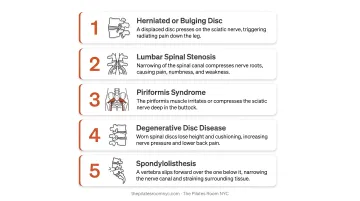
The cause matters enormously for exercise selection. Common culprits include:
- Herniated disc at L4/L5 or L5/S1 — approximately 90% of sciatica cases involve disc herniation with nerve-root compression, with roughly 95% of herniations occurring at these two levels
- Spinal stenosis — narrowing of the spinal canal that compresses nerves; notably, stenosis often improves with flexion and worsens with extension, which is the opposite of disc-related sciatica
- Piriformis tightness or spasm — the piriformis muscle sits directly over the sciatic nerve pathway; tightness here can mimic disc-related radiculopathy
- Facet joint inflammation — often associated with postural imbalances and prolonged sitting
- Postural contributors — tight hip flexors, weak glutes, and habitual forward-head posture all create compensatory load on the lumbar spine
Lower Back Pain vs. Sciatica
Lower back pain can exist without any nerve involvement. It's typically muscular, fascial, or joint-related. Sciatica specifically involves the sciatic nerve pathway, producing the characteristic radiating leg symptoms.
Both conditions frequently coexist, and they may respond quite differently to the same exercise. An extension-based movement that relieves disc pain, for instance, can sharply worsen stenosis symptoms — which is why a one-size-fits-all Pilates class carries real risk for someone presenting with nerve symptoms.
Why Pilates Is Effective for Lower Back Pain and Sciatica
Pilates is built around core stabilization — specifically the deep abdominal and spinal muscles that form a natural support system around the lumbar spine. When these muscles are weak or poorly coordinated, the spine relies on passive structures like discs and ligaments to absorb load. That's a problem for anyone with existing back or nerve issues.
The Core Stabilization Case
The transversus abdominis and multifidus — two key targets in Pilates — act like a corset around the lower spine. Strengthening them distributes spinal load more evenly, which reduces stress on vulnerable discs and nerve roots. The benefits extend to real outcomes:
- A 2023 meta-analysis found Pilates reduced both pain and disability in people with chronic lower back pain
- Cochrane-reviewed evidence supports its use over minimal intervention
- A clinical study on symptomatic lumbar disc herniation reported meaningful reductions in pain and disability — though this evidence is narrower than the broader chronic low back pain literature
Neutral Spine vs. Pelvic Tuck
The neutral spine principle is central to safe Pilates for back pain. Maintaining the natural lumbar curve, rather than flattening or over-arching it, protects the lower lumbar segments most at risk.
Many group classes default to posterior pelvic tilting (tucking the pelvis under) as a "core engagement" cue. For people with lower back pain, this flattens the lumbar curve and shifts how load moves through the spine. Neutral spine bracing is the more appropriate approach.
Hip Mobility's Role
Spinal mechanics don't exist in isolation — what happens at the hips has a direct upstream effect on the lower back. Tight hip flexors, hamstrings, and glutes force the lumbar spine to compensate for reduced range of motion, increasing stress on discs and joints.
Pilates addresses this through controlled hip mobility work integrated alongside stability training, rather than passive stretching alone.
Best Pilates Exercises for Lower Back Pain and Sciatica
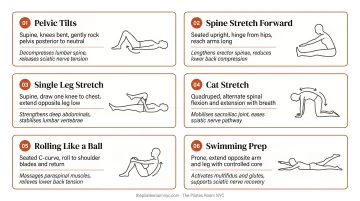
These exercises are selected for their ability to build core stability, decompress the spine, and reduce sciatic tension. Move slowly, breathe with intention, and stop immediately if sharp or shooting pain occurs. None of these should reproduce or worsen leg symptoms.
Here's a quick reference before you begin:
| Exercise | Primary Goal |
|---|---|
| Bridge (Glute Bridge) | Strengthen glutes, offload lumbar spine |
| Dead Bug | Build pelvic stability during limb movement |
| Bird Dog | Full trunk stabilization, spinal extensors |
| Modified Swan | Disc-related sciatica relief via extension |
| Figure Four Stretch | Release piriformis and gluteal compression |
| Side-Lying Leg Work (Clam) | Hip abductor strength, pelvic stability |
Bridge (Glute Bridge)
Setup: Lie on your back, knees bent, feet flat and hip-width apart. Hinge the hips upward while maintaining a neutral spine — no aggressive pelvic tuck at the top.
Why it helps: Strengthening the glutes and hamstrings offloads the lumbar spine by distributing hip-extension demands away from the lower back. This reduces compressive force along the sciatic nerve pathway.
Watch for: Avoid squeezing the glutes so hard that you tuck the pelvis under. The goal is a long, supported spine, not a forced posterior tilt.
Dead Bug
Setup: Lie on your back, arms extended toward the ceiling, knees in tabletop at 90 degrees. Extend the opposite arm and leg while keeping the lower back connected to the mat — without flattening the lumbar curve.
Why it helps: Your pelvis stays still while your limbs move — and that separation is exactly the motor pattern your lower back needs during walking, reaching, and daily activity. Training it here transfers directly to how your body moves off the mat.
Watch for: If the lower back arches away from the mat, reduce the range of the extending leg until core control improves.
Bird Dog
Setup: Start on hands and knees, wrists under shoulders, knees under hips. Extend the opposite arm and leg to hip height while maintaining a level pelvis and long, neutral spine.
Why it helps: Bird Dog activates the glutes, hamstrings, and spinal extensors simultaneously while demanding full trunk stability. Few exercises challenge so many lower back stabilizers at once — which is why it appears in nearly every lumbar rehabilitation protocol.
Watch for: Hip hiking or rotation as the leg extends. The pelvis should stay completely level — picture balancing a glass of water on your lower back.
Modified Swan
Setup: Lie face down, elbows bent and hands positioned by your sides. Gently press into your hands and pubic bone to lift the upper body, finding length through the spine rather than compressing the lower back.
Why it helps: Spinal extension exercises are particularly useful when sciatica stems from disc-related causes. Extension can reduce anterior disc pressure, which may decrease nerve irritation. This does not apply to stenosis — extension typically worsens stenosis symptoms.
Watch for: Keep the movement gentle and long. This is not a full backbend. Stop if leg symptoms increase.
Figure Four Stretch
Setup: Lie on your back, cross one ankle over the opposite thigh to form a figure four, and gently draw the supporting thigh toward your chest until you feel a stretch in the glute and outer hip.
Why it helps: Tight piriformis and gluteal muscles can compress or irritate the sciatic nerve directly. This stretch specifically targets those areas and works well for most types of sciatica — particularly piriformis-related cases.
Watch for: Keep the stretch comfortable and well within range. Aggressive pulling can overstretch the sciatic nerve itself rather than releasing the muscle.
Side-Lying Leg Work (Clam)
Setup: Lie on one side, hips stacked, knees bent at 90 degrees, feet together. Lift the top knee while keeping the hips completely stable — like a clamshell opening.
Why it helps: Hip abductor weakness contributes to pelvic instability, which in turn increases lumbar load. Strengthening these muscles through gentle side-lying work stabilizes the pelvis and reduces downstream pressure on the sciatic nerve.
Common mistake: Rolling the pelvis backward to create the appearance of range. The movement is small — hip stability matters far more than how high the knee lifts.
Pilates Exercises to Avoid with Lower Back Pain and Sciatica
Exercises that push the spine into extreme flexion, combine flexion with rotation, or demand heavy hip muscle recruitment without proper control can aggravate sciatic nerve irritation or worsen disc pressure.
Specific Exercises to Approach with Caution
| Exercise | Why to Avoid |
|---|---|
| Double leg lifts | Excessive lumbar strain, especially in weak cores |
| Full roll-ups | Aggressive spinal flexion that loads the disc |
| Forward fold stretches | Can stretch the sciatic nerve beyond tolerance in acute phases |
| Deep piriformis stretches | Counterproductive when piriformis is not the sciatica source |
The Pelvic Tuck Problem
Habitual posterior pelvic tilting — still used as a default "core engagement" cue in many Pilates classes — flattens the lumbar curve. For most people with lower back pain, the lumbar curve is already reduced. Flattening it further changes the loading context for the discs and can provoke symptoms in nerve-related conditions.
The more effective approach is neutral spine bracing: maintaining the natural lumbar curve while gently engaging the deep abdominals. It demands more body awareness than a tucking cue, and that awareness is precisely what builds lasting spinal stability.
How to Practice Pilates Safely for Lower Back Pain and Sciatica
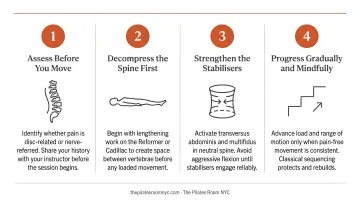
The Foundational Safety Framework
- Start at the lowest range version of every exercise
- Work only in a pain-free range — this is not a "push through it" situation
- Monitor how you feel in the hours after a session, not just during it. Nerve irritation often has a delayed onset, meaning you might feel fine during the session and significantly worse that evening
- Track leg symptoms specifically — any increase in radiating pain, tingling, or numbness is a signal to reduce load and range, or stop entirely
Know Your Cause Before You Start
Disc-related sciatica and stenosis-related sciatica can point in completely opposite directions:
- Disc herniation → generally benefits from extension, avoid end-range flexion
- Spinal stenosis → often improves with flexion, worsens with extension
- Piriformis-related → targeted hip and glute work is most relevant; aggressive stretching can backfire
Treating all sciatica identically is one of the most common mistakes in self-directed exercise programs. A medical assessment, combined with guidance from an instructor experienced in injury rehabilitation, helps clarify which category you're in before you begin.
What to Look for in an Instructor
Clinical training, injury rehabilitation experience, and the ability to modify exercises on the spot make a meaningful difference when back pain or sciatica is involved. At The Pilates Room NYC in Chelsea, instructors bring backgrounds ranging from sport science and postural restoration to massage therapy and Classical Pilates — including Enja Schenck (MS, CSCS), who specializes in adapting training to individual capabilities, and Pamela Pardi, who holds both a massage therapy license and 30+ years of classical teaching experience. New clients can note back pain or injury history in their intake form, and the studio matches them to the instructor best suited to their needs.
Common Mistakes When Using Pilates for Lower Back Pain and Sciatica
Even well-intentioned Pilates practice can slow recovery if these common errors go uncorrected:
- Defaulting to pelvic tucking for core engagement. This reinforces spinal flattening, which is harmful for most lumbar injuries. Start with neutral spine bracing instead.
- Overstretching to "release" the sciatic nerve. Aggressive hamstring and glute stretches can increase nerve irritation. Keep stretches comfortably within range, especially during the acute phase.
- Advancing by class difficulty rather than symptom response. Recovery pace should be guided entirely by how the body responds — not by the desire to keep up or move to harder work. Two steps forward, one step back is normal. Rushing it extends the timeline.
Frequently Asked Questions
What are the best Pilates exercises for lower back pain and sciatica?
Bridge, Dead Bug, Bird Dog, Figure Four Stretch, Modified Swan, and the Clam are the exercises with the strongest rehabilitation support. That said, the best exercises depend on the root cause of your pain — disc-related, piriformis-related, and stenosis presentations each respond differently. A personalized assessment is the most reliable starting point.
Is Pilates safe for people with Ehlers-Danlos syndrome or L4/L5 back problems?
Pilates can be adapted for both conditions, but each requires a different emphasis. EDS work prioritizes stability over flexibility, since overstretching can worsen joint instability; L4/L5 cases call for strict neutral spine awareness and avoidance of loaded spinal flexion. Professional guidance is strongly recommended for both.
Can Pilates make sciatica worse?
Yes — certain exercises can aggravate sciatica if they compress the disc, overstretch the nerve, or rely on excessive pelvic tucking. Exercise selection and form matter far more than whether something is labeled "Pilates." A poorly guided class can cause as much harm as no exercise at all.
How often should I do Pilates for lower back pain?
Starting with 2–3 sessions per week is a reasonable baseline. Allow recovery time between sessions and adjust frequency based on how the body responds in the 24 hours after each one — more sessions is not automatically better.
Is reformer Pilates or mat Pilates better for lower back pain and sciatica?
The Reformer's spring assistance makes movements more adjustable and accessible for sensitive conditions, which can be useful when working in a limited range. Mat Pilates is more accessible and still effective. Either can work well when guided by an experienced instructor. The quality of instruction ultimately matters more than the equipment.
Should I see a doctor before starting Pilates for sciatica?
A medical assessment is recommended, particularly for new or severe sciatica, to rule out serious underlying causes and confirm that exercise is appropriate. Once cleared, working with a qualified Pilates instructor who has injury rehabilitation experience is the most effective next step toward recovery.