Introduction
Staying active gets harder as we age — not because the desire fades, but because the body changes. Joint stiffness, balance concerns, and reduced mobility can make exercise feel more like a risk than a remedy. Many seniors who've heard about Pilates assume it's off the table entirely, imagining crowded mat classes or reformer machines that require getting down to the floor and back up again.
Seated Pilates adapts the core principles of traditional Pilates — breath, controlled movement, full-body engagement — into a format performed seated in an ordinary chair. No special equipment, no floor work, no reformer required. According to the CDC, more than 1 in 4 older adults fall each year, resulting in approximately 3 million emergency department visits. Seated Pilates directly addresses the strength and stability deficits that contribute to that risk.
This guide covers the benefits of seated Pilates for seniors, six foundational exercises to try, and practical advice for getting started safely.
Key Takeaways
- Seated Pilates uses a sturdy chair as a support prop to make classical Pilates principles accessible without floor work or specialized equipment
- Seniors managing osteoporosis, arthritis, balance issues, or limited mobility can train the whole body with reduced joint stress
- Consistent practice (2–3 times per week) produces cumulative gains in posture, core strength, and functional movement
- A certified instructor experienced with seniors ensures proper alignment and safe modifications from day one
What Is Seated Pilates?
Seated Pilates is a modified version of traditional Pilates where exercises are performed seated in a sturdy, armless chair. The same foundational principles apply — breath coordination, precise movement, and core engagement — but without requiring the participant to be on the floor or operate specialized apparatus.
It's worth distinguishing the chair used here from the Pilates Wunda Chair — a piece of classical studio apparatus. Seated Pilates for seniors uses an ordinary dining or kitchen chair as a support prop. The former costs nothing and requires no equipment; the latter is a sophisticated resistance machine used in professional Pilates studios.
The chair's role here is functional, not reductive. It provides a stable base so that older adults can:
- Perform controlled movements without fear of losing balance
- Engage core muscles fully without floor-level transitions
- Focus on precision and breath rather than managing physical access
The principles of Pilates remain fully intact — the chair simply makes them accessible to a wider range of bodies.
Key Benefits of Seated Pilates for Seniors
Builds Core Strength and Improves Posture
The core (deep abdominals, lower back muscles, and pelvic floor) is engaged in virtually every seated Pilates movement. Because seated exercises require the upper body to stabilize without floor support, even gentle movements produce measurable strength gains over time.
The daily-life payoff is direct: a stronger core supports better posture, reduces lower back discomfort, and makes tasks like rising from a chair, carrying groceries, or sitting through long periods noticeably easier. Research has consistently linked trunk muscle strength to improved balance and mobility in community-dwelling older adults.
Enhances Balance and Reduces Fall Risk
Falls are one of the most serious health risks facing older adults. The CDC reports 41,400 unintentional fall deaths among adults age 65+ in 2023 alone, with fall-death rates rising steadily across all older adult age groups over the past two decades.
Seated Pilates addresses several physical factors that contribute to falls:
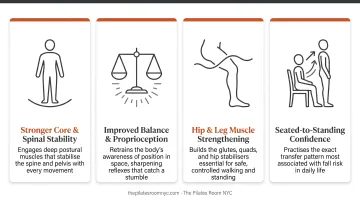
- Strengthens the hip, leg, and core muscles responsible for stability
- Trains proprioception (the body's sense of its own position in space) through slow, deliberate movement
- Builds confidence in controlled movement, which reduces fear-related avoidance
The seated position provides safety while still challenging the balance system. A 2023 systematic review of randomized controlled trials found Pilates training improved balance in older adults — a meaningful directional finding, even as research on seated Pilates specifically continues to develop.
Supports Joint Health Without Excess Strain
Because the chair bears body weight during exercises, the impact on joints (knees, hips, spine) drops significantly compared to standing or floor-based movement. This makes seated Pilates particularly practical for seniors managing arthritis. CDC data shows arthritis affects nearly 54% of adults aged 75 and older, making joint-friendly exercise a genuine priority for this population.
Seated work is gentler on joints — but it still delivers. Movements like leg extensions, pelvic tilts, and spinal rotations:
- Build muscular support around vulnerable joints
- Improve range of motion
- Promote circulation without compressive loading
The 2019 American College of Rheumatology guideline strongly recommends exercise for osteoarthritis of the knee, hip, and hand and places no hierarchy on exercise type, so low-impact seated work qualifies.
Improves Bone Health and Addresses Osteoporosis
Seated Pilates can support bone health by engaging muscles against gravity and creating mild mechanical loading , which signals the body to maintain bone tissue. The Bone Health and Osteoporosis Foundation's 2022 Clinician's Guide recommends weight-bearing, resistance, and balance exercise as part of osteoporosis management.
For seniors with osteoporosis, the exercise selection matters. Movements to emphasize:
- Leg and hip strengthening
- Spinal extension and posture work
- Balance challenges in a supported position
Movements to avoid or modify: excessive forward spinal flexion (such as rounding deeply forward at the waist), which the BHOF guidelines flag as increasing fracture risk. A qualified instructor can navigate these restrictions and build a safe, progressive routine.
Boosts Mental Well-Being and Body Awareness
The breath-focused, mindful quality of Pilates has a direct effect on how people feel, not just how they move. A 2021 meta-analytical review found Pilates may improve psychological health parameters (including quality of life, mood states, and depression indicators) in adults over 55.
For seniors managing isolation or anxiety, a consistent movement practice offers structure and a concrete sense of progress. Nearly one-third of US adults aged 50–80 reported feeling lonely in 2024, according to a JAMA research letter. Regular physical activity addresses this on multiple levels:
- Creates a predictable routine that anchors the week
- Builds body awareness and a tangible sense of improvement
- Provides a focused, purposeful activity that counters passive isolation
Essential Seated Pilates Exercises for Seniors
The following six exercises form a well-rounded starting routine covering the core, upper body, lower body, and spine. All can be performed in a sturdy, armless chair with feet flat on the floor. Move at your own pace and stop if anything causes pain or discomfort.
Before you begin, make sure you have:
- A sturdy, armless chair (dining chair or folding chair works well)
- Enough space on either side to extend your arms
- Bare feet or non-slip socks for stable contact with the floor
Seated Spine Twist
Sit tall with hands resting on your thighs or arms extended forward. Gently rotate the upper body to the right, pause, return to center, then rotate left. Keep hips and feet grounded throughout.
Targets: spinal mobility, obliques, shoulder flexibility — relieves stiffness and strengthens the rotational muscles that support upright posture.
Seated Pelvic Tilt
Sitting on the edge of the chair with feet flat, alternate between gently arching the lower back (tilting the pelvis forward) and rounding it back (tucking the tailbone). Move slowly and rhythmically, coordinating with your breath.
Targets: deep core and lower back. This is the foundational Pilates movement, reactivating muscles that go quiet from prolonged sitting.
Seated Marching
Sit tall and alternate lifting each knee upward in a controlled marching motion. Add opposing arm movement for extra coordination challenge.
Targets: hip flexors, quadriceps, and cross-body coordination — promotes circulation and builds the leg strength needed for walking and stair-climbing.
Arm Circles and Shoulder Rolls
Extend arms to the sides and make slow, controlled circles — first forward, then backward. Follow with shoulder rolls: lift the shoulders toward the ears, hold briefly, then release them down with an exhale.
Targets: shoulder mobility and upper-body tension — counteracts the rounded-shoulder posture that builds gradually from desk work and screen time.
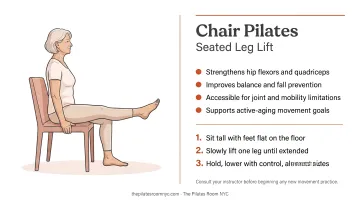
Chair Leg Extensions
Sit tall, slowly extend one leg forward until straight, hold for a moment, then lower with control. Alternate legs. Hold the sides of the chair for stability if needed.
Targets: quadriceps and knee stability — mimics the mechanics of standing and walking, making it one of the most practical exercises in this routine for daily independence.
Seated Side Leg Lifts
Sitting near the edge of the chair, lift one leg out to the side, keeping it straight, then lower slowly. Repeat on both sides.
Targets: hip abductors and outer thighs. Stronger hip abductors directly reduce fall risk by improving lateral stability and single-leg balance.
How to Get Started Safely with Seated Pilates
Before beginning any new exercise program, seniors should consult their physician or physical therapist — particularly if managing osteoporosis, recent joint surgery, or cardiovascular concerns. Most will be cleared to proceed, but personalized guidance matters.
Choosing the Right Chair and Setup
Look for:
- A sturdy, armless chair with no wheels
- Seat height that allows both feet to rest flat on the floor
- Enough surrounding space to extend both arms and legs freely
During early sessions, position the chair against a wall for added stability. A non-slip surface under the chair legs prevents sliding during leg exercises.
Starting with Expert Instruction
Seated Pilates is designed to be practiced at home with an ordinary chair. The Pilates Room NYC doesn't offer dedicated seated-Pilates classes — but a sturdy chair can be used as a supportive tool within a regular session, and working with a certified instructor first — particularly one trained in classical Pilates and experienced with senior clients — helps you learn proper alignment and safe modifications before practicing on your own.
At The Pilates Room NYC, instructors like Alison Johnson bring over 26 years of teaching experience working with seniors and clients managing conditions like osteoporosis and arthritis. The studio's specialized Pilates for Osteoporosis & Bone Health programming, designed for clients 60+, emphasizes posture, weight-bearing strength, balance training, and fall prevention, with each 55-minute session tailored to the individual's current physical condition. Private sessions are recommended for beginners or those managing specific conditions, as the one-on-one format allows for continuous, real-time modification.
Building Consistency Over Time
Consistency matters more than intensity here. A practical progression:
- Weeks 1–2: A short, manageable routine 2–3 times per week, focusing on form over duration
- Weeks 3–6: Gradually lengthen your sessions as strength and confidence build
- Beyond month 2: Add complexity or increase session frequency based on how your body responds
Short, regular sessions accumulate real strength gains over time — more reliably than sporadic longer ones.
Conclusion
Seated Pilates is a complete, purposeful movement practice rooted in the same principles — breath, precision, control, and body awareness — that make Pilates effective at every age. The chair adjusts the access point without changing what the work delivers.
Approached consistently, it improves the things that matter most to independent living: core strength, balance, joint health, and body awareness. If you're in New York City and ready to explore what classical Pilates can do for your body, The Pilates Room NYC works specifically with seniors and active-aging clients — meeting you where you are and building from there.
Frequently Asked Questions
How often should seniors do seated Pilates?
Two to three sessions per week is a well-supported starting point, keeping beginner sessions short and focused on good form. As strength and endurance build, both frequency and duration can increase gradually.
Does seated Pilates really work for seniors?
Yes. Clinical practice and directional research support seated Pilates as effective for improving core strength, balance, posture, and flexibility in older adults. Benefits become more pronounced with consistent, long-term practice.
Is seated Pilates safe for seniors with Ehlers-Danlos syndrome?
Seated Pilates is generally low-risk, but seniors with Ehlers-Danlos syndrome (a condition involving joint hypermobility and instability) should work closely with their physician and a qualified instructor. Modifications are essential to avoid overstretching or destabilizing joints.
What do I need to get started with seated Pilates at home?
A sturdy, armless chair on a non-slip surface, enough space to extend your arms and legs, and comfortable clothing. No Pilates equipment or gym membership required.
Can seated Pilates help with fall prevention in seniors?
Yes. Seated Pilates strengthens the core, hips, and legs while training balance and body awareness through controlled movement — directly addressing the physical factors that contribute to falls in older adults.
Is seated Pilates suitable for seniors with osteoporosis?
Seated Pilates is well-suited for seniors with osteoporosis because it builds bone-supporting muscle through gentle loading without high-impact stress. An experienced instructor should guide exercise selection to avoid movements that increase fracture risk, such as deep forward spinal flexion.