Introduction
Osteoporosis affects 1 in 3 women and 1 in 5 men over age 50, according to the International Osteoporosis Foundation. In the United States alone, the condition causes 2 million broken bones every year. Those numbers make exercise feel genuinely frightening for anyone who's just received a diagnosis.
Osteoporosis reduces bone density, leaving vertebrae, hips, and wrists far more vulnerable to fracture under loads that healthy bone handles without difficulty. Everyday movements — bending to pick something up, reaching overhead — can feel like they carry real risk.
Pilates is safe and beneficial for people with osteoporosis — but only when practiced correctly. The wrong exercises can increase fracture risk rather than reduce it, and a standard group class is not the same as an adapted session.
This guide covers exactly what you need to know — which exercises help, which to avoid, how to modify safely, and what to look for in an instructor.
Key Takeaways
- Pilates builds strength, posture, and balance that directly reduce fracture and fall risk
- Forward spinal flexion, loaded rotation, and rolling movements must be avoided or modified
- Back-extension and weight-bearing exercises are the most beneficial patterns for bone health
- Always disclose your osteoporosis diagnosis before your first session so your program is designed safely
- Pilates works best as part of a broader plan that includes medical care, calcium, vitamin D, and weight-bearing exercise
How Pilates Benefits People with Osteoporosis
Bone Loading and Mechanical Stimulus
Pilates applies controlled mechanical load to bones and muscles through movement — and bone tissue responds to that stimulus. The Bone Health & Osteoporosis Foundation identifies weight-bearing and muscle-strengthening exercise as the two most important exercise types for maintaining bone density, and Pilates incorporates both.
The research on Pilates and bone mineral density (BMD) tells a nuanced story. A 2022 meta-analysis in the Journal of Geriatric Physical Therapy found Pilates did not produce statistically significant BMD gains at the lumbar spine, hip, or femoral neck in postmenopausal women. What research does support more clearly is that Pilates helps preserve bone density and delivers meaningful secondary benefits — strength, posture, and fall prevention — that matter enormously for fracture risk.
Fall Prevention: The Most Underrated Benefit
Falls cause 86–95% of low-trauma fractures in community-dwelling older adults, according to research published in Clinical Epidemiology and Outcomes Research. That makes fall prevention the single highest-value target in osteoporosis management.
Pilates is particularly well-suited here. The method builds:
- Balance and proprioception through single-leg and standing exercises
- Dynamic stability through controlled, coordinated movement patterns
- Core strength that keeps the body upright and responsive when balance is challenged
A Cochrane review found that exercise reduces the overall rate of falls in older adults by 23% — a meaningful reduction for anyone whose bones are less forgiving of impact.
Posture and Spinal Extension
Osteoporosis increases the risk of vertebral compression fractures, which can progressively round the upper back into a condition called hyperkyphosis. This forward curvature then increases spinal loading and compounds fracture risk over time.
Back-extension exercises directly counter this pattern. The "Too Fit To Fracture" consensus — a clinical guideline specifically for people with osteoporosis — recommends targeting the spinal extensor muscles and building postural awareness as core components of an osteoporosis exercise program. Pilates exercises like Swan and spine extension on the Reformer address both goals directly.
Movement Confidence and Quality of Life
Many people with osteoporosis develop kinesiophobia — a fear of movement — that leads to inactivity, which accelerates bone and muscle loss. Pilates' emphasis on breath, body awareness, and mindful concentration helps rebuild confidence in movement gradually. Clients learn what their body can do safely, which is often far more than fear had led them to believe.
Pilates Exercises That Are Safe for Osteoporosis
The guiding principle: safe Pilates for osteoporosis keeps the spine in a neutral or extended position, uses controlled movement, and loads the hips, wrists, and spine in ways that strengthen rather than strain.
Back Extension and Postural Exercises
Back-extension exercises are among the best-studied movements for people with osteoporosis. A landmark study comparing flexion versus extension exercise in postmenopausal women with spinal osteoporosis found the extension group had far lower rates of additional vertebral fractures.
Recommended exercises:
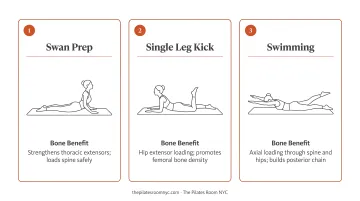
- Dart and Swan Prep — prone exercises that strengthen the paraspinal muscles along the entire spine, counteract kyphotic posture, and place the spine in safe extension
- Quadruped (all-fours) work — distributes controlled weight through the wrists and spine while building coordination and stability throughout the body
- Prone leg and arm lifts — activate the glutes and back extensors without any spinal flexion
One contraindication worth noting: spinal stenosis can make extension exercises uncomfortable or contraindicated. Anyone with a dual diagnosis should check with their physician before performing prone extension work.
Hip and Core Strengthening Exercises
The hip is one of the three primary fracture sites in osteoporosis, alongside the spine and wrist. Strengthening the musculature around the hip joint is both a protective and a bone-loading strategy.
Recommended exercises:
- Bridge variations — engage the glutes, hamstrings, and core in spinal-neutral or extended positions without dangerous flexion loading
- Side Leg Series — builds hip abductor and adductor strength, improving lateral stability and fall resistance
- Standing Pilates and single-leg balance work — provides direct bone-loading stimulus through the legs while training the proprioceptive responses that prevent falls
Standing exercises deserve particular attention. Weight-bearing through the legs (Standing Footwork, balance challenges with a wall for support) offers a bone stimulus that mat-based exercises alone cannot replicate — making them an essential complement to floor work, not an optional add-on.
Pilates Movements to Avoid with Osteoporosis
Why Spinal Flexion Is the Main Concern
The anterior (front) portion of vertebrae bears disproportionate compressive load during spinal flexion, especially when that flexion is loaded, rapid, or repeated at end range. For vertebrae already compromised by low bone density, this load pattern raises compression fracture risk meaningfully.
Research from Sinaki and Mikkelsen found that additional vertebral fractures occurred in 89% of the flexion exercise group versus just 16% of the extension group in postmenopausal women with spinal osteoporosis. The clinical implication for Pilates is clear.
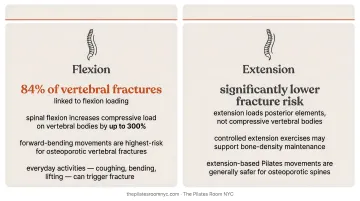
The Royal Osteoporosis Society notes that moderate bending is generally safe but cautions against repetitive, uncontrolled, or loaded forward flexion that puts strain on the spine in a curved position.
Exercises to Avoid or Approach with Extreme Caution
| Exercise | Why It's Problematic |
|---|---|
| Roll Up / Roll Down | Full spinal flexion under load — compresses anterior vertebrae |
| Rolling Like a Ball | Spinal flexion combined with momentum and bodyweight |
| Roll Over | Extreme spinal flexion with added body weight load |
| The Saw | Loaded spinal rotation with forward flexion |
| Spine Twist | Rotation with a loaded, upright spine |
| Hip Roll | Loaded rotation of the lumbar spine |
| Curl Up / Ab Curls | Repeated thoracic flexion — high risk for compression fracture |
| Cat Stretch | Repeated flexion-extension cycling through the thoracic spine |
The Important Nuance on Rotation
Rotation is not entirely off-limits. According to the Royal Osteoporosis Society, smooth and comfortable rotational movements are generally safe. The risk rises under specific conditions:
- Rotation paired with spinal flexion
- Movement taken to end range under load
- Fast or momentum-driven execution
A qualified instructor can assess which rotational movements to adapt versus omit based on your bone density level and fracture history — that individualized judgment is what separates safe Pilates from risky Pilates for this population.
How to Modify Pilates for Osteoporosis
The Neutral Spine Principle
Every modification for osteoporosis starts from the same place: maintain a neutral spine. In practice, this means:
- Substituting a hip hinge for forward folds — the spine stays long while the hips bear the bend
- Omitting head and shoulder lifts in abdominal work, replacing them with leg movements or bridge variations that load the core without flexing the thoracic spine
- Keeping the upper back long and supported during any sitting or transitional movement
Props and Support Modifications
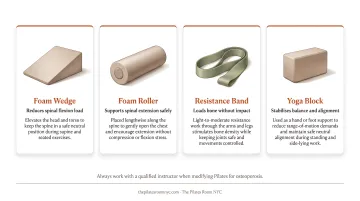
Simple props make many exercises safer and more accessible:
- Wall support during standing balance exercises reduces fall risk while still providing the bone-loading benefit of weight-bearing
- Folded towel under the forehead during prone work keeps the neck in neutral when full neck extension is uncomfortable
- Chair support during standing leg work allows clients to focus on hip strength without balance anxiety
- Resistance bands can replace exercises that would otherwise require spinal flexion, allowing targeted hip and back work in safer positions
Working with a Qualified Instructor
Self-directed modification introduces real risk. Without an experienced eye watching your movement, it's easy to unknowingly flex the spine during exercises that are supposed to be neutral, or to miss subtle patterns that accumulate into injury over time.
At The Pilates Room NYC, instructors like Enja Schenck — holding an MS in Sport Science, CSCS certification, and training in Postural Restoration Institute principles — bring multidisciplinary depth to programming for complex populations. Owner Alison Johnson has 26 years of experience adapting Pilates for clients with conditions including osteoporosis. Sessions are tailored to your physical state that day, not drawn from a generic sequence.
Managing Progression
Starting with pre-Pilates or foundational movements builds body awareness and movement confidence before advancing. Once basic patterns feel stable, resistance — through bands, the Reformer, or the Tower — can gradually increase the bone-loading stimulus. The key word is gradually. Strength and confidence should build ahead of the program's demands, not scramble to keep up with them.
Common Mistakes to Avoid
Three mistakes come up repeatedly — and each one is easy to avoid once you know what to watch for.
- Assuming a standard class is safe. Most general Pilates classes aren't designed with osteoporosis in mind. An instructor unfamiliar with the diagnosis may cue Roll Up, Spine Twist, or ab curl variations without recognizing the risk. That's not negligence — it's an information gap your disclosure can close.
- Pushing through back pain. Pain during or after a Pilates exercise, particularly in the thoracic or lumbar spine, is a warning signal. Stop the movement, tell your instructor immediately, and don't return to it without guidance. Persistent back pain warrants medical evaluation.
- Treating Pilates as a complete solution. Pilates is a powerful management tool, but it works best alongside medication, adequate calcium and vitamin D intake, and other weight-bearing activities like walking. Relying on it exclusively leaves real gaps in your bone health plan.
Frequently Asked Questions
What should I avoid in Pilates if I have osteoporosis?
Avoid any exercise that creates forward spinal flexion, loaded rotation, or curves the spine under bodyweight. Specific exercises to skip include Roll Up, Rolling Like a Ball, the Saw, Spine Twist, and ab curl variations. Your instructor can identify safe alternatives for each of these.
What is the best exercise to reverse osteoporosis?
No single exercise reverses osteoporosis. Weight-bearing and resistance exercises — including targeted Pilates, walking, and strength training — are the most supported by research for slowing bone loss. Combining exercise with medical treatment and adequate nutrition is consistently more effective than any one intervention alone.
What is the most important vitamin for bone health?
Vitamin D is critical for calcium absorption and bone formation, and deficiency is common in people with osteoporosis. The Bone Health & Osteoporosis Foundation recommends 800–1,000 IU daily for adults over 50, but individual needs vary — get your levels tested and discuss supplementation dosing with your doctor.
Can Pilates increase bone density?
Pilates is unlikely to build significant new bone density on its own; high-impact and heavy resistance training are more potent for that. What research does suggest is that Pilates may help slow bone density loss while delivering meaningful benefits for muscle strength, posture, and fall prevention — all of which reduce fracture risk.
Is Pilates safe after a spinal fracture?
Yes, with appropriate modifications. Many pre-Pilates and extension-based movements remain fully accessible after a vertebral fracture. Work with an instructor or physiotherapist experienced in post-fracture rehabilitation, and get physician clearance before starting.
Should I tell my Pilates instructor about my osteoporosis diagnosis?
Yes — before your first session. Disclosing your diagnosis allows the instructor to adapt every exercise, avoid contraindicated movements, and monitor your form throughout. Withholding this information removes the safety net that makes Pilates appropriate for you.