Introduction
It starts subtly. By 3 PM, your neck aches. On the subway home, your lower back seizes. You roll your shoulders back and they drift up toward your ears again within minutes — without you noticing.
This is not a personal failing. It's a predictable physical response to how modern desk work is designed. Sitting for six or more hours a day, focused forward, typing and scrolling, reshapes your muscles in patterns most people don't register until the pain gets loud enough to demand attention.
A 2021 study of office workers found overall musculoskeletal disorder prevalence of 71.9%, with lower back, wrist, and shoulder complaints most common. That's not a minority problem — it's the norm.
This post breaks down exactly what prolonged sitting does to your body, why Pilates corrects it more effectively than most alternatives, and which exercises to start with today. It also covers when one-on-one work with a classical Pilates instructor makes a meaningful difference — especially if pain or structural issues are already in the picture.
Key Takeaways
- Prolonged sitting weakens your posterior chain (glutes, mid-back, deep spinal muscles) while shortening your anterior chain (hip flexors, chest, neck)
- Pilates rebuilds deep core stabilizers, retraining how your nervous system coordinates spinal support
- Four classical exercises directly address the most common desk-work dysfunctions
- Personalized instruction catches and corrects compensatory patterns that self-directed practice overlooks
What Sitting All Day Actually Does to Your Body
The problem isn't sitting itself. It's sustained, static sitting — hours of forward-focused posture that the body treats as a signal to adapt.
Your body is extraordinarily good at optimizing for whatever position you hold most. And desk posture consistently overloads the same muscles while letting their opposites quietly switch off.
The Anterior Chain Takes Over
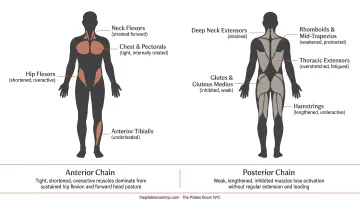
Typing, scrolling, and leaning toward a screen shortens the muscles on the front of your body:
- Pectorals — pull the shoulders forward and inward
- Hip flexors — shorten and tighten, pulling the pelvis into anterior tilt
- Neck flexors — drag the head forward off its ideal stacking point
While these muscles overwork, the opposing posterior chain — mid-back, glutes, deep spinal extensors — becomes progressively underused and neurologically inhibited, meaning the brain gradually stops recruiting them. This imbalance drives most desk-related pain.
Gluteal Inhibition and Your Lower Back
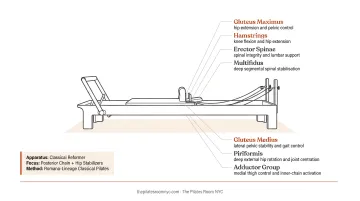
Extended sitting compresses the glutes and gradually suppresses their activation. As Mayo Clinic's clinical commentary on gluteus maximus dysfunction notes, when the gluteus maximus is inhibited, the hamstrings and erector spinae compensate — taking on stability demands they weren't designed to carry alone. This is a primary mechanism behind chronic lower back pain in desk workers.
Thoracic Immobility Drives Neck and Shoulder Pain
The mid-back should provide rotation and extension that the neck and shoulders don't have to generate. When prolonged sitting eliminates thoracic mobility, the neck and upper traps compensate. Research confirms this: a 2018 study of young adults found sedentary sitters had roughly 10 degrees less thoracic rotation than active peers, with sitting time negatively correlated with thoracic mobility.
The tension headaches and upper trapezius tightness familiar to most office workers often originate here — not in the neck itself.
Beyond Musculoskeletal Pain
The stakes extend past posture. A 2015 meta-analysis published in Annals of Internal Medicine found high sedentary time associated with a 29% higher risk of fatal and non-fatal cardiovascular disease compared to low sedentary time — with every additional sedentary hour carrying an incremental risk increase.
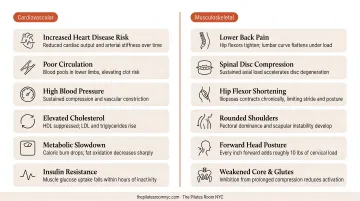
Reduced circulation, mood changes, and metabolic disruption compound the musculoskeletal picture. Movement breaks matter even when you feel fine.
Why Pilates Works Where Other Fixes Fall Short
Foam rolling, ergonomic chairs, and generic stretching address surface discomfort. They don't retrain the neuromuscular patterns — how the brain coordinates muscle activation — that prolonged sitting has disrupted.
Pilates works at the level of movement re-patterning.
The Deep Core Unit
The transversus abdominis, multifidus, and pelvic floor function as an internal stabilizing system for the lumbar spine. Research on this mechanism describes these muscles as an "anatomical girdle" that stabilizes from the inside out — distinct from the superficial abdominals that most people think of as "core" work.
In people with lower back pain, transversus abdominis activation is delayed during movement. Pilates specifically trains these deep stabilizers to activate first and maintain control through a full range of motion.
Balanced, Multi-Planar Movement
Classical Pilates was designed to systematically work every muscle group in every plane of motion. For desk workers, this means:
- Spinal extension — countering hours of forward flexion
- Hip opening — addressing shortened hip flexors
- Scapular stabilization — reactivating the mid and lower trapezius
- Abdominal strengthening — without increasing spinal compression
No single gym exercise or stretching sequence does all four consistently.
The Mind-Body Reset
Desk work is cognitively demanding. Pilates requires focused attention on breath, alignment, and muscular engagement — which functions as a mental reset, not another task to push through. Stress-driven habits like elevated shoulders and shallow breathing compound postural strain. Pilates interrupts these patterns deliberately — through the same focused attention that makes each session restorative rather than depleting.
Every desk worker presents a different pattern of tightness and weakness. That's what makes individualized instruction so effective here.
At The Pilates Room NYC in Chelsea, instructors assess each client's physical, mental, and emotional state before every session and adapt classical exercises accordingly. If you come in with acute neck tension or lower back tightness from a long day, that shapes what the session addresses — the work meets you where you are.
Key Pilates Exercises for Office Workers
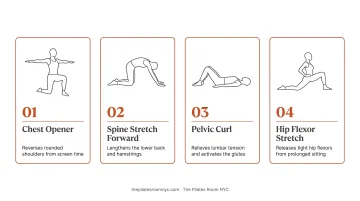
The following four exercises directly address what prolonged sitting does to your body. Each one targets a specific consequence of desk work — lost spinal mobility, dormant glutes, compressed extensors, and a pelvis that has forgotten what neutral feels like. Learning them with a qualified instructor ensures you're actually doing what you think you're doing, which matters more than it sounds.
Each exercise targets a specific desk-work consequence:
- Pelvic Tilt — restores neutral spine awareness and activates deep core stabilizers
- Spine Twist — recovers thoracic rotation lost through sustained sitting
- Swan Prep — reverses forward-flexed posture by strengthening spinal extensors
- Shoulder Bridge — reactivates glutes and hamstrings while mobilizing the lumbar spine
Pelvic Tilts and Neutral Spine Finding
Lie on your back with knees bent. Gently rock the pelvis between a small arch (anterior tilt) and a light imprint (posterior tilt). Settle into the neutral position where the spine neither jams into the floor nor exaggerates its curve. Breathe slowly throughout.
Many chronic desk sitters have genuinely lost the felt sense of where neutral spine is. This exercise restores that awareness and activates deep core stabilizers before any other movement — the foundation of nearly every classical Pilates exercise.
Spine Twist
Sit tall with legs extended or crossed, arms open wide at shoulder height. Inhale to grow taller through the spine. Exhale to rotate the entire torso to one side with a controlled finish, keeping the hips grounded. Return to center and repeat.
This exercise directly targets thoracic rotation — the mobility prolonged sitting eliminates. It trains the obliques and teaches movement to initiate from the center rather than the neck or shoulders, resetting the mid-back tension that builds through a full workday.
Swan Prep (Chest and Spine Extension)
Lie face-down with hands under the shoulders. Inhale to prepare. Exhale to peel the head and chest off the mat using the back muscles, not primarily the arms. The gaze stays forward and down, the neck long, the lower body relaxed.
Swan Prep directly counteracts the rounded, forward-flexed posture of desk work by strengthening spinal extensors and opening the chest. It's particularly valuable for reawakening the posterior chain muscles that go dormant from sustained sitting.
Shoulder Bridge
Lie on your back with knees bent, feet hip-width apart. Exhale to articulate the spine off the mat one vertebra at a time until the hips are lifted and the body forms a diagonal line. Hold briefly. Inhale at the top. Exhale to roll down with the same sequential control.
Shoulder Bridge powerfully activates the glutes and hamstrings — the muscles most suppressed by sitting — while providing therapeutic articulation through the lumbar and thoracic spine. The rolling motion both strengthens and gently mobilizes a spine that has been static for hours.
How to Build Pilates Into a Busy Work Schedule
Time is the most common reason people put off starting. Here's the reframe: movement breaks don't subtract from productive work time. Research shows that breaking up sitting every 30 minutes with brief movement can improve attention and working memory — meaning the time invested in moving pays back.
Realistic Scheduling for NYC Professionals
Rather than carving out a completely new time block, tie sessions to existing routines:
- Before work — The Pilates Room NYC opens at 7 AM weekdays, giving commuters a window before the office
- Lunch break — a 1-hour session fits within an extended lunch, particularly for those with flexible schedules
- Work-from-home days — the absence of a commute is a natural opportunity to use that recovered time
Consistency beats duration. Three focused 40-minute sessions per week produce better results than one 90-minute class you can rarely make.
Desk Micro-Resets
Studio sessions build the foundation; desk habits protect it between classes. Pick one or two exercises from this post — pelvic tilts work at any chair, spine twist can be done standing — and pair them with a habit you already do:
- Brewing your morning coffee
- Wrapping up a call
- Moving between meetings
The goal isn't a workout — it's breaking the pattern of sitting still for hours. Even 5 minutes of deliberate movement every hour adds up.
The Difference Between Desk Exercises and Studio Pilates
The exercises above are a solid starting point. They are not, however, a complete solution — and understanding why matters if you're dealing with persistent pain or long-established postural patterns.
The Self-Assessment Problem
The core limitation of solo practice is that the compensatory habits responsible for your pain are largely invisible to you. Without trained eyes observing your movement in real time, you will often default to the exact patterns that created the problem. Research on supervised versus unsupervised exercise for musculoskeletal pain found that supervised therapy reduced presenteeism more effectively than self-directed care. Adherence is also substantially more consistent when sessions are led by an instructor.
What Apparatus Work Offers
Reformer, Cadillac, and other classical apparatus provide adjustable spring resistance that simultaneously supports and challenges the body. This allows an instructor to isolate specific weaknesses — the deep hip stabilizers, the lower trapezius — that are genuinely difficult to target on a mat alone. A 2016 pilot study of workers with chronic lower back pain found that a 6-week equipment-based Pilates protocol significantly reduced both pain and disability scores. That precision matters most when the goal is correcting the specific patterns desk work creates, not just moving more.
The Pilates Room NYC for Office Workers
The Pilates Room NYC is built for exactly this kind of work. Instructors adapt each session in real time based on how you present that day — no fixed routine, no class format pushing you through a sequence your body isn't ready for.
The teaching depth here is specific: Alison Johnson, owner and lead instructor, has 26 years of classical training rooted in the Romana lineage. Enja Schenck brings a distinct cross-disciplinary lens — certified by Bob Liekens, she holds an MS in Sport Science, a CSCS designation, and integrates Postural Restoration Institute methodology into her work with clients managing postural and structural challenges. Sessions take place without music or social media recording, in a focused Chelsea studio where that level of attention is the point.
Private sessions start at $125 with junior instructors, and apprentice sessions are available at $80 — making consistent instruction a realistic option for working professionals. First-time clients receive 15% off their first private session with code INTRO.
Frequently Asked Questions
Is Pilates good for office workers?
Pilates is particularly well-suited to office workers because it directly targets the muscle imbalances, postural deviations, and movement deficits that desk work creates — strengthening the posterior chain and deep core while restoring mobility in the hips, thoracic spine, and shoulders.
How often should office workers do Pilates to see results?
Two to three sessions per week is a practical starting point. Consistency matters more than frequency. Most clients notice improved posture, reduced tension, and greater body awareness within four to six weeks, though the timeline depends on how long the patterns have been in place.
Can Pilates fix bad posture from years of sitting at a desk?
Yes, Pilates can reverse many of the postural effects of prolonged desk work, but the process involves retraining neuromuscular patterns. That takes consistent, progressive practice over time. Personalized instruction speeds up the process considerably compared to self-directed work.
What type of Pilates is best for back pain caused by sitting?
Classical Pilates (particularly private or semi-private instruction on apparatus) is most effective for desk-related back pain. The instructor can tailor exercises to your specific restrictions and ensure movements are performed correctly, avoiding the risk of reinforcing existing dysfunctional patterns.
Is mat Pilates or Reformer Pilates better for desk workers?
Both are valuable. Mat Pilates builds foundational body awareness and is highly accessible. Reformer and classical apparatus work adds spring-loaded resistance that more precisely targets inhibited posterior chain and hip stabilizer muscles. Many office workers benefit most from combining both within a structured program.
Should I do Pilates before or after work?
Both have real benefits — morning sessions establish healthy movement patterns for the day ahead, while evening sessions decompress accumulated tension. The best time is whichever one you'll actually stick to.