Introduction
Living with a bulging disc means navigating a frustrating contradiction: you've been told to stay active, but movement feels like a minefield. Lower back stiffness in the morning, radiating pain down the leg, the constant worry that the wrong movement will make everything worse — it's exhausting.
Pilates is one of the most reliably recommended low-impact approaches for people managing disc conditions. Its focus on deep core activation, neutral spinal alignment, and controlled movement targets the exact mechanical problems that make bulging discs so persistent.
This article covers what a bulging disc actually is, why Pilates works for spinal rehabilitation, which exercises are safe to try, which to avoid entirely, and how to get started without making things worse.
Key Takeaways
- A bulging disc occurs when the outer disc wall weakens and expands outward — painful, but not always surgical
- Pilates strengthens the deep core muscles that stabilize the spine and reduce pressure on the disc
- Safe exercises maintain a neutral spine position, avoiding heavy bending, compression, or twisting
- Avoid deep forward bends, sit-ups, heavy lifting, and high-impact exercise — all can aggravate symptoms
- Always get medical clearance first, and work with an instructor who understands spinal conditions
What Is a Bulging Disc?
The Anatomy in Plain Terms
Spinal discs sit between each vertebra, functioning as shock absorbers. Each disc has a tough outer ring (the annulus fibrosus) surrounding a gel-like center (the nucleus pulposus). A bulging disc occurs when the outer wall weakens and the disc expands outward around a portion of its circumference — but the outer layer remains intact and the inner material stays contained.
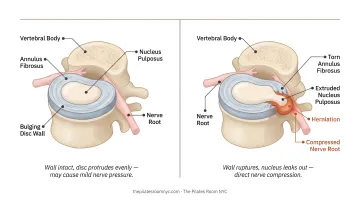
This is different from a herniated disc, where the inner nucleus actually pushes through a tear in the outer ring. Both conditions can cause similar symptoms, but they differ in severity and how aggressively they're managed.
Common Symptoms
When a disc bulge presses against nearby nerves, the effects extend well beyond local back pain:
- Localized lower back stiffness and achiness
- Radiating pain, tingling, or numbness down one or both legs
- Weakness in the legs or feet
- Symptoms that worsen with prolonged sitting, bending forward, or certain movements
Lumbar discs, particularly L4-L5 and L5-S1, are by far the most commonly affected — approximately 95% of lumbar disc herniations occur at these two levels, according to StatPearls.
How Common Are Bulging Discs?
A 2015 systematic review in AJNR found disc bulges in asymptomatic adults rose from 30% of 20-year-olds to 84% of 80-year-olds. That means a bulge showing up on your MRI doesn't automatically explain your pain. Clinical evaluation matters as much as imaging.
For most people, conservative management — including targeted exercise — leads to meaningful improvement without surgery.
Why Pilates Works for a Bulging Disc
Deep Core Activation
The muscles most critical for spinal stability — the transversus abdominis, multifidus, and pelvic floor — don't get recruited much through conventional exercise. When these deep stabilizers are weak or inhibited, the disc itself absorbs more mechanical load than it should.
Pilates is specifically designed to activate these muscles. Controlled deep-core engagement improves segmental spinal support, taking pressure off vulnerable disc levels. A 2019 review on transversus abdominis retraining supports this mechanism, and a 2011 biomechanical study confirmed that abdominal muscle activation increases lumbar spinal stability. One caveat: muscle activation also introduces some compressive force, which is why proper technique and progressive dosing matter.
Posture and Load Distribution
Poor posture creates uneven pressure across spinal discs. Nachemson's classic disc pressure research showed that forward flexion combined with rotation increases intradiscal load by as much as 400% compared to standing. For desk workers spending hours in a slumped position, this compounds over time.
Pilates trains the body to maintain a neutral spine during movement — distributing load more evenly and reducing the strain concentrated on already-vulnerable disc levels.
Mobility Without Aggravation
That reduced strain only helps if you keep moving. Fear-avoidance — the pattern of restricting movement to avoid pain — is a real problem with disc conditions. People move less to avoid pain, surrounding muscles stiffen, and the situation worsens. Pilates uses gentle, controlled movements to maintain hip and thoracic spine mobility — taking compensatory pressure off the lumbar discs — without pushing into the ranges that provoke symptoms.
What the Research Shows
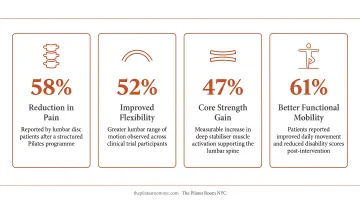
A 2023 randomized controlled trial studied 54 patients with symptomatic lumbar disc herniation involving bulging and protrusion at L3-L4, L4-L5, and L5-S1. Participants completed clinical Pilates three times per week for six weeks. Compared to controls, the Pilates group showed meaningful improvements across four measures:
- Pain levels
- Oswestry Disability Index scores
- Flexibility
- Trunk endurance
This is currently one of the strongest direct Pilates studies for disc-specific conditions.
Pilates Exercises for a Bulging Disc
Important note: These exercises are general starting points, not a prescription. Get clearance from your doctor or physical therapist before beginning, and work with a qualified instructor for proper form guidance.
Here's a quick overview of all five exercises before the full descriptions:
| Exercise | Starting Position | Primary Benefit |
|---|---|---|
| Pelvic Tilts | Supine, knees bent | Core activation, lumbar mobility |
| Glute Bridges | Supine, knees bent | Glute/hamstring strength, spinal support |
| Dead Bugs | Supine, arms up, knees at 90° | Anti-rotation stability, no compression |
| Cat-Cow Stretch | Hands and knees | Spinal mobility, disc circulation |
| Knee-to-Chest Stretch | Supine | Lumbar traction, lower back release |
Pelvic Tilts
Lie on your back with knees bent and feet flat. Slowly tilt the pelvis to gently flatten the lower back into the mat, hold briefly, then release to neutral.
This small, controlled movement activates the deep core, mobilizes the lumbar spine through a safe range, and relieves morning stiffness without loading the disc.
Glute Bridges
From the same supine position, slowly lift the hips until you form a straight line from shoulders to knees. Lower with control.
This strengthens the glutes and hamstrings, which directly support the lumbar spine. For bulging disc clients, keeping the back flat (non-articulated — no sequential vertebral peel) is the safest starting point. It avoids the compressive loading that comes with spinal flexion.
Dead Bugs
Lie on your back with arms reaching toward the ceiling and knees bent at 90 degrees. Slowly lower one arm and the opposite leg toward the floor while pressing the lower back firmly into the mat. Return and alternate sides.
Dead Bugs build anti-rotation core stability and train deep stabilizers without any spinal flexion or axial compression — which is exactly what disc conditions require at the start.
Cat-Cow Stretch
Start on hands and knees. Alternate between arching the spine gently downward (cow) and rounding it upward (cat), moving slowly with breath.
The goal here isn't range — it's circulation and gentle mobilization across the full spine. Small, controlled movement is more therapeutic than pushing either direction. Exaggerating the arc can irritate an already-sensitive disc.
Knee-to-Chest Stretch
Lying on your back, gently draw one or both knees toward the chest and hold for several breaths.
This creates mild traction in the lumbar spine and releases tension in the lower back and hip flexors. It's gentle enough to try even during a flare-up, as long as you move slowly.
Movements and Exercises to Avoid
Loaded Spinal Flexion
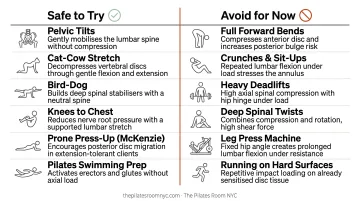
Deep forward bends, toe touches, traditional sit-ups, and crunches are among the highest-risk movements for lumbar disc conditions. Research has shown sit-up intradiscal pressure is approximately 2.1 times higher than standing, and forward flexion under load increases disc pressure by over 100%. These movements push directly against the disc bulge and can compress nearby nerves.
Avoid:
- Sit-ups and crunches
- Deep forward bends and toe touches
- Loaded trunk flexion of any kind during the acute or early recovery phase
Spinal Twisting and Rotation
Uncontrolled or loaded lumbar rotation adds shear forces to discs already under stress. Combined flexion and rotation is particularly problematic — research shows up to a 400% increase in disc load in that position. Avoid:
- Heavy trunk rotations
- Loaded yoga twists
- Conventional ab machine exercises with rotation
Gentle thoracic (upper back) rotation is a different story and can actually be beneficial. The problem is specifically uncontrolled lumbar twisting.
High-Impact and Compressive Activities
During the recovery phase, activities that add jarring compressive forces to the spine should be avoided or significantly modified:
- Running and jumping
- Heavy overhead lifting
- Leg press machines
- Contact sports
Low-impact alternatives like walking, swimming, and appropriately modified Pilates let you maintain fitness without the added spinal loading.
How to Get Started Safely
Step 1: Get Medical Clearance
Before beginning any exercise program with a bulging disc, see a doctor, physical therapist, or spine specialist. This confirms your diagnosis, rules out red-flag symptoms (bowel or bladder changes, progressive leg weakness, saddle numbness), and gives you specific movement guidelines based on your disc level and symptom pattern.
Step 2: Follow the Progression Principle
A well-designed program for a bulging disc follows a clear sequence:
- Neutral spine stability first — pelvic floor, transversus abdominis, neutral-position core work
- Gentle, supported mobility — cat-cow, knee-to-chest, hip mobility
- Introduce flexion carefully — only once stability and symptom control are established
- Add rotation last — and only with controlled thoracic emphasis, not lumbar
Rushing this sequence is one of the most common mistakes. Stability before mobility is not optional.
Step 3: Choose the Right Instruction Environment
Group reformer classes — even well-intentioned ones — are not designed for disc conditions. A standard class sequence will include movements that are contraindicated for most people managing a bulging disc, and there's no mechanism for real-time modification based on your symptoms.
Private, one-on-one instruction makes a meaningful difference. At The Pilates Room NYC, instructors like Enja Schenck (MS in Sport Science, CSCS) and studio owner Alison Johnson (Classical Pilates certified since 1998, with a BFA in dance and foundational training in anatomy and kinesiology) bring the kind of clinical grounding that spinal conditions require.
The studio's distraction-free, no-music environment supports precise body awareness — clients hear detailed cueing clearly, and instructors catch immediate responses to every movement. The studio's Pilates for Injury Recovery & Rehabilitation service addresses herniated and bulging disc conditions directly, with programming adapted to each client's recovery stage by senior instructors with 15–35 years of experience.
Step 4: Know the Difference Between Good Fatigue and a Warning Sign
Not all discomfort during exercise is equal. Understanding the difference protects you:
| What You May Feel | What to Do |
|---|---|
| Mild muscle fatigue, gentle warmth in working muscles | Continue — this is normal effort |
| Sharp or shooting pain, increased numbness or tingling, pain radiating further down the leg | Stop immediately |
The general rule: no movement should increase your symptoms during or after the session. If it does, stop and consult your instructor or doctor.
Frequently Asked Questions
Is Pilates good for a bulging disc?
Yes, when done correctly and under qualified guidance. Pilates strengthens the deep core stabilizers, improves posture, and restores controlled movement without the compressive loading of higher-impact activities. Medical clearance and experienced instruction are non-negotiable starting points.
Is yoga good for a bulging disc in the lower back?
Yoga offers some benefits — gentle stretching, breathwork, body awareness — but certain poses carry real risk. Deep forward folds, unsupported backbends, and strong lumbar twists can aggravate disc conditions. Pilates is generally more spinal-safe, with its consistent emphasis on neutral spine and deep core activation.
Is a bulging disc the same as a herniated disc?
No. A bulging disc involves the outer wall of the disc expanding outward while remaining intact. A herniated (prolapsed) disc involves the inner gel-like material pushing through a tear in the outer ring. Both can cause similar symptoms, but a herniation is generally considered more severe.
What exercises should I avoid with a bulging disc?
Avoid deep forward bends, sit-ups and crunches, heavy spinal loading, high-impact activities, and uncontrolled lumbar rotation. The specific list may vary based on which disc level is affected and how significant the bulge is — your clinician can help refine this for your situation.
How soon can I start Pilates after being diagnosed with a bulging disc?
This depends on symptom severity and your doctor's guidance. During acute pain, rest and medical management come first. Once cleared, gentle neutral-spine exercises can often begin relatively early under supervision — the NHS notes that gradual movement, as soon as tolerated without worsening pain, supports faster recovery.
Can a bulging disc heal on its own?
Discs don't regenerate, but symptoms often improve significantly over weeks to months. A 2025 guideline review found that more than 85% of acute lumbar disc herniation with radiculopathy resolves over time with conservative care. For most people, surgery is not necessary — consistent movement, core strengthening, and lifestyle changes drive that recovery.