According to a JAMA analysis of U.S. women, roughly one in four American women has at least one symptomatic pelvic floor disorder — a figure that climbs to nearly 50% in women over 80. Yet the pelvic floor remains one of the least understood muscle groups in the body.
Classical Pilates is one of the most effective tools for addressing this. Not through isolated squeezing, but through whole-body movement, breath coordination, and postural alignment — training the pelvic floor the way it actually functions.
This guide covers what the pelvic floor is, how classical Pilates supports it, six foundational exercises to start with, what to approach carefully, and who benefits most.
Key Takeaways
- Pilates trains the pelvic floor through coordinated movement, breath, and alignment — not just squeezing
- A healthy pelvic floor needs both strength and the ability to relax; Pilates works both
- Some high-intensity core exercises can overload a weak or tight pelvic floor — modifications matter
- Pre/post-natal women, seniors, and those recovering from pelvic surgery benefit most
- Instructor guidance makes a measurable difference in outcomes versus unsupervised practice
What Is the Pelvic Floor and Why Does It Matter?
The Anatomy
The pelvic floor is a group of muscles and connective tissue forming a hammock-like base at the bottom of the pelvis. It supports the bladder, bowel, and uterus — but it doesn't work alone.
Research identifies the diaphragm, transverse abdominis, multifidus, and pelvic floor muscles as an integrated "anatomical girdle" that coordinates spinal stability and manages pressure through the trunk.
It does more than control bladder function:
- Continence — controlling the release of urine, gas, and stool
- Spinal and pelvic stability — absorbing impact during walking, running, and lifting
- Sexual function — supporting sensation and comfortable intercourse
- Pressure management — responding to increases in intra-abdominal pressure (pressure inside the core during exertion)
Two Types of Dysfunction — and Why "Squeeze Harder" Misses the Point
Pelvic floor dysfunction falls into two main categories:
- Weakness (underactivity): Muscles lose their ability to support the pelvic organs and resist pressure, leading to stress urinary incontinence — leakage during sneezing, coughing, or exercise — and increased prolapse risk.
- Overactivity (hypertonic): Muscles stay in chronic contraction or spasm and cannot properly relax. According to the Cleveland Clinic, this causes pelvic pain, difficulty with urination or bowel movements, and painful intercourse.
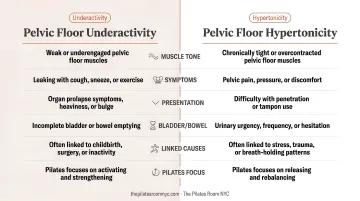
The goal of pelvic floor training isn't to contract harder. It's to restore balanced, coordinated function — the ability to engage when needed and fully release when not.
How Classical Pilates Uniquely Supports Pelvic Floor Health
Coordination Over Isolation
A Kegel contracts the pelvic floor in isolation. Classical Pilates does something more useful: it trains the pelvic floor to engage and release as part of coordinated full-body movement. Every exercise in the classical repertoire initiates from the center — the deep core — and expands outward. That means the pelvic floor is working reflexively within functional movement patterns, not just during a deliberate squeeze you do lying in bed.
The Breath Connection
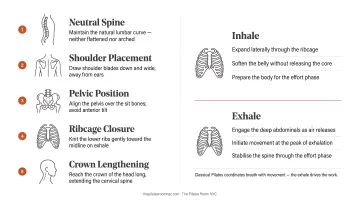
This is where Pilates has a genuine physiological advantage. A 2022 peer-reviewed review confirms that pelvic floor muscles function as expiratory muscles — they contract with the diaphragm during exhalation and relax during inhalation. Dynamic MRI shows the pelvic floor and thoracic diaphragm moving upward in parallel during correct expiratory effort.
Classical Pilates is built around this. The exhale cues the lift; the inhale allows the release. Practiced consistently, this trains automatic pelvic floor coordination during movement — something isolated Kegels cannot replicate.
Breath-holding under load has the opposite effect. When you hold your breath during exertion, intra-abdominal pressure spikes without corresponding pelvic floor support, placing significant downward stress on weakened tissue.
Postural Alignment Affects Everything
A neutral pelvis distributes load evenly across the pelvic floor. Chronic anterior tilt (lower back arch) or posterior tilt (tucked pelvis) changes how pelvic floor muscles are loaded and can contribute to dysfunction over time. Postural alignment is a central focus of classical Pilates — and research confirms that pelvic floor muscle activity varies significantly with body position and pelvic posture.
Strength and Release Both Matter
For clients with an overactive pelvic floor, the issue isn't that they need to squeeze more — it's that they can't let go. Classical Pilates, with its emphasis on returning to neutral after each engagement, trains the release as much as the contraction. Mindless gripping through an entire workout can worsen symptoms for hypertonic clients.
Why Instructor Guidance Changes Outcomes
NICE states that supervised pelvic floor muscle training with trained professionals can significantly improve symptoms and represents first-line care for stress or mixed urinary incontinence. A 2023 systematic review found supervised training better supports pelvic floor muscle function and strength than unsupervised practice alone.
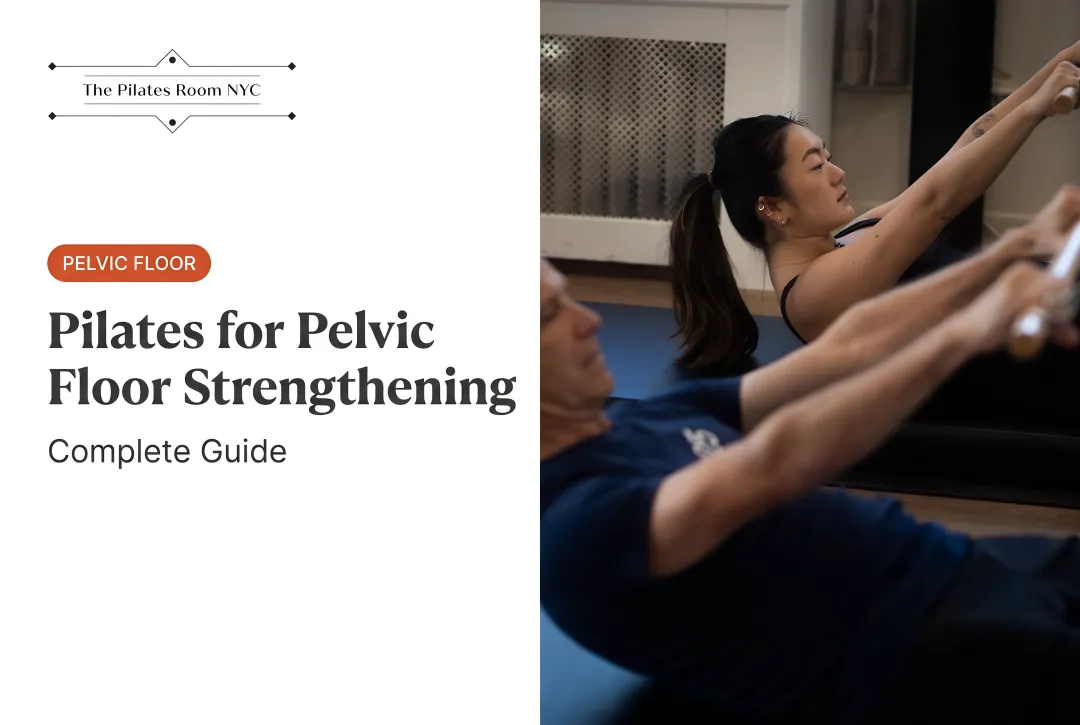
At The Pilates Room NYC, instructors cue breath coordination, monitor alignment in real time, and modify exercises based on what your body needs that session. A client with pelvic floor hypertonicity, for instance, needs different cues than someone rebuilding strength after childbirth — and a trained eye catches the difference.
6 Pilates Exercises to Strengthen Your Pelvic Floor
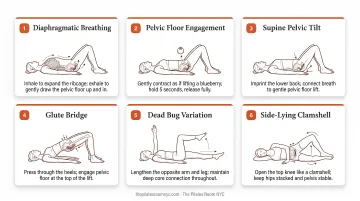
These six exercises are foundational, pelvic-floor-safe movements appropriate for most beginners and intermediate practitioners. If you have active pelvic floor symptoms, consult an instructor before starting.
1. Pelvic Tilt and Imprint
Lie supine with knees bent, feet flat on the floor. Begin in neutral pelvis — a small natural curve in the lower back. On an exhale, gently flatten the lower back into the mat (imprint), engaging the deep abdominals. Inhale to release back to neutral.
This is where the breath-core-pelvic floor connection starts. Get this right before moving on to anything more demanding.
2. Shoulder Bridge
From the same starting position, press through your feet to lift the hips, engaging the glutes at the top while drawing the pelvic floor upward on the exhale. Lower with control on the inhale. The glutes and hamstrings work alongside the pelvic floor here, and that's the point: pelvic support is a team effort, not an isolated squeeze.
3. Single Leg March
Lying supine, knees bent. On an exhale, brace the deep core and lift one foot a few inches off the floor, keeping the pelvis completely still. Lower on the inhale and alternate sides. This challenges the pelvic floor and deep core to maintain stability against a moving limb — a pattern used constantly in walking, climbing stairs, and any single-leg activity.
4. Clam
Side-lying with knees bent to approximately 90 degrees, heels stacked. On an exhale, rotate the top knee open without allowing the pelvis to rock backward. Lower on the inhale.
Key focus: keep the pelvis anchored. The clam targets the hip external rotators and glutes, muscles that share attachments at the pelvis and directly influence how the pelvic floor functions.
5. Bird Dog
Start in a quadruped position with a neutral spine. On an exhale, engage the pelvic floor and extend the opposite arm and leg. Hold briefly at the top, then return on the inhale and allow full release. Bird dog trains anti-rotation and spinal stability, requiring the pelvic floor to respond during integrated, full-body movement.
6. Deep Squat
Feet slightly wider than hip width, toes turned out. Lower into a deep squat while maintaining a lifted chest and neutral spine. At the bottom, breathe in and let the pelvic floor lengthen and release. Exhale and engage as you rise.
This is one of the few exercises that takes the pelvic floor through its full range — lengthening at depth, lifting on the way up. That complete range builds functional strength, not just the ability to contract.
Pilates Exercises to Approach with Caution
Not every classical Pilates exercise is appropriate for every pelvic floor. Two mechanisms explain why:
Intra-abdominal pressure overload — Intense upper abdominal work generates significant downward pressure. A 2014 study measured median maximal intra-abdominal pressure at 18.5 cmH₂O during curl-ups versus 60.4 cmH₂O during feet-held sit-ups. A weak or prolapsed pelvic floor may not be able to resist that load.
Chronic gripping in overactive floors — Sustained core contraction without conscious release can increase pelvic floor tension over time.
Exercises that require caution for symptomatic individuals:
- The Hundred with legs fully extended
- Roll Ups
- Scissors
- Double Leg Stretch
- Sustained Chest Lifts or Sit-Ups
- Plank
- Push-Up
These are not categorically unsafe. A healthy, well-trained pelvic floor can handle them. But women with prolapse, postpartum weakness, post-surgical pelvic conditions, or perimenopausal tissue changes should not approach these unmodified without instructor guidance.
Modification Principles
Keep legs in tabletop rather than extended to reduce lever length and intra-abdominal pressure. Avoid breath-holding at any point. Actively cue the release of the pelvic floor and core between repetitions. An experienced instructor can assess which modifications suit your specific condition, accounting for factors like prolapse staging, postpartum recovery timeline, or tissue sensitivity that a general program cannot address.
Who Benefits Most from Pelvic Floor-Focused Pilates
Pre- and Postnatal Women
Pregnancy and delivery — whether vaginal or cesarean — place extraordinary demands on the pelvic floor through hormonal changes, the physical load of a growing baby, and the mechanics of birth itself. A systematic review found that 33% of women experience urinary incontinence in the first three months postpartum, with some experiencing it daily.
Prenatal Pilates builds the strength and body awareness needed for labor. Postnatal Pilates helps restore pelvic floor function and core integrity — including for women recovering from C-sections, where the abdominal wall has been surgically divided.
At The Pilates Room NYC, Alison Johnson has guided clients through every stage of pregnancy and postpartum recovery for over 26 years — drawing on her own experience with two cesarean sections as much as her classical training.
Seniors and Perimenopausal Women
Estrogen receptors are expressed throughout pelvic floor musculature, the urethral sphincter, and surrounding ligaments. As estrogen declines with menopause, connective tissue elasticity decreases — directly affecting pelvic support. A 2024 review reported postmenopausal urinary incontinence prevalence as high as 63.1% across included studies. PFD prevalence reaches nearly 50% in women over 80.
Classical Pilates, with its gradual load progression and consistent emphasis on postural alignment, provides conditioning that is both safe and genuinely effective for this group — particularly when modifications account for reduced connective tissue resilience.
People Managing Pelvic Floor Dysfunction or Recovering from Surgery
Beyond age-related changes, pelvic floor dysfunction shows up across a much broader population. Classical Pilates adapts well to conditions including:
- Pelvic pain (including vaginismus, endometriosis-related pain, and pudendal neuralgia)
- Post-surgical recovery from prolapse repair, hysterectomy, or prostatectomy
- Connective tissue disorders such as hypermobility spectrum disorders
- Chronic conditions affecting neuromuscular control
The key is working with an instructor trained to recognize when to modify, when to hold back, and when to refer out. Pelvic floor dysfunction is not something you work through by pushing harder — a qualified instructor knows the difference.
Building Your Pelvic Floor Pilates Practice
Getting Started
- Frequency: 2–3 sessions per week, 30–45 minutes each
- Start foundational: Pelvic tilts, bridges, clams, and bird dog before progressing to more demanding work
- Prioritize quality: 10 well-executed shoulder bridges with breath coordination and pelvic floor awareness outperform 30 mechanical repetitions
Consistency matters more than intensity. The pelvic floor responds to repetition of correct patterns — not volume for its own sake.
When to Work with an Instructor
General Pilates benefits the pelvic floor. If you have active symptoms — leakage, pelvic pressure, postpartum recovery, or pelvic pain — working with an experienced instructor produces meaningfully better outcomes. A skilled instructor can assess alignment, cue breath coordination, and adjust exercises in real time in ways no written guide can replicate.
At The Pilates Room NYC in Chelsea, Manhattan, every session is private and structured around what each client actually needs that day. Instructors bring 15 to 35 years of classical training and regularly work with postpartum clients, those managing pelvic pressure, and people navigating injury recovery. Sessions are focused and distraction-free — no shared class format, no divided attention.
Frequently Asked Questions
Is Pilates good for your pelvic floor muscles?
Yes. Pilates strengthens the pelvic floor through breath-coordinated, whole-body movement that trains the muscles to engage and release in functional patterns. This is more effective for real-world function than isolated squeezing, because the pelvic floor learns to respond automatically during movement.
Can Pilates help with bladder leakage or incontinence?
Pilates can support improvement in stress urinary incontinence by strengthening the pelvic floor and deep core. For significant or persistent symptoms, working with both a pelvic floor physical therapist and a qualified Pilates instructor typically produces the best outcomes.
Can Pilates make pelvic floor problems worse?
Certain high-intensity exercises (extended leg Hundreds, Roll Ups, Plank) can place excessive downward pressure on a weak pelvic floor or increase tension in an overactive one. With appropriate modifications and instructor guidance, Pilates can be safe and beneficial even with existing dysfunction.
How often should I do Pilates for pelvic floor strength?
Two to three sessions per week of mindful, well-cued practice is a solid starting point. Consistency and quality of engagement matter more than frequency — one focused session beats three rushed ones.
Is Pilates good for Ehlers-Danlos syndrome?
Classical Pilates — with its emphasis on controlled movement, joint stability, and postural alignment — can be beneficial for hypermobility-type EDS. Sessions must be modified by an experienced instructor to avoid end-range stretching and joint strain, as the goal is stability, not flexibility.
Is Pilates good for high cortisol?
Pilates may support stress regulation over time through its combination of mindful movement and breath focus. A 2022 meta-analysis found physical activity lowers cortisol on average, and research supports Pilates specifically for psychological stress symptoms. It works best alongside, not instead of, broader stress management strategies.