Introduction
Joseph Pilates didn't design his method for dancers or fitness enthusiasts. He developed it to rehabilitate people — specifically, injured soldiers during World War I, using springs attached to hospital beds to help bedridden patients move safely. That origin is why the Reformer remains one of the most effective tools for recovery work today.
Many people associate Pilates with lean bodies and ballet aesthetics. The clinical reality is different. The Reformer's adjustable spring resistance, sliding carriage, and horizontal working positions make it uniquely suited to people who can't yet handle the demands of upright, weight-bearing exercise. That includes most people in early recovery from injury or surgery.
This article covers what Pilates Reformer rehabilitation actually involves, which conditions it benefits most, what the evidence says, and how to do it safely.
Key Takeaways
- The Reformer's spring resistance can be dialed down, making movement accessible from the earliest stages of recovery.
- It targets deep stabilizing muscles commonly weakened by injury, surgery, or chronic pain.
- Clinical evidence supports its use for lower back pain, joint recovery, osteoporosis management, and prenatal/postnatal care.
- Effective rehab requires a qualified instructor who can identify contraindications and modify exercises for the individual's condition.
- The mind-body focus of Pilates actively supports psychological recovery, not just physical restoration.
What Is Pilates Reformer Rehabilitation?
Reformer rehabilitation uses the spring-resistance, sliding-carriage apparatus to help people recover safely from injury, surgery, or chronic physical conditions.
Unlike a general Pilates class, rehabilitation-focused Reformer work is individualized at every level. Exercises are selected, modified, and progressed based on the client's specific diagnosis, pain level, range of motion, and recovery stage.
The Reformer isn't a replacement for physical therapy or medical care. It works best as what comes next — or alongside clinical treatment: a structured method for rebuilding strength, stability, and movement quality once the acute phase has passed, sometimes during it with appropriate medical oversight.
How It Differs from General Pilates
In a standard Pilates class, even a classical one, the instructor works through a repertoire appropriate for that group. In rehabilitation sessions:
- Exercise selection follows the client's diagnosis and current limitations
- Resistance starts lower than a healthy client would use
- Progress tracks precision and range, not load or volume
- The instructor watches for compensatory movement patterns each session
- Medical clearance from a physician or physiotherapist defines the program's boundaries
At The Pilates Room NYC, this structure is built into how the studio operates. Owner Alison Johnson brings 26 years of teaching experience across injury recovery, autoimmune conditions, pre/postnatal care, and seniors. Her intake process captures injury history, current symptoms, and movement limitations before any session begins — so the program is built around the individual from the start.
Key Benefits of the Reformer for Rehabilitation
Reduced Joint Load
Most Reformer exercises are performed lying down or seated, which removes the vertical compression that upright, weight-bearing movement creates. For someone recovering from a knee replacement, a lumbar injury, or a hip labral tear, this matters enormously. The body can move, strengthen, and build range of motion without fighting gravity through healing tissue.
Precise, Incremental Resistance
Free weights jump in fixed increments. The Reformer's spring system doesn't. Resistance can be reduced to near-zero for acute recovery, then increased gradually as the client builds capacity — in small enough steps that the transition feels almost imperceptible. No gym machine offers this level of fine-tuned adaptability.
Correcting Muscle Imbalances
Injury creates compensation. When one side of the body is hurting, the other side overworks to protect it. Left unaddressed, this becomes its own problem — those overcompensating muscles and joints eventually break down. Reformer exercises train all muscles of a given region with equal demand, which interrupts compensatory patterns before they become secondary injuries.
Deep Core Activation
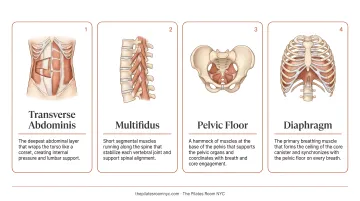
Every Reformer exercise, regardless of which body region it targets, requires engagement of the deep stabilizing muscles. That includes:
- Transversus abdominis
- Multifidus
- Pelvic floor
- Diaphragm
These are exactly the muscles that injury, surgery, and prolonged inactivity tend to switch off. Rebuilding this foundation is essential for joint protection and spinal stability throughout recovery.
Psychological Recovery
Being injured or in chronic pain is exhausting in ways that go beyond the physical. The concentration, breath control, and body awareness that Pilates demands give clients an active role in their own recovery — which matters more than it might seem.
A 2025 randomized controlled trial found that Reformer Pilates significantly improved pain, sleep quality, kinesiophobia (fear of movement), and active coping in women with chronic musculoskeletal pain. That restored confidence in movement is what enables people to return to daily life — not just tolerate it.
Conditions the Reformer Can Help
The Reformer's adaptability makes it effective across a wide diagnostic range. Exercise selection and resistance are always matched to the specific condition and recovery stage — there is no universal rehabilitation protocol.
Back Pain and Sciatica
Lower back pain is one of the most common reasons people seek Reformer rehabilitation. According to the WHO, 619 million people globally had low back pain in 2020. Exercises like Pelvic Curls, Footwork, and Bridging specifically target the core and spinal stabilizers that chronic back pain progressively weakens.
For sciatica, the Reformer's supine working positions reduce the spinal compression that tends to aggravate nerve symptoms. Sciatica should always be assessed by a clinician before beginning Reformer work — exercises that help one presentation can worsen another.
On the evidence side, a 2017 study comparing equipment-based and mat Pilates for chronic nonspecific low back pain found that both improved pain, function, and transversus abdominis activation — with equipment-based Pilates showing faster improvement across several measures.
Joint Injuries and Post-Surgical Recovery
The Reformer supports recovery from knee and hip injuries, ligament damage, and joint replacement surgery. Spring-assisted leg work allows clients to strengthen the surrounding musculature — quadriceps, hamstrings, glutes, adductors — without bearing full body weight through a healing joint.
A few important parameters:
- Medical clearance and a specific timeline from the surgeon or physiotherapist are required before starting
- Post-surgical inflammation and tissue healing determine what's appropriate, not just pain levels
Xavier Cha and Alison Johnson at The Pilates Room NYC both have specific experience guiding clients through post-operative joint rehabilitation.
Osteoporosis and Bone Health
Spring resistance provides bone-stimulating load without the fracture risk that high-impact exercise carries. For clients with osteoporosis or low bone density, this is a meaningful distinction — they need resistance work, but the wrong kind can cause harm.
A 2021 meta-analysis found that Pilates and yoga did not produce statistically significant improvements in bone mineral density compared to controls. The value of Reformer work for this population lies elsewhere — in building balance, proprioception, postural strength, and body awareness that reduce fall risk, which is the primary safety concern for people with low bone density. An instructor experienced with osteoporosis protocols is essential; the classical repertoire requires specific modifications for this group.
Prenatal and Postnatal Recovery
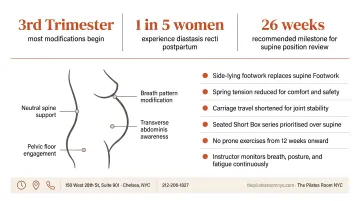
Modified Reformer exercises strengthen the pelvic floor, support the postural changes of pregnancy, and reduce lower back and pelvic pain. Clinical Pilates has been shown to improve functional disability, pain, quality of life, and lumbopelvic stabilization in pregnant women with low back pain.
Postnatally, the focus shifts to rebuilding core integrity and hip stability. Diastasis recti abdominis — the separation of the abdominal midline — affects roughly 60% of women at six weeks postpartum, declining to 32.6% by 12 months. Targeted pelvic floor and core work supports both vaginal and cesarean recovery.
Alison Johnson has personal experience with two cesarean deliveries and has worked with many women preparing for, going through, and recovering from childbirth — which directly shapes how these sessions are structured.
Medical clearance is required before beginning, and sessions must be led by an instructor with specific prenatal/postnatal training.
Best Practices for Safe and Effective Reformer Rehab
Start with Medical Clearance and a Proper Intake
Before any Reformer rehabilitation program begins, clients need explicit clearance from their doctor, surgeon, or physiotherapist. A qualified instructor then conducts an intake assessment covering injury history, current symptoms, movement limitations, and recovery stage. That intake is what makes truly individualized programming possible.
At The Pilates Room NYC, new clients complete a form that captures their experience level, injury history, and what brought them in. From there, the first session includes movement assessment, and the instructor establishes a baseline before building the program forward.
Prioritize Quality Over Quantity
In rehabilitation, how well a movement is executed matters far more than how much resistance is used or how many repetitions are completed. Poor technique during recovery doesn't just fail to help — it reinforces the compensatory patterns that the rehab work is trying to correct.
Key principles for quality:
- Proper spinal alignment before any movement begins
- Breath initiation coordinated with movement
- Deep core engagement from the first repetition
- Full control through the entire range of motion, not just the effort phase
Progress Gradually and Systematically
Resistance, range of motion, and exercise complexity should increase only when the client demonstrates readiness — not on a fixed calendar. The progression arc typically moves through three stages:
- Early stage: Gentle activation, breath work, mobility, and minimal resistance
- Mid-stage: Strengthening target muscle groups, widening range of motion, and introducing more complex movement patterns
- Late stage: Functional strength, movement retraining, and return to activity-specific demands
Work with a Qualified Instructor
Not every Pilates instructor is equipped to work with medical conditions and injuries. Rehabilitation clients need someone who understands anatomy in a clinical context, can recognize contraindications, and knows how to modify the classical repertoire for specific conditions — not just offer "low-impact" variations.
At The Pilates Room NYC, instructors like Enja Schenck — who holds an MS in Sport Science, CSCS certification, and integrates Postural Restoration Institute principles into her teaching — and Alison Johnson, whose 26 years of experience spans injury recovery, autoimmune conditions, and pre/postnatal work, represent the depth of background rehabilitation clients should seek. Clinical knowledge matters as much as the Pilates credentials themselves.
What Happens When Rehabilitation Lacks Proper Guidance
Doing Reformer exercises without appropriate oversight isn't a neutral choice — it carries real risks.
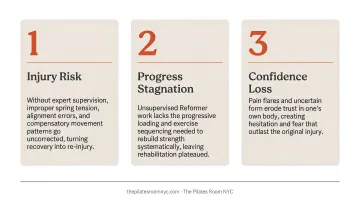
Three patterns tend to emerge when rehab Reformer work is unsupervised:
- Injury aggravation — Incorrect form or inappropriate resistance can strain compensating structures or create new problems. This risk is highest in early-stage recovery, when tissue is still healing and the body hasn't relearned normal movement patterns.
- Stagnation — Without structured progression and regular reassessment, clients plateau. The body responds quickly to early stimulus, but without advancing the program, progress stalls — sometimes for months.
- Loss of confidence — Pushing past readiness, even with good intentions, can trigger pain flares. A bad session doesn't just hurt physically; it erodes trust in the body and can lead to avoidance of movement altogether, one of the harder patterns to reverse in chronic pain recovery.
Frequently Asked Questions
Is Reformer Pilates good for rehabilitation?
Yes. The Reformer is used in physiotherapy clinics and rehabilitation-adjacent settings because its adjustable spring resistance allows safe, controlled movement at every recovery stage — from acute post-injury through long-term strength rebuilding. A clinical review in Physical Therapy confirmed that Pilates apparatus work supports rehabilitation outcomes across a range of conditions.
Can Pilates help a torn meniscus?
With appropriate medical clearance, Reformer Pilates can support meniscus recovery by strengthening the muscles surrounding the knee — quadriceps, hamstrings, and inner thighs — without placing direct compressive load on the joint. Work with your physiotherapist to establish the right timeline before starting.
Can Pilates help a weak bladder?
Pelvic floor activation is central to every Reformer exercise, which means sessions can help strengthen the muscles that support bladder control. Let your instructor know about any pelvic floor concerns upfront so exercises can be targeted appropriately.
How soon after surgery can I start Reformer Pilates?
Timing depends entirely on the procedure. For major joint surgeries, most physiotherapists recommend waiting several weeks to months before beginning Reformer work. Medical clearance is required — no qualified instructor should begin a post-surgical program without it.
Is Reformer Pilates safe for osteoporosis?
Generally, yes. The Reformer provides resistance training without high-impact fracture risk and builds the balance needed to reduce falls — both priorities for this population. An instructor with osteoporosis-specific experience and knowledge of required modifications is essential.
Do I need a doctor's clearance before starting Reformer Pilates for rehab?
Always. Medical clearance is required before beginning any rehabilitation-focused Reformer program, particularly after surgery or injury. A qualified instructor will ask for this before your first session. If they don't, that's a red flag worth taking seriously.