Pilates gets written off as a flexibility class or a beginner practice. That reputation is wrong. NFL teams have had reformers in their facilities for years, and elite athletes across multiple sports have made structured Pilates work a consistent part of how they train — not because it's trendy, but because it addresses the things their sport-specific training doesn't.
This article covers what Pilates actually does for athletic performance, why skipping it creates compounding problems, and how to integrate it practically into an existing training program.
Key Takeaways
- Builds deep core stability that powers more efficient, explosive sport-specific movement
- Corrects muscle imbalances from repetitive training patterns, cutting overuse injury risk
- Improves proprioception and body control under competition conditions
- Skipping corrective cross-training lets imbalances accumulate — and shortens careers
- Fits into any training schedule as a consistent complement, not a swap-out
What Is Pilates for Athletes?
Pilates for athletes is not a standard group fitness class. It's a precision-based movement practice targeting the deep stabilizing muscles, movement efficiency, and postural alignment that sport-specific training routinely misses.
Athletes typically integrate it in three ways:
- In-season cross-training — shorter sessions focused on movement quality, recovery, and maintaining structural balance during heavy competition loads
- Off-season corrective work — longer, more intensive sessions to address accumulated imbalances and build new movement foundations before the next training cycle
- Post-injury rehabilitation — modified programming that rebuilds strength and alignment while protecting healing tissue
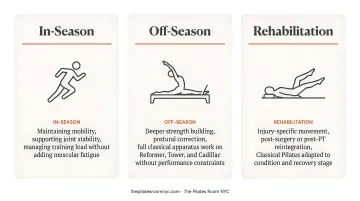
Used consistently, Pilates helps athletes generate more power, absorb impact more safely, and sustain performance under competition demands — without adding another taxing training layer.
At The Pilates Room NYC, each session is tailored to the athlete's specific physical state, sport demands, and goals. The studio's instructors bring unusually deep credentials for this work — Enja Schenck, for instance, holds an MS in Sport Science, a CSCS from the NSCA, and a powerlifting coaching certification alongside her classical Pilates training, giving her the dual lens that effective athlete programming requires.
Key Performance Benefits of Pilates for Athletes
Strong on the surface doesn't mean structurally sound. Detailed assessment of even well-conditioned athletes often reveals core disconnection, compensatory movement patterns, and structural imbalances that steadily undermine both performance and durability. Pilates addresses all three.
Core Strength and Explosive Power
Most gym-based training targets the superficial "six-pack" muscles. Pilates trains the deep core — the transverse abdominis, multifidus, pelvic floor, and diaphragm — as an integrated system. According to Kibler, Press, and Sciascia in Sports Medicine, core stability means controlling trunk position over the pelvis to allow optimal production, transfer, and control of force to the limbs. When that system is working, force travels more efficiently through the body — producing a stronger throw, a faster sprint, a more powerful swing, a more controlled landing.
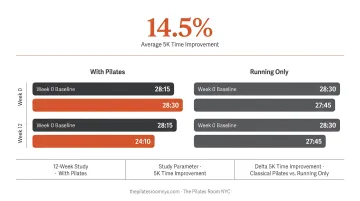
The research supports this. A 2018 randomized trial by Finatto et al. assigned 32 male runners to either running alone or running plus two one-hour mat Pilates sessions per week for 12 weeks. The Pilates group improved their 5K time from 25.65 to 23.23 minutes, while the control group went from 25.33 to 24.61 minutes. Metabolic cost at 12 km/h also dropped significantly in the Pilates group — meaning they ran faster using less energy, with reduced postural muscle EMG activity in the obliques, longissimus, and gluteus medius.
This benefit has the highest impact in:
- Rotational power sports (baseball, tennis, golf)
- Sprint-based team sports (soccer, basketball, football)
- Any activity demanding dynamic balance under load (gymnastics, martial arts, swimming)
Injury Prevention Through Balanced Training
Most athletes develop dominant muscle groups through repetitive, one-sided patterns — a pitcher's throwing arm, a soccer player's dominant kicking leg, a cyclist's chronically shortened hip flexors. These imbalances are among the primary drivers of overuse injuries, which account for 10–20% of all sports medicine presentations according to one stress fracture review.
Pilates addresses this by targeting underworked stabilizer muscles, improving joint alignment, and distributing load more evenly across joints, tendons, and ligaments — the structures that fail when one side is chronically overworked.
That said, the evidence has limits. As Bliven and Anderson noted in Sports Health (2013), clear proof directly linking poor core stability to all musculoskeletal injuries is lacking. Pilates is best positioned as a corrective and movement-quality tool — not a blanket shield against injury. What the research does support: poor core endurance correlates with nonspecific low back pain in collegiate athletes, and reduced core stability is a recognized risk factor. Back injuries remain among the most common performance-ending conditions in sport.
The reformer's non-weight-bearing resistance is particularly useful for athletes in rehabilitation or managing joint stress from years of high-impact training — it allows full range-of-motion work without compressive loading that irritates healing tissue.
Flexibility, Longevity, and Mind-Body Focus
Passive flexibility — the kind you gain from static stretching alone — isn't what athletes need. Pilates develops dynamic flexibility: muscles that are both long and strong, capable of producing force across their full range. That's the kind of mobility that's actually useful under load.
Muscle mass decreases approximately 3–8% per decade after age 30, with accelerating decline after 60. For athletes in their mid-career who have logged years of asymmetrical training volume, maintaining muscle elasticity and postural integrity isn't a nice-to-have — it's what determines whether the next phase of a career happens at all.
Physical longevity and neuromotor control are two sides of the same coin. Pilates requires deliberate, controlled movement with coordinated breathing. This trains the neuromotor system — proprioception, spatial awareness, and the ability to self-correct movement in real time. Research on proprioceptive training has found positive effects on balance, explosive strength, and physiological performance capacity. Athletes who can accurately sense and adjust their body position in space make fewer mechanical errors and respond faster under pressure.
The focused, intentional quality of Pilates practice — no music, no distractions — mirrors the psychological presence that sports coaches are already asking athletes to develop. The Pilates Room NYC structures every session around that same principle: no music, no social media, full attention on movement.
What Happens When Athletes Train Without Cross-Training
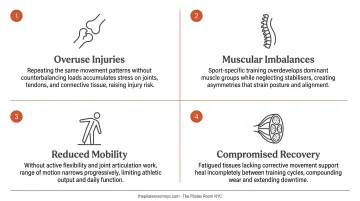
The pattern is predictable. Athletes who train exclusively in sport-specific or high-intensity formats without structured corrective work accumulate imbalances silently — until a soft-tissue injury, stress fracture, or onset of chronic pain forces them to stop.
The consequences compound over time:
- Dominant muscle groups become increasingly overloaded while antagonist and stabilizer muscles weaken, creating unpredictable movement patterns under fatigue
- Shortened, inflexible muscles from heavy lifting or repetitive sport movements raise tear and strain risk
- Without core stabilization training, back injuries become significantly more likely
- Performance plateaus as athletes push harder without addressing inefficiencies in how their body transfers force
The career cost of this pattern is concrete. Research by Tenforde et al. found expected return to full participation after stress fracture diagnosis averages 12–13 weeks across injury sites. A review of NBA injury data found that over one-third of injuries resulted in missed games. Injuries alter mechanics, require months of rehabilitation, and can permanently limit what an athlete is capable of.
Gabbett's training-injury prevention model, published in the British Journal of Sports Medicine, supports this directly: athletes adapted to well-managed chronic loads tend to have fewer injuries, while abrupt workload spikes create risk. Pilates fits this framework by adding trunk control and mobility work without stacking more sport-specific volume onto an already-loaded system.
How to Integrate Pilates Into Your Athletic Training
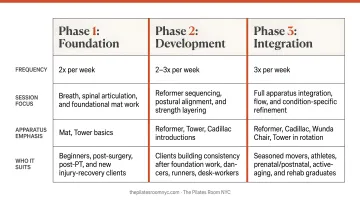
Pilates works when it's treated as a consistent part of the training schedule, not an occasional experiment. The evidence-based frequency benchmark: the Finatto runner trial used two one-hour sessions per week for 12 weeks and produced measurable performance gains. Rehabilitation-focused Pilates research most commonly uses 2–3 sessions per week over 8-week blocks.
A practical framework by training phase:
| Phase | Recommended Frequency | Focus |
|---|---|---|
| In-season | 1–2 sessions/week | Movement quality, recovery, maintenance |
| Off-season | 2–3 sessions/week | Corrective work, imbalance correction, new foundations |
| Rehabilitation | 2–3 sessions/week (load-managed) | Alignment, stabilizer activation, tissue loading |
Sport-specific programming matters. A swimmer's Pilates program should look different from a football player's. U.S. Masters Swimming notes that Pilates helps swimmers build core strength for a long powerful stroke, improve streamlined position, and execute faster turns. At the NFL level, adoption is widespread. The Green Bay Packers have kept a reformer available to players for years, as reported by The Athletic — a sign that structured Pilates work earns its place even in contact sport environments.
Getting this right requires an instructor who understands both classical Pilates principles and the specific demands of the athlete's sport.
At The Pilates Room NYC, Enja Schenck brings that combination directly. Her background spans an MS in Sport Science, CSCS, USAPL Powerlifting Coach certification, and classical certification under Bob Liekens. She integrates Postural Restoration Institute principles, strength and conditioning, and classical Pilates as a single system — not as competing disciplines bolted together.
For athletes training with a partner or in a small group, the studio also offers duet sessions and small group classes (3–4 people) on the Reformer, Tower, and mat — a practical way to build Pilates cross-training into a shared program, at a lower per-session cost than private instruction.
Conclusion
Pilates works alongside athletic training, not against it. Core stability, balanced musculature, dynamic flexibility, and sharper body awareness all reinforce what sport-specific work demands — and protect it from unraveling under the strain of a long season.
The athletes who perform at a high level longest aren't simply the ones who trained hardest. They're the ones who addressed what their sport-specific work couldn't — the asymmetries, the overuse patterns, the weak links that accumulate quietly until they don't. Consistent Pilates, matched to the demands of your sport, is one of the most direct ways to do that.
Frequently Asked Questions
Is Pilates good for athletes?
Pilates is highly effective for athletes because it builds the deep core stability that transfers force more efficiently through the body, corrects muscle imbalances created by repetitive sport-specific training, and improves overall movement quality — with direct payoffs in performance and injury prevention across virtually all sports.
Do any NFL players do Pilates?
Yes. Martellus Bennett has publicly credited Pilates as part of his training regimen. The Green Bay Packers have also had a reformer available to players for years, as reported by The Athletic in 2024 — one of the better-verified examples of Pilates inside an NFL program.
Does Pilates help with high cortisol?
Pilates may support autonomic recovery and stress regulation through its emphasis on controlled breathing and focused movement. A 12-week Pilates program improved heart rate variability in one randomized controlled trial. However, direct evidence in competitive athletes with high training loads is limited, so the cortisol benefit is best understood as a plausible recovery tool rather than a proven intervention.
How often should athletes do Pilates?
Most practitioners and the available research support 2–3 sessions per week, with frequency adjusted by training phase. During competition season, 1–2 lighter sessions focused on maintenance work well; off-season allows for more intensive corrective programming.
Does Pilates replace strength training for athletes?
No. Pilates targets the stabilizing, deep-core, and connective tissue work that strength training misses — but it doesn't replace the force production and hypertrophy adaptations that come from resistance training. The two work best together: strength training builds capacity, Pilates ensures the body can use that capacity efficiently and safely.
Can Pilates help with sports injury recovery?
Yes, and it's widely used for this purpose. Pilates exercises can be modified to accommodate injury at almost any stage of recovery, and the reformer provides non-weight-bearing resistance that reduces joint loading — making it effective for rehabilitation without aggravating the injury.