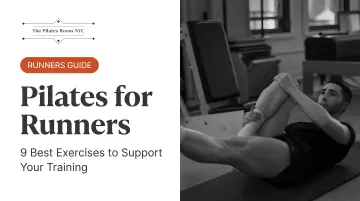
What most runners are missing isn't mileage. It's the stability and control that make mileage sustainable.
Pilates builds exactly that. It targets the deep core muscles, hip stabilizers, and spinal mobility that running demands but never directly trains. A 2018 randomized controlled trial published in PLOS One found that trained runners who added twice-weekly classical mat Pilates to their training improved their 5K time from 25.65 to 23.23 minutes and increased VO2max from 51.8 to 58.53 mL/kg/min over 12 weeks — without changing their run volume.
This guide covers the 9 best Pilates exercises for runners, organized by what they fix.
Key Takeaways
- Running is repetitive and single-plane; Pilates counterbalances it by training deep stabilizers and restoring lateral and rotational movement
- Core fatigue causes form breakdown late in runs — Pilates trains the muscles that hold your alignment under load
- The 9 exercises here address three areas: core stability, hip and glute strength, and spinal mobility
- Pilates fits a training week without overhauling it: 10–15 minutes before or after runs, or 20–30 minutes on recovery days
- Research shows real performance gains in runners who follow a consistent Pilates practice over 12 weeks
Why Runners Break Down
Most running injuries don't come from one bad workout. They develop gradually, as the same joints absorb the same forces, thousands of times, until the body can no longer distribute load efficiently.
When stabilizing muscles fatigue, compensation patterns take over. Common examples:
- Hip instability causes the pelvis to drop during the single-leg stance phase, increasing stress on the IT band and knee
- Weak gluteus medius allows inward knee collapse, driving patellofemoral pain
- Trunk fatigue leads to forward lean and stride collapse, shifting load onto the lower back and hip flexors
The research reflects this. A systematic review in the Journal of Sport and Health Science found overall running-related injury incidence at 40.2%, with the knee as the most common site. Hip abductor and external rotator weakness is consistently associated with both IT band syndrome and patellofemoral pain.
Why Stretching Alone Doesn't Solve It
Many runners respond to tightness with more stretching. The problem: static stretching doesn't change how load moves through the body when fatigued. A large meta-analysis in the British Journal of Sports Medicine found stretching had no meaningful injury-prevention effect (RR 0.963).
Strength training, by contrast, reduced sports injuries to less than one-third (RR 0.315), and proprioceptive training cut injury risk nearly in half (RR 0.550).
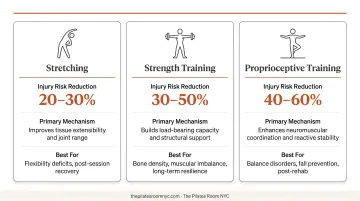
Temporary range of motion gains feel good. But pelvic control, trunk endurance, and hip stability are what actually change the pattern.
Pilates targets exactly those deficits — and trains them together rather than in isolation, which is what makes it effective for runners specifically.
How Pilates Improves Running Performance
Running Economy: The Metric That Matters
Among trained runners with similar fitness levels, running economy — how efficiently the body uses oxygen at a given pace — accounts for more of the variation in race performance than VO2max alone. In fact, running economy can vary by as much as 30% among runners with comparable aerobic capacity.
When the pelvis is stable and posture remains upright, the body moves as one efficient system. When it doesn't, energy leaks at every stride.
What Pilates Targets That Traditional Training Misses
Most gym-based strength work trains the muscles you can see: quads, hamstrings, glutes. Pilates specifically targets the deep stabilizing system — with an emphasis on control and coordination rather than just load. Key muscles include:
- Transverse abdominis — the deep core layer that stabilizes the spine with every footstrike
- Multifidus — small spinal muscles that maintain upright posture over long distances
- Hip external rotators and gluteus medius — critical for controlling pelvic drop and knee alignment
Every exercise begins with breath and requires whole-body connection. That integration is what makes Pilates carry over to real movement, rather than building isolated muscle strength that stays in the gym.
Proprioception and Movement Sequencing
Runners develop compensations gradually — a slight pelvic tilt here, a knee drift there — and most can't feel them happening. Proprioception training teaches you to sense and control your alignment directly, which prevents the small errors that accumulate over miles and become injury.
Classical Pilates — rooted in the Romana Kryzanowska lineage and practiced at studios like The Pilates Room NYC — addresses exactly this need. The system trains the body as an integrated whole, which suits endurance athletes who need durability across long distances, not just strength in a single movement pattern.
9 Best Pilates Exercises for Runners
Core Stability Exercises
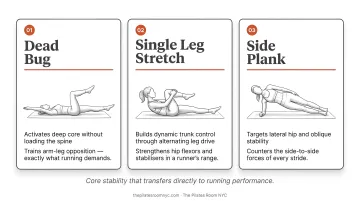
Exercise 1 — Dead Bug
Lie on your back with arms pointing toward the ceiling and knees bent at 90 degrees. Slowly extend one arm overhead while the opposite leg straightens toward the floor, then return and switch sides.
This directly mimics the reciprocal rotation of running gait while training the deep abdominals and obliques to resist rotation. Key cue: maintain a small natural curve in the lower back throughout and only lower the limbs as far as control allows. The moment your back arches, you've gone too far.
10 reps per side.
Exercise 2 — Single Leg Stretch
Lying on your back with head and shoulders lifted, draw one knee toward your chest (hands on shin and ankle) while extending the other leg long. Switch alternately in a controlled, flowing rhythm.
This classical mat exercise builds core endurance while lengthening the hip flexors — a crucial pairing for runners whose hip flexors are chronically shortened by the forward-motion demand of running.
The hand position also activates the upper back, reinforcing the upright posture that degrades over long runs.
8–10 reps per side.
Exercise 3 — Side Plank with Leg Lift
In a side plank position (supported on one hand or forearm), lift the top leg 6–8 inches and lower with control. Keep the hips stacked and the torso long.
This targets the gluteus medius and obliques : the muscles responsible for preventing pelvic drop during the single-leg stance phase of every stride. For runners new to Pilates, modify with the bottom knee down until you build the lateral stability needed for the full version.
5–8 reps per side.
Hip Strength and Glute Endurance Exercises
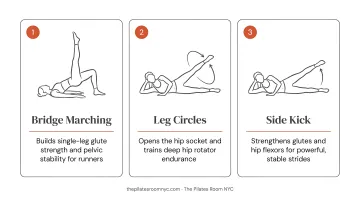
Exercise 4 — Bridge with Marching
Lie on your back with knees bent and feet flat. Raise your hips to a diagonal, then lift one foot off the floor and extend that leg while keeping the pelvis completely level. Lower and switch.
This builds posterior chain strength (glutes and hamstrings) while training pelvic stability simultaneously — directly replicating the push-off phase in running. The pelvis must not drop or shift as the leg lifts. That discipline is the point of the exercise.
8–10 reps per side.
Exercise 5 — Single Leg Circles
Lying on your back with one leg extended toward the ceiling, draw controlled circles from the hip while the opposite leg and pelvis remain completely still. Small circles first; increase size as stability allows.
This builds hip joint mobility and core stability at the same time — a combination that's rare in other exercises. It's particularly useful for runners who notice one hip feels tighter or weaker, since asymmetries revealed here often predict where overuse injuries develop across a training season.
6–8 circles in each direction, per leg.
Exercise 6 — Side Leg Kick Series
Side-lying with the body long and hips stacked, perform front/back kicks (one leg swinging forward and back with control), small circles, and inner thigh lifts. The series works the outer hip, inner thigh, and hip flexors together.
This builds lateral hip endurance — specifically, the capacity to maintain knee tracking when fatigue sets in during long miles. Start with your weaker side, work your stronger side, then return to the weaker side again. That sequencing addresses imbalances rather than reinforcing them.
8–10 reps per direction.
Mobility and Flexibility Exercises
Exercise 7 — Book Openings
Side-lying with knees bent and arms extended in front of you, open the top arm toward the ceiling, rotating the ribcage while the hips and lower body stay still. Follow your hand with your eyes. Return with control.
Running is almost entirely forward motion, and the thoracic spine gradually rounds and stiffens as a result. Book Openings directly address this. Better thoracic rotation means more efficient arm swing, less shoulder tension, and less energy wasted fighting your own upper body during long runs.
6–8 reps per side.
Exercise 8 — The Saw
Sit tall with legs extended slightly wider than hip-width and arms out to the sides. Rotate the spine and reach the opposite hand toward the opposite foot in a controlled twist-and-reach. Return through center before switching.
This delivers three things runners rarely get in a single exercise: spinal rotation mobility, active hamstring lengthening, and lower back decompression. Sit as tall as possible before initiating the rotation ; collapsing the trunk defeats the purpose entirely. An ideal post-run or recovery-day exercise.
5 reps per side.
Exercise 9 — Cat-Cow and Roll Down
Cat-Cow: On all fours, alternate between rounding the spine toward the ceiling and letting it drop toward the floor. Move segment by segment, not as one rigid block.
Roll Down: Standing with your back against a wall, slowly peel away vertebra by vertebra — chin to chest, then upper back, then mid-back, then lower back — until you're hanging forward. Roll back up the same way.
Together, these restore full spinal mobility and decompress the vertebrae after the compressive load of running. The Roll Down also provides sensory feedback about which sections of your spine move freely and which ones don't — worth paying attention to if you deal with recurring back tightness.
6–10 reps of each.
How to Add Pilates to Your Running Routine
You don't need to overhaul your training schedule. Here's a simple integration framework:
| Day Type | Pilates Format | Recommended Exercises |
|---|---|---|
| Short or speed run day | 10–15 min post-run activation | Dead Bug, Single Leg Circles, Bridge with Marching |
| Long run day | 10–15 min pre-run warm-up | Cat-Cow, Book Openings, Single Leg Stretch |
| Rest or recovery day | 20–30 min full session | All 9 exercises, with emphasis on mobility |
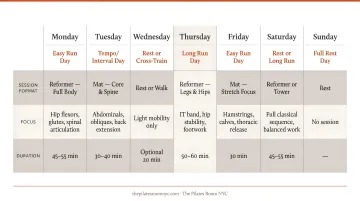
Even two or three exercises done consistently will produce results. The runner-specific RCT by Finatto et al. used two one-hour sessions per week for 12 weeks to generate measurable improvements in 5K time, VO2max, and metabolic efficiency. You don't need that volume to start seeing a difference — most runners notice improvements in posture, reduced late-run fatigue, and better stride quality within 4–6 weeks of consistent practice.
For runners dealing with recurring issues (IT band syndrome, runner's knee, persistent hip tightness) or preparing for a race like the NYC Marathon, working with an instructor who understands athletic bodies is worth the investment. At The Pilates Room NYC, instructor Enja Schenck holds an MS in Sport Science and is a certified Strength and Conditioning Specialist (CSCS) — credentials that directly inform how she trains athletes, not just general fitness clients.
Private sessions let instructors assess your specific imbalances in the first session and build from there, rather than defaulting to a generic sequence.
Conclusion
Running performance and longevity depend on more than the miles you log. The stability, control, and mobility that support every stride have to be trained separately — and Pilates builds exactly that foundation.
Start with two or three exercises from this list. Done consistently — even twice a week — they'll do more for your running than cramming in extra sessions ever will.
NYC-area runners looking for personalized guidance are welcome to explore private and small group sessions at The Pilates Room NYC, located at 150 West 28th Street in Chelsea. The studio's instructors bring classical training rooted in the Romana Kryzanowska lineage alongside specialized experience working with athletes and movers at every level — including instructors with advanced credentials in sport science and strength and conditioning — whether you're running your first 5K or preparing for another marathon.
Frequently Asked Questions
Is mat Pilates good for running?
Mat Pilates is well-suited for runners. It builds deep core stability, hip control, and mobility without any equipment, making it easy to fit around any training schedule. Research confirms its positive impact on running economy, VO2max, and race performance.
How often should runners do Pilates?
Most runners see meaningful results with 1–2 sessions per week. Even 10–15 minutes of targeted work on run days can improve stability and reduce late-run fatigue over time.
Should I do Pilates before or after a run?
Short, activation-focused Pilates (Dead Bug, bridges, leg circles) works well before runs to prime the stabilizers. Longer mobility sessions — such as The Saw, Book Openings, and Roll Down — are better suited after runs or on recovery days.
Can Pilates help prevent runner's knee?
Runner's knee is often driven by poor hip and pelvic stability. Pilates directly addresses this by strengthening the gluteus medius and improving single-leg control, reducing excess load placed on the knee with every stride.
Does Pilates replace strength training for runners?
No — Pilates complements but doesn't replace strength training. Pilates improves stability, control, and mobility; traditional strength work builds power and force production. Runners benefit most from both.
How long before I see results from Pilates as a runner?
Most runners notice improved posture and reduced fatigue within 4–6 weeks of consistent practice. Stride efficiency and injury resilience continue to improve as the work compounds over subsequent months.