Pilates addresses lower back pain at its source: weak deep core muscles, underactive glutes, tight hip flexors, and poor spinal awareness. The 8 exercises below build on each other logically, moving from gentle mobilization through core activation to hip strengthening. Practiced consistently with good form, they can produce real, lasting relief.
Key Takeaways
- Pilates strengthens the deep core and lumbar stabilizers (particularly the transverse abdominis and multifidus) that directly support the spine
- Neutral spine is the foundational principle behind every exercise here — maintaining it protects the lumbar discs
- Weak glutes and tight hip flexors are frequent contributors to lower back pain; several of these exercises target them directly
- These 8 exercises work best as a sequence, practiced together 2–3 times per week
- Stop any exercise that increases pain and consult an instructor for a modification
Why Pilates Works for Lower Back Pain
Lower back pain rarely has a single cause. Most cases involve a combination of weak deep core muscles, underactive glutes, and tight hip flexors — and these three problems reinforce each other in a cycle that worsens over time, especially with prolonged sitting.
Pilates addresses all three through low-impact, controlled movement. The key muscles involved:
- Transverse abdominis — the deepest abdominal layer, acts as a dynamic stabilizer for the lumbar spine
- Multifidus — small segmental muscles along the spine; atrophy and inhibition of these are closely linked to chronic mechanical lower back pain
- Gluteus medius — a 2019 systematic review found reduced gluteus medius strength and more trigger points in people with lower back pain compared to pain-free controls
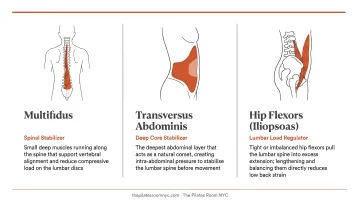
The neutral spine principle sits at the center of all Pilates work. Rather than flattening or exaggerating the lumbar curve, exercises are designed to build strength around the spine's natural position. A Cochrane review found Pilates is probably more effective than minimal intervention for short- and intermediate-term pain and disability — and the 2021 APTA/JOSPT clinical guidelines specifically name Pilates as a recommended active treatment for chronic lower back symptoms.
At The Pilates Room NYC, instructors adapt each session to the client's specific condition. Enja Schenck — who holds an MS in Sport Science, CSCS certification, and integrates Postural Restoration Institute principles — works with clients navigating back pain by addressing the underlying movement patterns, not just the symptoms.
The 8 Best Pilates Exercises for Lower Back Pain
1. Pelvic Tilt (Imprinting)
This is the entry point. Pelvic tilts gently mobilize the lumbar spine and build awareness of pelvic positioning, training the deep abdominals to engage without forcing an aggressive posterior tuck.
How to do it:
- Lie on your back, knees bent, feet hip-width apart
- Exhale and gently draw the lower back toward the mat — no forcing, just a soft engagement
- Inhale to return to neutral
- Perform 8–10 slow, controlled repetitions
The goal is awareness and gentle mobilization, not maximum range. Once you can feel the difference between a neutral lumbar curve and a flattened one, you have what you need to move forward.
2. Bridge (Glute Bridge)
When the glutes are weak, the lower back compensates during any hip extension movement (standing up, climbing stairs, walking). The bridge targets the glutes and hamstrings to redistribute that load.
How to do it:
- Lie on your back, knees bent, feet flat and hip-distance apart
- Exhale and press through your heels to lift the hips until shoulders, hips, and knees form a diagonal line
- Engage the glutes without over-arching the lower back at the top
- Inhale at the top; exhale to lower down one vertebra at a time
- Perform 8–12 reps
Modification: Reduce the range of motion or place a pillow between the knees for added inner-thigh engagement and pelvic stability.
3. Dead Bug
The dead bug builds anti-extension core stability, training the transverse abdominis to hold the lumbar spine in neutral while the limbs move. That coordination is exactly what protects the lower back during everyday activities like reaching, lifting, and carrying.
How to do it:
- Lie on your back, arms extended toward the ceiling, legs in tabletop (knees above hips, shins parallel to the floor)
- Exhale and slowly extend the right arm behind you and the left leg long — keep the lower back from arching off the mat
- Inhale to return; alternate sides for 6–8 reps each
Modification: Extend only the leg while keeping both arms up until core control improves.
4. Bird Dog
Bird dog is one of the most well-supported exercises for lumbar rehabilitation. A 2021 study in the Journal of Orthopaedic & Sports Physical Therapy found that diagonal bird dog variations (extending the opposite arm and leg simultaneously) produced greater lumbar multifidus contraction thickness than single-limb variations, supporting the deep stabilizers of the spine.
How to do it:
- Begin in quadruped — wrists under shoulders, knees under hips, spine long and neutral
- Exhale and extend the right arm forward and left leg back simultaneously; keep the hips level
- Avoid rotating or hiking the hip — the pelvis stays square
- Inhale to return; perform 6–10 reps per side
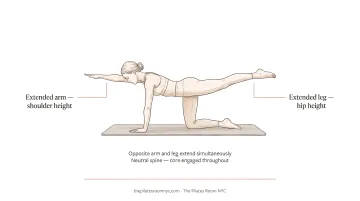
Modification: Extend one limb at a time until stability is reliable.
5. Toe Taps (Tabletop Leg Lowering)
Leg raises are a common exercise that often creates more lower back problems than they solve. Toe taps offer the same lower abdominal training at a manageable intensity, reinforcing the habit of maintaining spinal position while the legs move.
How to do it:
- Lie on your back with legs in tabletop, spine neutral
- Slowly lower one foot toward the floor, going only as far as the lower back stays on the mat
- Exhale to return; alternate sides for 8–10 reps each
If the lower back lifts off the mat at any point, reduce the range of motion. The floor contact is your reference point: losing it means the load has exceeded your current core control.
6. Modified Swan (Prone Press)
Most people with desk-work posture live in flexion all day, rounded forward with the lumbar spine under continuous load. The modified swan introduces gentle spinal extension, strengthening the erector spinae and posterior chain.
How to do it:
- Lie on your stomach, elbows bent with hands beside the chest, forehead hovering off the mat
- Press the pubic bone gently into the floor
- Inhale and slowly press through the hands, lengthening the spine and lifting the chest — focus on creating length rather than height
- Exhale to lower back down; perform 8–10 reps
Important: This exercise is not appropriate during an acute pain flare-up. Keep the range small to start, and stop if symptoms travel into the legs or buttocks.
7. Side-Lying Hip Work (Clam)
The gluteus medius stabilizes the pelvis during single-leg activity. When it's weak, the pelvis drops to one side with every step, creating uneven loading on the lower back that compounds over time.
How to do it:
- Lie on your side, hips and shoulders stacked, knees bent at 90 degrees
- Keeping the feet together, exhale and lift the top knee toward the ceiling — rotate from the hip, not the pelvis
- Avoid rolling the pelvis backward as the knee lifts
- Inhale to lower; perform 10–15 reps per side
Progression: Add a resistance band just above the knees once the movement feels controlled and fatigue-free.
8. Figure Four Stretch (Piriformis Release)
Tight hip rotators and glutes pull on the sacrum and lower back. The figure four stretch targets the piriformis and deep hip rotators, releasing tension that limits the effectiveness of every strengthening exercise above it.
How to do it:
- Lie on your back with knees bent
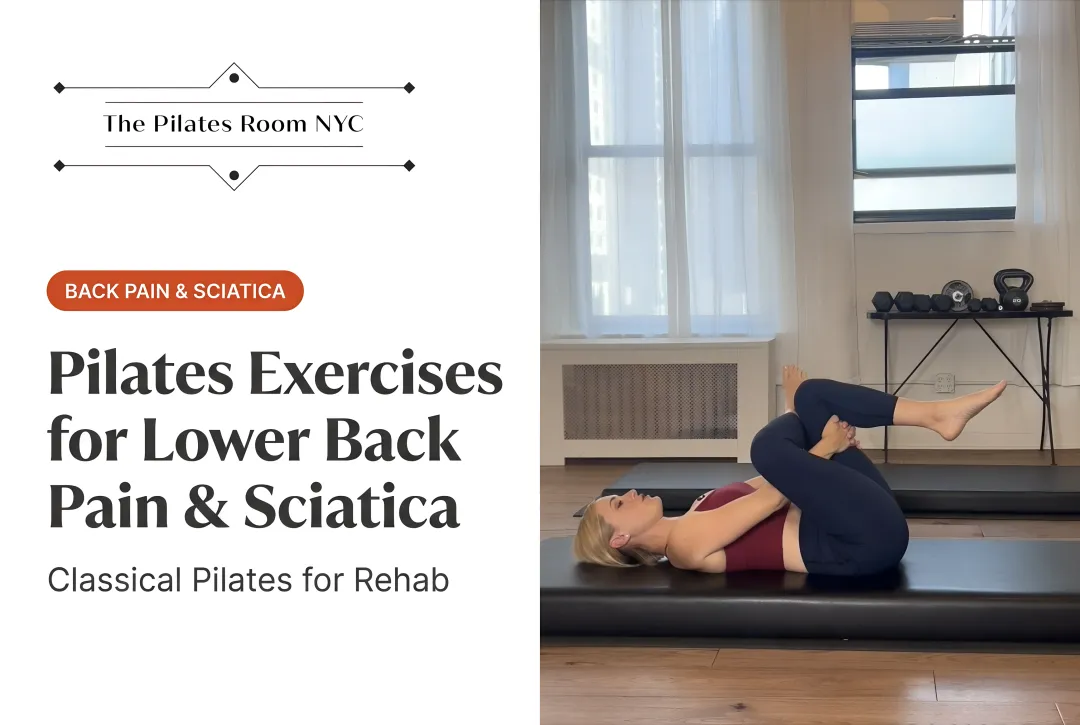
- Lift one foot and cross the ankle over the opposite thigh, forming a figure four shape
- Clasp hands behind the back of the lower thigh and gently draw both legs toward your chest until you feel a stretch in the outer hip
- Hold 30–60 seconds per side
This is a cool-down movement. It should feel like relief — not strain, and never a sharp or radiating sensation.
How to Practice These Exercises Safely
The Neutral Spine Rule
Every exercise in this list assumes neutral spine — meaning the natural arch in the lower back is maintained throughout movement. Exercises that require flattening or dramatically exaggerating this curve (aggressive posterior pelvic tilts, deep knee-to-chest pulls, extreme backbends) can increase disc pressure and should be approached with caution during any pain flare-up.
Consistency Over Intensity
2–3 sessions per week is the right starting point. Published Pilates trials for lower back pain typically run 6–8 weeks at this frequency, and that's where measurable improvements show up. One well-designed study found that practicing once, twice, or three times weekly produced similar pain improvements over six weeks — meaning showing up consistently matters more than frequency alone.
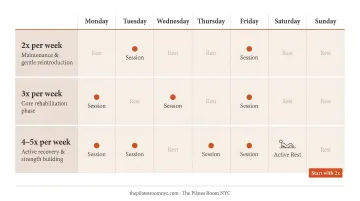
A few practical rules:
- Work within a pain-free range of motion — always
- Pain during an exercise is a signal to stop, reduce range, or ask for a modification
- Short daily practice of two or three foundational exercises maintains progress between full sessions
That said, consistent practice has a ceiling — and knowing when to bring in expert eyes matters as much as showing up regularly.
When to Seek Professional Guidance
These exercises are appropriate for most chronic, non-specific lower back pain. They are not a substitute for medical evaluation if:
- Pain is acute or severe
- Symptoms radiate into the legs
- You experience numbness, tingling, or weakness in the lower extremities
Working with an experienced instructor means each exercise gets adapted for your specific diagnosis — whether that's a disc herniation, spondylolisthesis, or post-surgical recovery. In a private session, an instructor can catch compensation patterns, adjust range of motion in real time, and progress you safely in ways a general class simply can't.
Conclusion
These 8 exercises address the most common drivers of lower back pain: a weak core, underactive glutes, tight hip rotators, and poor awareness of spinal position. None of them is complicated. Practiced 2–3 times per week with honest attention to form, they build the kind of lasting strength that reduces pain over weeks and months — not just hours.
For New Yorkers who want hands-on guidance, The Pilates Room NYC offers private, duet, and small group sessions with classically trained instructors — several holding credentials in sport science, rehabilitation, and Postural Restoration Institute methodology. Every session is tailored to your specific needs, whether you're just starting out or working through a diagnosed lumbar condition.
Frequently Asked Questions
Should I do Pilates if I have lower back pain?
Yes — Pilates is widely recommended for lower back pain because it strengthens stabilizing muscles without high-impact loading. Exercises should be modified to avoid aggravating movements, and anyone with acute or severe pain should get clearance from a healthcare provider before starting.
Which Pilates is best for lower back pain?
Mat-based Pilates emphasizing core stability, neutral spine, and glute strengthening (like the exercises in this article) is highly effective. Reformer Pilates with a qualified instructor adds spring-assisted support and tactile feedback, which can be especially helpful for those managing specific injuries.
Is Pilates good for L4 and L5?
L4-L5 is the most common site of disc herniation. A 2023 randomized controlled trial found clinical Pilates practiced three times per week for six weeks improved pain, function, and flexibility in patients with symptomatic disc herniation at L3-L4, L4-L5, and L5-S1.
Can Pilates make lower back pain worse?
It can, if exercises involve excessive spinal flexion, aggressive posterior pelvic tilts, or range of motion beyond what the person can currently control. Choosing exercises appropriate to your condition and working with a knowledgeable instructor significantly reduces this risk.
How often should I do Pilates for lower back pain?
Start with 2–3 sessions per week. Research trials commonly use this frequency over 6–8 weeks to produce measurable results. Even a short daily practice of a few foundational exercises can help maintain progress between full sessions.