Introduction
Walk into a classical Pilates studio for the first time and you'll likely find yourself staring at two very different pieces of equipment : the reformer, with its sliding carriage and rope-and-pulley system, and the tower, a vertical frame mounted to the wall or the end of a mat. Both look purposeful. Neither looks immediately intuitive.
This is one of the most common questions new clients bring to The Pilates Room NYC: what's the difference, and which one do I need?
The short answer is that they work differently. The reformer creates horizontal resistance through a moving carriage; the tower uses vertically arranged springs from a fixed frame. Each targets your body from a different angle, suits different goals, and has distinct strengths.
What most comparisons overlook is this: in classical Pilates, these two apparatus aren't competing options. They're partners, designed to complement each other within a complete practice.
This guide breaks down how each works, who benefits most, and how to decide which one belongs in your practice — and when both do.
Key Takeaways
- The reformer's sliding carriage creates horizontal resistance, demanding constant core stabilization across every exercise
- The tower uses fixed vertical springs, making it ideal for spinal mobility, deep stretching, and unilateral work
- Both apparatus share many of the same exercises, though the change in spring angle shifts which muscles do the work
- The tower's stable base often feels more approachable for beginners
- The reformer builds dynamic, full-body conditioning faster once you're comfortable with the fundamentals
- Classical Pilates treats them as a system — most practitioners benefit from working on both
Reformer vs Tower: Quick Comparison
| Factor | Reformer | Tower |
|---|---|---|
| Resistance Direction | Horizontal — springs move with a sliding carriage | Vertical — springs attach at multiple fixed heights |
| Base of Support | Moving carriage; requires dynamic balance | Fixed platform; stable and grounded |
| Workout Type | Flowing, dynamic, full-body | Targeted, precise, stretch-focused |
| Primary Benefits | Core conditioning, functional strength, rehab, cardiovascular (with jumpboard) | Spinal mobility, deep stretch, unilateral balance correction |
| Learning Curve | Moderate — the carriage moves while you work | Gentle — stable base lets beginners focus on movement quality |
| Ideal For | Athletes, rehab clients, general conditioning, pre/postnatal | Scoliosis, postural asymmetry, dancers, seniors, beginners |
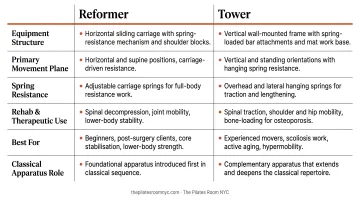
The biggest mechanical difference comes down to what the spring resistance is doing to your body. On the reformer, you're managing a surface that moves beneath you. On the tower, the platform holds still, but the springs pull from angles that shift based on their attachment point on the frame.
What Is the Pilates Reformer?
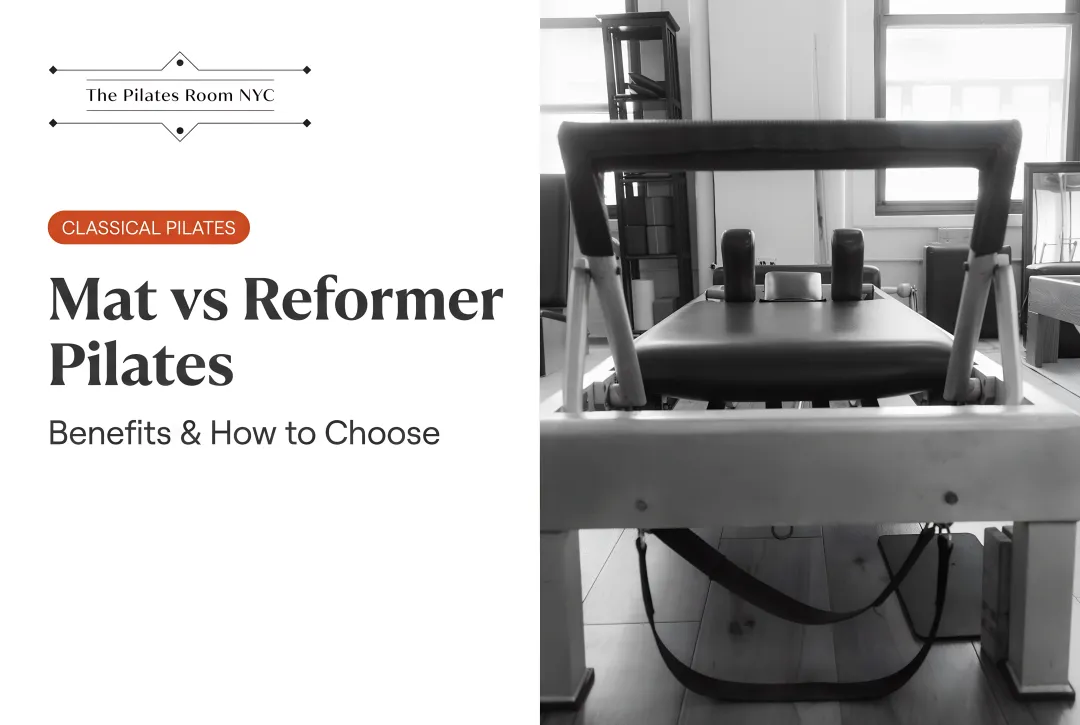
The reformer is a bed-like frame housing a padded sliding carriage connected to adjustable springs, a footbar, and rope-and-pulley straps. As the carriage moves along its tracks, springs create resistance — you push or pull against that resistance whether you're lying, sitting, kneeling, or standing on the carriage.
Joseph Pilates designed it to simultaneously support and challenge the body. That dual function is why it appears in both elite athletic training and rehabilitation settings today. Research on its origins confirms that Pilates used spring tension to engage muscles concentrically and eccentrically, with isometric control built into the exercise patterns — a design principle that modern movement science continues to validate.
The Core Mechanical Principle
Every reformer exercise demands stabilization, even when the movement targets legs or arms. That's by design. The carriage never stops moving, so your core never stops working. This makes the reformer one of the most time-efficient full-body training tools in classical Pilates.
Spring resistance can be adjusted from very light to genuinely challenging. That range makes the reformer appropriate across a wide spectrum: a post-surgical client rebuilding hip strength works at different resistance settings than a dancer preparing for a demanding performance season, but both are on the same machine.
Who Benefits Most from the Reformer?
A 2018 randomized controlled trial of 55 adults aged 65–95 found that once-weekly Reformer Pilates over 10 weeks significantly improved balance, functional mobility, gait, hip extension, and ankle range of motion compared with a control group. That's meaningful evidence for a population where fall prevention matters.
Beyond seniors, the reformer serves:
- Athletes using it for cross-training and injury prevention
- Pre/postnatal clients seeking low-impact full-body conditioning (with appropriate modifications and medical clearance)
- Individuals recovering from orthopedic injuries, where spring resistance can be adjusted to unload joints while maintaining movement
- General fitness clients who respond well to varied, flowing sequences
At The Pilates Room NYC, instructors like Enja Schenck, a certified Strength and Conditioning Specialist (CSCS) with a Master's in Sport Science, work with this full range of clients on the reformer. Resistance and body position are adjusted based on what each client's body needs that day.
What Is the Pilates Tower?
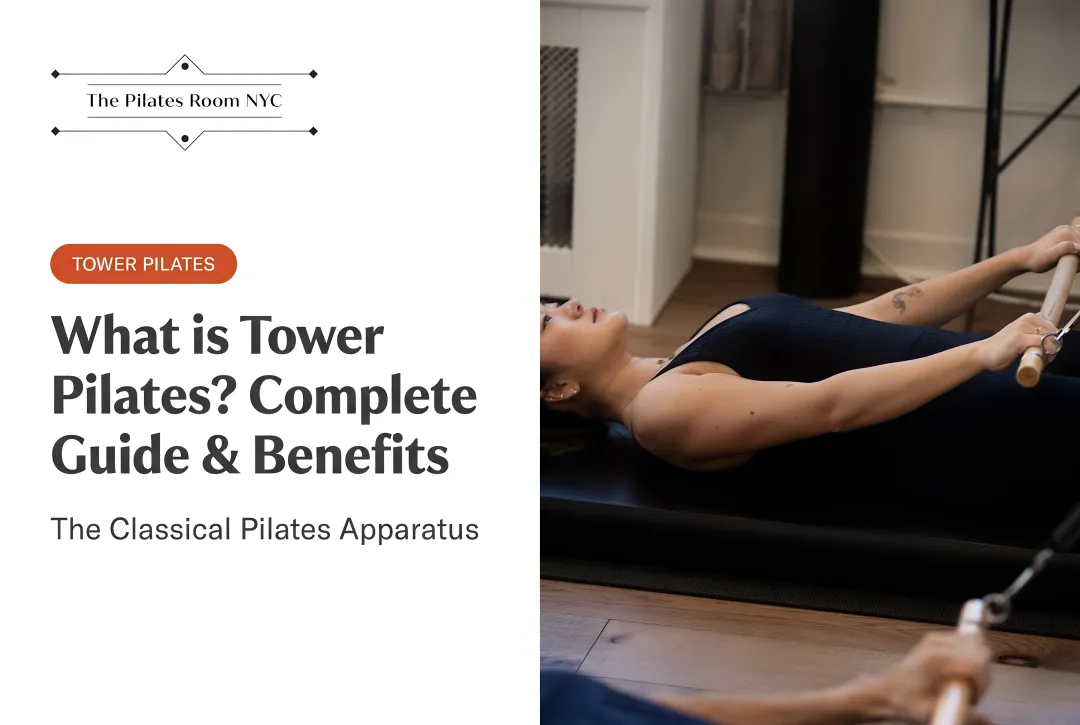
The tower (also called a wall unit or half-trapeze) is a vertical spring apparatus fixed to a wall or attached to the end of a reformer mat. It's equipped with arm and leg spring loops, a roll-down bar, and a push-through bar. You work on a mat or platform beneath or beside the frame, pulling or pressing against springs that attach at different heights.
It evolved from Joseph Pilates' original Cadillac Trapeze Table — a compact version of the Cadillac's spring system adapted for smaller spaces. Manufacturers like Balanced Body and Gratz build their towers with multiple attachment points, allowing springs to be positioned higher, lower, or to either side of the frame.
The Key Mechanical Difference
Because the springs pull vertically and interact with gravity from a fixed point, the angle of resistance is fundamentally different from the reformer. The same exercise (feet in straps or short spine, for example) engages different stabilizing muscles depending on whether you're on the reformer or the tower. Research on elastic resistance direction confirms that changing the vector of resistance changes muscular demand — and that's precisely the mechanical shift these two pieces of equipment create.
That shift in resistance angle produces a distinct set of training advantages. The tower's signature strengths:
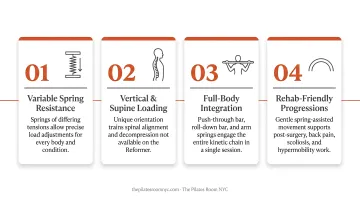
- Spinal decompression and mobility — the vertical spring angle creates longer lines of pull, particularly valuable for spinal articulation work
- Deep stretching — gravity and spring tension work together rather than against each other in certain positions
- Unilateral training — springs attach independently on each side of the frame, so each side of the body can be worked separately; this matters for clients with scoliosis, asymmetry, or one-sided injuries
- Assisted skill-building — exercises like the roll-up and teaser can be practiced with spring support, helping students feel correct spinal sequencing before attempting them on the reformer or mat
Who Benefits Most from the Tower?
The tower's fixed, stable platform makes it a natural entry point for beginners who feel uncertain about managing a moving carriage. But it's equally valuable for experienced practitioners — and particularly well-suited for:
- Clients with scoliosis or spinal asymmetry, who benefit from the independent spring attachments that allow each side to be worked differently
- Dancers and performers, who prioritize spinal articulation, range of motion, and precise body awareness
- Seniors seeking controlled, supported movement
- Anyone working through postural imbalances in the back, shoulders, or hips
At The Pilates Room NYC, instructor Barbara Hoon brings firsthand understanding of what the tower offers performers. She began her Pilates practice as a dancer at The Juilliard School and went on to perform with Twyla Tharp Dance. As co-founder of the Pilates for Performers program with studio owner Alison Johnson, her background directly shapes how the studio approaches tower work with the performing arts community.
Reformer vs Tower: Which Is Right for You?
Neither apparatus is universally superior. The right choice depends on your current goals, physical condition, experience level, and what kind of movement challenge your body actually needs right now.
Choose the Reformer If You:
- Want a dynamic, full-body conditioning practice with cardiovascular potential
- Are recovering from an orthopedic injury and need progressive, adjustable resistance with support
- Respond well to varied, flowing sequences rather than slow, precise holds
- Are working toward advanced Pilates work, including the jump series
Choose the Tower If You:
- Are dealing with spinal asymmetry, postural imbalances, or chronic tension in the back and shoulders
- Find the idea of a moving carriage anxiety-inducing — the tower's stable base builds confidence without sacrificing challenge
- Need unilateral work to address one-sided weakness or asymmetry
- Are a dancer or performer prioritizing articulation and range of motion
The Case for Using Both
Classical Pilates was designed as a system, and the reformer and tower were always meant to work together. Many practitioners find that learning an exercise on the tower reveals something about body positioning or spinal sequencing they hadn't noticed on the reformer.
The change in spring angle doesn't just make exercises feel different. It makes you understand them differently.
That's the approach at The Pilates Room NYC. Small group sessions integrate reformer, tower, and mat work within a single session. Private clients have access to all apparatus, with instructors making real-time decisions about which machine best serves what the body needs that day.
New clients complete an intake form and receive a thorough in-session assessment. Instructors establish a baseline for strength and flexibility, then build a practice around it — so your first session is already working toward something specific.
Conclusion
The reformer and tower each bring something the other can't fully replicate. The reformer excels at dynamic, full-body conditioning and has the stronger research base for outcomes like balance improvement, functional mobility, and rehabilitation across a range of populations.
The tower offers targeted spinal mobility, superior stretching mechanics, and the ability to address asymmetry and postural imbalance in ways the reformer's horizontal carriage doesn't allow.
Choosing between them in isolation misses the point of classical Pilates. Both apparatus were designed to work together — and when you train on both, your body develops movement patterns that neither machine can build on its own.
If you're in Manhattan and want to experience both under instructors with classical certifications and up to 35 years of teaching experience, The Pilates Room NYC in Chelsea offers private sessions, small group classes, and affordable apprentice sessions for clients at every level.
New clients receive a 15% discount on their first private session with code INTRO. Reach the studio at info@thepilatesroomnyc.com or 212-206-1827 — or fill out the new client form online to get started.
Frequently Asked Questions
What is the difference between a Pilates tower and a reformer tower?
A "tower" or wall unit is a standalone vertical spring apparatus attached to a wall or mat platform. A "reformer tower" combines both machines in one unit — a full reformer with a tower frame added to one end. The reformer tower provides access to most Cadillac-style exercises without purchasing two separate pieces of equipment.
Is Pilates tower harder than reformer?
Neither is inherently harder. The tower's challenge comes from precision and control against gravity from a fixed position. The reformer's challenge comes from the moving carriage, which requires constant core stabilization throughout dynamic, flowing sequences. Difficulty depends on the exercise, spring resistance, and the individual's experience level.
Can beginners use both the reformer and the tower?
Both are accessible to beginners with qualified instruction. The tower's stable base often makes it an easier entry point, while the reformer's moving carriage is typically mastered quickly under the guidance of a trained classical Pilates instructor.
Which apparatus is better for injury rehabilitation?
Both are used therapeutically. The reformer suits post-surgical and joint rehabilitation well — its adjustable spring resistance and supportive carriage make it highly adaptable. The tower is particularly valuable for scoliosis, spinal asymmetry, and postural imbalances, where its independent spring attachments allow unilateral work on each side of the body.
Can I do the same exercises on both the reformer and the tower?
Many exercises — including short spine, feet in straps, bridging, swan, and teaser — can be performed on both. They feel and function differently due to the change in spring angle, emphasizing different muscles and often revealing new aspects of an exercise that improve performance on the other apparatus.
Do I need to choose between the reformer and the tower?
No. Classical Pilates was designed for both apparatus to be used together, and most experienced practitioners work on both regularly. Training on one consistently deepens your understanding of movement on the other — which is exactly how the system was intended to work.