That gap is precisely where Pilates fits. Joseph Pilates demonstrated his conditioning system at Jacob's Pillow Dance Festival in 1943, and the connection between these two disciplines has only deepened since. Today, institutions like the School of American Ballet, ABT Studio Company, and The Royal Ballet School all incorporate Pilates into their official training curricula.
This guide covers what Pilates actually does for dancers that class doesn't, the most effective mat and Reformer exercises, how Pilates addresses injury prevention, and how to build it practically into an existing training schedule.
Key Takeaways
- Pilates targets deep core muscles, hip stabilizers, and intrinsic foot muscles — areas consistently undertrained by dance training alone
- Exercises like the Clam, Roll Up, and Side Leg Series translate directly into improved turnout, balance, and extension
- The Reformer allows dancers to strengthen muscles at end ranges of motion without overloading vulnerable joints
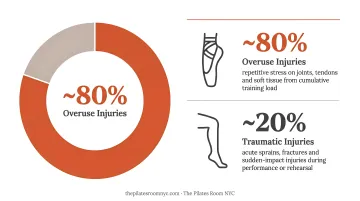
- Research on professional ballet companies shows overuse injuries account for up to 82% of all ballet injuries, most rooted in correctable muscle imbalances
- Consistency over several weeks matters more than session length
Why Pilates Is Essential Cross-Training for Dancers
Pilates and dance share the same underlying philosophy: controlled, intentional movement over brute force. Both disciplines demand precision, breath coordination, and full-body integration rather than isolated muscular effort. That alignment makes Pilates uniquely suited as cross-training rather than just supplementary exercise.
The Physical Gap Dance Training Doesn't Fill
Dance training develops strength in the movement patterns dance requires — but those patterns are highly specific. Research on ballet dancers' hip flexor morphology shows that ballet selectively loads the iliopsoas, tensor fascia latae, and sartorius, while leaving other stabilizing structures comparatively underdeveloped.
When those deep stabilizers of the trunk and hip can't do their job, the hip flexors and lower back extensors compensate. That compensation makes technique harder to execute cleanly and raises injury risk over time.
The same compensatory loading shows up in the trunk. A study by Gildea et al. found measurable differences in transversus abdominis and internal oblique morphology between the dominant and non-dominant sides. Pilates, with its emphasis on bilateral symmetry and deep core recruitment, directly addresses both the hip and trunk imbalances that ballet selectively creates.
The Injury Reality
The numbers make supplementary training hard to argue against. According to a systematic review of musculoskeletal injury in ballet:
- Professional dancers sustain 1.24 injuries per 1,000 dance hours
- Lower-extremity injuries account for 66–91% of all ballet injuries
- Overuse injuries represent 64% of female professional injuries and 50% of male professional injuries
Among the most common overuse diagnoses: patellofemoral pain syndrome (8.20%), Achilles tendinopathy (6.83%), and patellar tendinopathy (5.19%). None of these are the result of a single traumatic event. They accumulate from repeated compensatory patterns — exactly the kind of movement dysfunction Pilates is designed to interrupt.
Best Pilates Mat Exercises for Dancers
Mat exercises are the most accessible entry point, and they're where most dancers should start. That said, completing the movement isn't what produces results. Correct muscle activation is. A dancer who gets through ten Roll Ups by pulling with the hip flexors gains almost nothing compared to one who completes six with genuine spinal articulation and core engagement.
Building the Powerhouse: Core Exercises
Roll Up (8–10 reps) Rolling down and up one vertebra at a time — with feet pressed into the floor — builds sequential spinal articulation and genuine core engagement. It directly counters the hip-flexor-dominant sit-up pattern many dancers default to. The payoff: cleaner port de bras, more controlled piqués, and better overhead stability in relevé.
Rolling Like a Ball (8–10 reps) Pull the navel backward toward the spine to find balance at the top rather than using momentum. Dancers with strong back extensors from arabesque training often pop the lower back forward; this exercise demands genuine core control instead. Progress to Open Leg Rocker once the basic version feels stable.
Hip Stabilizers and Turnout
The Clam (8–12 reps) No mat exercise targets the external hip rotators more directly. Set up side-lying with hips and shoulders stacked, as if positioned between two panes of glass. The pelvis must not roll backward as the top knee opens: that rolling is the body substituting lumbar movement for genuine hip rotation.
Consistent clam work often reveals that a dancer's functional turnout is less than their passive range. Active hip external rotation in professional classical dancers averages around 35 degrees, compared to passive hip external rotation of approximately 50 degrees — a gap that targeted strengthening can narrow over time.
Side Leg Series (8–10 reps each side) Forward-and-back kicks and side lifts in the side-lying position train the core to stay active while the limbs work, which is exactly what développé and adagio demand. Zero movement in the torso while the leg travels through its full range is the standard to aim for.
Spinal Articulation and Back Strength
Pilates Bridge (6–8 reps) Articulating the spine off the mat one vertebra at a time opens the chronically tight hip flexors, activates the hamstrings, and builds the posterior chain strength needed for jumps and supported lifts. A flat-back bridge skips the sequential peel entirely — that controlled vertebra-by-vertebra movement is where the actual work lives.
Single Leg Kick (6–8 reps each leg) The prone setup with a lifted chest and actively engaged abdominals protects the lower back while the alternating hamstring pulse works. Upper back extensors and hamstring strength both develop here — exactly what arabesque and attitude positions require.
Single-Leg Circles (5 reps each direction, both legs) Lying supine with the working leg lifted, tracing controlled circles while keeping the pelvis completely still builds hip mobility alongside pelvic stability. That combination is precisely what the standing leg needs during pirouettes and promenades.
Quick Reference: Mat Exercises by Primary Benefit
| Exercise | Primary Benefit | Dance Application |
|---|---|---|
| Roll Up | Spinal articulation, core | Port de bras, piqués |
| Rolling Like a Ball | Core control, lumbar awareness | Balance, center work |
| The Clam | External hip rotation | Functional turnout |
| Side Leg Series | Hip stability, core endurance | Développé, adagio |
| Pilates Bridge | Posterior chain, hip flexor release | Jumps, supported lifts |
| Single Leg Kick | Hamstrings, upper back extensors | Arabesque, attitude |
| Single-Leg Circles | Hip mobility, pelvic stability | Pirouettes, promenades |
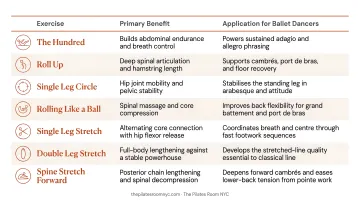
These seven exercises cover the core demands of classical dance training. Once they feel consistent and controlled on the mat, reformer work adds resistance and range that accelerates each of these gains further.
Essential Pilates Reformer Exercises for Dancers
The Reformer changes the equation in one important way: spring resistance provides both assistance and challenge simultaneously, allowing dancers to work at their end ranges of motion with support. That matters because dance demands strength in extended, lengthened positions — not just the mid-range where most strengthening exercises live.
Footwork Series
Working the feet against spring resistance in turnout targets several systems at once. Key targets include:
- Intrinsic foot muscles and full calf complex, trained in turnout under offloaded conditions
- Hip rotators engaged in positions that mirror the demands of dance
- Reduced joint loading for dancers managing foot or ankle issues or preparing for pointe work
IADMS guidelines on pointe readiness identify core stability, plantar-flexion range, lower-extremity alignment, and additional strengthening for hypermobile feet and ankles as key readiness factors. Reformer Footwork addresses several of these in a single exercise series.
Asymmetrical and Rotational Work
Exercises like the Advanced Snake place the body in off-center positions that demand spinal control, rotational stability, and simultaneous integration of the core, hips, and upper body — the same coordination dance requires during turning sequences and partnering work.
The Reformer's spring mechanism is especially useful for hypermobile dancers, a common profile in dance training populations. Rather than hanging passively on joints at end range, the spring feedback prompts genuine muscular engagement throughout the full movement.
Dancers seeking Reformer programming tailored to performance goals can work with instructors at The Pilates Room NYC who bring direct performance backgrounds. Instructor Barbara Hoon began her Pilates practice as a dancer at The Juilliard School, trained under Patrick Strong and Kathryn Ross-Nash, and performed as an original member of Twyla Tharp Dance. She credits Pilates with preventing injuries throughout her entire performance career.
The studio's Pilates for Performers program, co-founded by Hoon and studio owner Alison Johnson (a BFA dance graduate who began Pilates training as a dancer in 1994), is designed specifically for performing artists and movement professionals.
How Pilates Prevents and Rehabilitates Common Dance Injuries
Most serious dance injuries don't arrive suddenly. They build. Repetitive turnout, relevé, and jumping patterns create predictable overuse injuries — stress fractures, hip impingement, patellar and Achilles tendinopathy — not from a single incident but from muscle imbalances accumulating rep after rep, class after class.
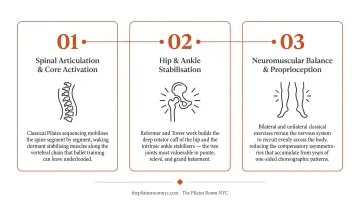
Pilates addresses this by building muscular balance in the areas dance systematically loads unevenly:
- Strengthens the hip rotators, glutes, and lower abdominals
- Releases demand from the overworked hip flexors and lower back extensors
- Restores equilibrium that prevents compensatory patterns from becoming structural habits
Rehabilitation and Return to Training
When injuries do occur, Pilates allows dancers to maintain conditioning and begin re-strengthening before full weight-bearing is appropriate. Spring-assisted Reformer work minimizes joint loading while preserving the neuromuscular firing patterns that full training later requires — meaning dancers return to class with their motor memory intact rather than having to rebuild from scratch.
One critical caveat: Pilates done with the wrong muscles reinforces exactly the imbalances it's supposed to correct. A dancer compensating through hip flexors and lower back during mat work won't get the injury-prevention benefit — they'll simply get stronger at the wrong pattern. Periodic work with a knowledgeable instructor is especially important when managing an active injury or returning from one.
At The Pilates Room NYC, Enja Schenck (MS in Sport Science, CSCS) specializes in adapting training to each client's individual capabilities — a critical skill when working with dancers navigating injury. Barbara Hoon, co-founder of Pilates for Performers and a former member of Twyla Tharp Dance, brings firsthand performance experience to how she addresses dancer-specific movement patterns.
How to Build Pilates Into Your Dance Training Schedule
The most common concern is straightforward: there's no room in an already demanding schedule. But Pilates, done correctly, functions more as neuromuscular re-patterning than additional load. Many dancers report that consistent Pilates actually reduces overall training fatigue by improving how efficiently they use their bodies in class.
A Practical Starting Framework
If you're new to Pilates, start here:
- Begin with 2–3 mat sessions per week on non-consecutive days
- Focus on the core and hip exercises described above
- Keep sessions to 20–30 minutes — well-executed short sessions outperform longer ones done with the wrong muscles
Once mat fundamentals feel consistent and the right muscles are reliably activating:
- Add one Reformer session per week
- This combination — mat foundations plus Reformer — is where results accelerate
At The Pilates Room NYC, several session formats work well for dancers:
- Apprentice sessions ($80) are ideal for students, dancers, and performers seeking affordable, consistent practice
- Private sessions with senior instructors offer closer attention to technique for those working through injury or technical challenges
- Small group sessions ($50/person) provide a focused environment for dancers comfortable with the fundamentals
Setting Realistic Expectations
The scheduling framework above sets you up for progress — but knowing what to expect keeps you consistent through the early weeks when changes are still subtle.
A well-cited principle attributed to Joseph Pilates goes: in 10 sessions you feel the difference, in 20 you see it, and in 30 you have a whole new body. The research supports the general timeline: an 11-week mat Pilates program in ballet students produced significant gains in isometric strength for skills including penché and développé.
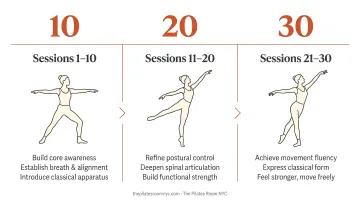
Expect 10–12 weeks of consistent practice before measurable changes appear in dance technique.
Frequently Asked Questions
Should dancers do Pilates?
Yes. Pilates builds the deep core stability, hip rotator strength, and body awareness that dance training alone consistently undertrain. Those gaps directly increase injury risk and limit technical control — addressing them through Pilates produces measurable improvements in both.
What is the 10/20/30 rule in Pilates?
It's a principle attributed to Joseph Pilates: in 10 sessions you feel the difference, in 20 you see the difference, and in 30 you have a whole new body. Published research supports the general timeline, with meaningful strength and neuromuscular gains documented after 8–11 weeks of consistent practice.
How often should dancers do Pilates?
Start with 2–3 mat sessions per week on non-consecutive days. Once the foundations feel solid, add one Reformer session weekly. Consistency across several weeks matters more than session length — even 20 minutes of well-executed work produces results.
Can Pilates improve turnout for dancers?
It can improve functional (active) turnout, which is what matters on stage. Professional dancers average roughly 35 degrees of active hip external rotation versus 50 degrees of passive range. Exercises like the Clam and Side Leg Series strengthen the external rotators, which can close that gap over time.
Is mat Pilates or Reformer Pilates better for dancers?
Both serve different purposes and work best together. Mat work builds fundamental core activation and is accessible anywhere. The Reformer enables strength work in extended, end-range positions with spring assistance — the positions dance actually demands. Neither replaces the other.
Can Pilates help with pointe work preparation?
Yes. IADMS pointe-readiness guidelines identify core stability, plantar-flexion range, and foot/ankle strength as key factors. Reformer Footwork combined with hip-stabilizer and alignment work directly addresses several of these requirements.