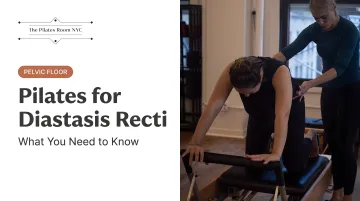
The frustrating reality is that Pilates can be one of the most effective tools for recovery — or it can make the separation worse. Which outcome you get depends almost entirely on which exercises you choose and whether someone knowledgeable is watching your form.
This article covers what diastasis recti actually is, how to check if you have it, why Pilates is well-suited for recovery when done correctly, which moves to skip, what safe modifications look like, and why personalized instruction matters more here than in almost any other fitness context.
Key Takeaways
- Diastasis recti affects core stability, not just appearance — it can contribute to back pain, pelvic floor issues, and postural changes
- Pilates targets the transverse abdominis, the deep muscle layer most critical to healing
- Common exercises like crunches, the Hundred, and full planks can worsen separation without proper modification
- The key warning sign during any exercise is visible "doming" along the midline of the abdomen
- In early recovery, work with a qualified instructor in a private or semi-private setting
What Is Diastasis Recti?
The Anatomy
Diastasis recti is a separation of the rectus abdominis — the paired "six-pack" muscles — along the linea alba, the connective tissue running down the center of the abdomen. During pregnancy, intra-abdominal pressure and hormonal changes cause this tissue to stretch and thin, allowing the two muscle columns to pull apart.
The European Hernia Society defines diastasis recti as a separation wider than 2 cm, which roughly corresponds to two finger-widths, a screening benchmark referenced throughout clinical guidance.
Who It Affects
Diastasis recti is most common in pregnant and postpartum women, but it also occurs in people who have never been pregnant. Factors like rapid weight change, improper heavy lifting, and changes in abdominal pressure over time can all contribute.
A 2024 cross-sectional study found a prevalence of nearly 30% in a sample of over 1,500 men using a 2 cm threshold. This condition isn't exclusive to the postpartum conversation.
Severity ranges widely: some people have a mild separation with minimal functional impact, while others have a significant gap that warrants medical evaluation before starting any exercise program.
Why It Matters Beyond Appearance
This is not a cosmetic issue. A separated linea alba compromises core stability, which can contribute to:
- Lower back and lumbopelvic pain
- Pelvic floor dysfunction, including stress urinary incontinence
- Reduced ability to generate and transfer force through the trunk
- Poor postural control that persists long after delivery
The evidence on causation is genuinely mixed — some studies find associations between diastasis recti and back pain while others don't. But one thing holds consistently: when the muscles of the abdominal wall can't coordinate properly, surrounding structures like the lower back and hips pick up the slack. Over time, that load redistribution contributes to the pain and dysfunction many people experience.
How to Check If You Have Diastasis Recti
The Self-Assessment
You can perform a basic screen at home:
- Lie on your back with knees bent and feet flat on the floor
- Place two or three fingertips horizontally just above your belly button
- Slowly lift only your head off the mat — not your shoulders
- Feel for a gap between the muscle columns and notice how deep your fingers sink
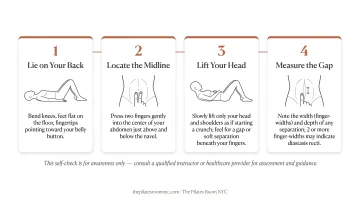
A soft, trench-like gap wider than approximately two finger-widths (about 2 cm) suggests separation worth investigating. If you feel your fingers sinking in significantly with little resistance, that indicates the connective tissue has thinned.
Why Professional Assessment Matters
What you find at home is a reason to seek evaluation — not a diagnosis. Research comparing finger-width palpation to ultrasound found that palpation reliability ranged from poor to moderate, with poor validity against ultrasound overall.
A trained healthcare provider or postnatal movement specialist can offer much more:
- Palpate more accurately than self-assessment allows
- Check for visible "doming" during movement
- Screen for any associated hernia
- Determine a safe starting point for exercise
If you suspect moderate-to-severe separation, consult your doctor or a certified postnatal specialist before starting any program.
Why Pilates Supports Diastasis Recti Recovery
The Transverse Abdominis Connection
Pilates is built around the transverse abdominis (TVA) — the deepest abdominal layer, wrapping around the torso like an internal corset. That's exactly what diastasis recti recovery builds on.
Unlike exercises that target the superficial rectus abdominis and push outward on the healing linea alba, TVA engagement draws the abdomen inward. That inward tension provides the internal support the connective tissue needs to regain function and, over time, reduce in width.
An 8-week Pilates program in a 2023 study reduced inter-recti distance, decreased waist circumference, and improved abdominal muscle endurance in postpartum women — evidence that supervised Pilates, when properly structured, produces measurable results.
Breath-Core Coordination
Pilates teaches coordinated breathing: exhaling on exertion while drawing the navel toward the spine. This breath pattern re-establishes the functional relationship between the diaphragm, pelvic floor, and deep abdominals — the pressure management system that diastasis recti disrupts.
Breath coordination and core engagement aren't just warmup cues in Pilates. They're woven into every exercise, which is why the method translates so directly to postpartum recovery — the rebuilding happens with every rep, not just the exercises labeled "rehab."
Progressive, Low-Impact Loading
Pilates allows a systematic build from gentle activation work to increasingly demanding movement, without the high intra-abdominal pressure generated by running, jumping, or heavy lifting. This matters because healing connective tissue needs load applied gradually:
- Too much too soon widens the gap
- Too little means slow, stalled progress
- The right progression builds load while protecting the linea alba
The method also trains the core as part of an integrated system — the core stabilizes while the limbs move, which mirrors the demands of real daily life and protects the healing abdomen in the process.
Postural Restoration
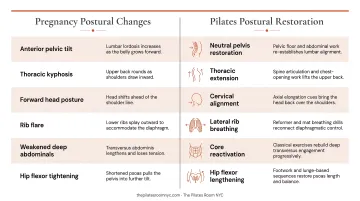
Pregnancy shifts the body's center of gravity and alters spinal alignment, rib positioning, and hip tilt. These changes often persist postpartum, placing additional mechanical stress on an already-weakened linea alba. Pilates directly addresses these postural imbalances. That makes it useful not just for the gap itself, but for the compensation patterns that develop throughout the body when the core stops doing its job.
Pilates Moves to Avoid with Diastasis Recti
The real focus here is identifying which movements create unmanageable intra-abdominal pressure, then modifying or skipping them when your body gives you the signal.
The primary warning sign: doming. This is when the abdomen visibly bulges upward in a ridge along the midline during an exercise. Any movement that causes doming should be stopped and modified immediately.
Movements That Commonly Cause Problems
| Exercise Category | Examples | Why It's Problematic |
|---|---|---|
| Forward flexion from supine | Crunches, sit-ups, the Hundred, Roll Up | Pushes outward on the linea alba; common cause of doming |
| Bilateral leg lowers | Double leg lowers, the Teaser | High load on pelvic floor and abdominal wall |
| Front-loaded holds | Full high planks, push-ups | Gravity-loaded positions that can cause the separation to widen early in recovery |
| Loaded rotation | Criss-Cross, Corkscrew without modification | Stresses obliques and linea alba in ways that can impede healing |
| High-impact and heavy-loading | Running, jump rope, heavy deadlifts | Generates pressure the weakened core cannot manage safely |
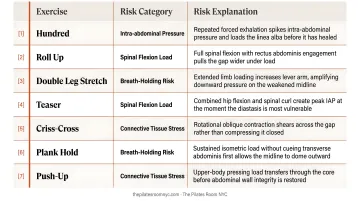
Worth noting: research doesn't support a flat rule like "all planks are harmful" or "all flexion is forbidden." What it does support is avoiding movements that produce doming, pain, breath-holding, or uncontrolled separation. An instructor who can watch for those signs in real time will always give you more useful guidance than any static list.
Safe Pilates Exercises and Modifications for Recovery
Start With Breath and TVA Activation
Every safe diastasis recti exercise starts with the same foundation: learning to engage the TVA through breath. The "draw the navel to the spine on exhale" cue is the cornerstone of every safe diastasis recti exercise.
Practice diaphragmatic breathing first — expanding the ribcage in all directions on the inhale, gently drawing in on the exhale — before progressing to any loaded movement. For many postpartum clients, this is the primary work in early sessions — not a warmup.
Lower-Load Starting Positions
These positions reduce gravitational challenge on the healing abdomen while building strength in the surrounding structures:
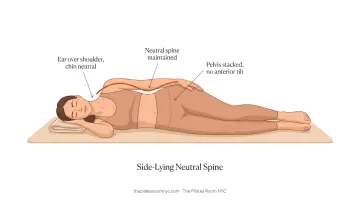
- Side-lying exercises: Clamshells, side-lying hip abduction, leg circles
- Seated arm work: Builds upper body and posterior chain without loading the midline
- Supported bridge variations: Excellent for glute and hip activation with controlled abdominal engagement
- Tabletop bird dog: Extending one arm and the opposite leg from a hands-and-knees position, maintaining neutral spine throughout
Modified Classical Movements
The intent of Classical Pilates exercises can be preserved while removing harmful pressure:
- Modified single-leg marching in supine, with one foot grounded, instead of bilateral leg work
- Incline plank variations with hands on a wall or bench, gradually reducing the incline as strength builds
- Wall-supported standing exercises that engage the whole body without floor-based pressure
Knowing When to Progress
The signal to advance is functional, not calendar-based. Look for:
- No doming during current exercises
- Improved TVA awareness and consistent engagement through breath
- Reduced gap width and increased tissue tension on self-check (gently pressing two fingers along the midline to feel for depth and resistance)
Change only one variable at a time — position, range of motion, or load — before adding the next challenge.
Individual timelines vary considerably based on age, number of pregnancies, delivery type, and consistency of practice. A client recovering from a cesarean section will have a different starting point than someone who had an uncomplicated vaginal birth.
Why Working with a Qualified Instructor Matters
The Risk of Unmodified Classes
A standard Pilates class — even one marketed as "beginner" — will typically include exercises that are contraindicated in early diastasis recti recovery: some form of spinal flexion, bilateral leg work, and plank variations. Without an instructor who understands the condition and can observe abdominal response in real time, a well-intentioned routine can deepen separation rather than heal it.
Pilates itself isn't the issue. The missing piece is individualization.
What to Look for in an Instructor
For diastasis recti recovery, seek instructors who can demonstrate:
- Documented experience with pre/postnatal clients
- Ability to assess abdominal separation and identify doming during movement
- Willingness to adapt exercises based on what they observe in each session
- Clear scope of practice — a good instructor refers out to a healthcare provider when needed, rather than diagnosing or treating medical conditions
One-on-one or small-group sessions are preferable in early recovery. The instructor needs to see your abdomen, watch your breath, and adjust cues in real time. That simply isn't possible in a general class of any size.
Working with Experienced Postnatal Specialists
At The Pilates Room NYC in Chelsea, owner and lead instructor Alison Johnson brings over 26 years of teaching experience and a specific background in pre- and postnatal movement. Having had two children by cesarean section herself, she offers both professional expertise and firsthand understanding of postpartum recovery.
The studio's approach — tailoring each session to the client's physical, mental, and emotional state that day — fits particularly well with the variable, non-linear nature of diastasis recti recovery.
Frequently Asked Questions
Will Pilates heal diastasis recti?
Properly modified Pilates can significantly support healing by strengthening the transverse abdominis and restoring core function. An 8-week supervised program showed measurable reductions in inter-recti distance. That said, Pilates needs to be modified for your specific presentation — unmodified sessions can worsen separation rather than help it.
What Pilates moves should you avoid with diastasis recti?
Avoid forward flexion from supine (crunches, sit-ups, the Hundred), bilateral leg lowering, and full planks or push-ups. The more reliable rule: stop any movement that causes visible doming along the midline of your abdomen.
How do I know if I have diastasis recti?
Lie on your back with knees bent, place two fingers horizontally above your belly button, and slowly lift just your head. A soft gap wider than about two finger-widths (roughly 2 cm) suggests separation worth evaluating. A healthcare provider or trained postnatal specialist can assess more accurately than any self-test.
When can I start Pilates after having a baby?
Most care providers recommend waiting for medical clearance — typically around 6 weeks postpartum, and longer after a cesarean section. Early recovery should start with gentle breathing and TVA activation rather than full movement programs. Individual timelines vary, so always follow your care team's guidance.
Can diastasis recti heal without exercise?
Mild cases may partially resolve with time. For moderate-to-severe separation, passive recovery rarely produces full functional improvement. Targeted exercise that activates the transverse abdominis consistently outperforms rest alone in the available research.
Do I need private sessions, or can I attend group classes?
Private or semi-private sessions are strongly recommended in early recovery — an instructor needs to observe your movement, watch for doming, and adjust exercises in real time. Group classes become more appropriate once you have solid TVA awareness and your instructor has confirmed it's safe to progress.