Introduction
Pilates participation in the US hit 11.9 million people in 2023, up 28.3% from 2019, and New York City sits at the center of that growth. Reformer studios, boutique group classes, hybrid fitness formats — the options multiply every season.
But beneath the marketing, two distinct traditions shape everything: classical Pilates and contemporary Pilates. For anyone in NYC trying to choose a studio, that distinction is worth understanding before you book.
The style you practice shapes how you progress, what your sessions look like week to week, and whether your instructor is trained to work with your specific body and goals. This article breaks down the differences across philosophy, equipment, sequencing, and certification — so you can make an informed choice.
Key Takeaways
- Classical Pilates preserves Joseph Pilates' original system — fixed exercise order, original apparatus, documented lineage
- Contemporary Pilates adapts that foundation using modern biomechanics and physical therapy research
- Both traditions share the same six core principles: breath, control, precision, centering, concentration, and flow
- The right choice depends on your goals, body, and instructor quality — not which style is inherently superior
- In NYC, always ask a prospective instructor about their certification program, training hours, and lineage
Classical vs. Contemporary Pilates: A Quick Comparison
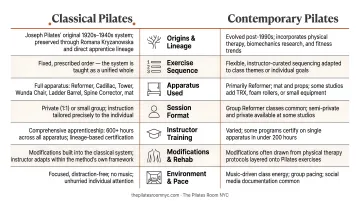
| Dimension | Classical Pilates | Contemporary Pilates |
|---|---|---|
| Philosophy | Original method, complete as designed | Living framework, evolves with research |
| Exercise Order | Fixed, systematic classical sequence | Variable, instructor-selected by client need |
| Equipment | Original Joseph Pilates apparatus (e.g., Gratz) | Original apparatus plus modern variants |
| Props | None beyond the apparatus | Resistance bands, foam rollers, small balls common |
| Instructor Lineage | Documented, traceable to Joseph Pilates | Not required; programs develop independent curricula |
| Adaptability | Method stays fixed; application adapts to individual | Both method and application adapt to context |
| Certification Depth | Comprehensive, integrated (600 hours, full repertoire) | Often modular; depth varies widely by program |
What Is Classical Pilates?
Joseph Pilates called his system Contrology — a complete, integrated method of physical and mental conditioning he developed in New York City from the 1920s until his death in 1967. He codified the mat work in Return to Life Through Contrology, first published in 1945, which details the original 34 mat exercises. The key word is system — classical Pilates is not a collection of exercises. It has an internal logic.
The Lineage That Kept It Intact
After Joseph Pilates died, a group of first-generation students — sometimes called the Elders — preserved and transmitted the method. The most significant lineage anchor for classical Pilates today is Romana Kryzanowska, who became Joseph Pilates' student and assistant in 1940, studied and worked with Joseph and Clara until his death in 1967, and continued teaching with Clara until 1977. Romana formalized classical teacher training and the lineage most classical instructors trace today runs directly through her.
Several instructors at The Pilates Room NYC hold certifications in that direct line:
- Alison Johnson (Owner) — trained under Romana and Bob Liekens through The Pilates Guild, certified 1998
- Pamela Pardi — studied under Romana at the Original Pilates Studio; appointed Level 3 Instructor Trainer in Romana's Pilates program in 2004, authorizing her to certify other teachers
- Ilaria Cavagna — received her Pilates certification directly under Romana Kryzanowska in NYC
- Xavier Cha — completed over 900 hours at True Pilates New York through Romana's Pilates, studying under Romana and her daughter Sari Mejio Santo
Enja Schenck brings a complementary lineage: certified by Bob Liekens in 2004, she spent eight years working alongside him before serving as Lead Teacher-of-Teachers for the Power Pilates Teacher Training Program, a 600-hour comprehensive classical certification.
What a Classical Session Actually Looks Like
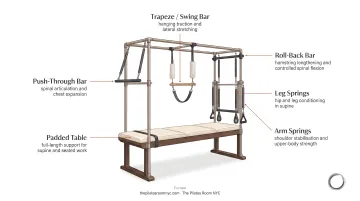
Classical sessions follow the established sequence — exercises ordered so each movement prepares the body for the next. On the mat, that sequence comprises the original 34 exercises. On the Reformer, Cadillac (Trapeze Table), Wunda Chair, Ladder Barrel, and Spine Corrector, the sequencing logic extends across the full apparatus.
A common misconception: classical Pilates is rigid or inaccessible. The sequence is a framework, not a straitjacket. Exercises are skipped, modified, or built toward based on each client's level, injury history, and goals. The architecture stays the same; how you inhabit it changes.
Over time, classical sessions deepen rather than just vary. Each session builds on the last. Clients who stay with it long enough notice the difference between having done many sessions and having developed a practice.
Who Classical Pilates Serves Well
That depth makes classical Pilates well-suited to a wide range of people:
- Athletes, dancers, and performers seeking systematic strength and movement quality
- Individuals with long-term goals around posture, functional movement, and progressive mastery
- Special populations — injury rehabilitation, osteoporosis, cancer recovery, pre/postnatal, and seniors — where the full classical apparatus allows precise, carefully adapted work
At The Pilates Room NYC, this breadth is lived experience. Alison Johnson has navigated her own two cesarean births alongside clients managing autoimmune disorders, cancer treatments, and acute injuries. One client with a chronic shoulder injury — unresolved after physical therapy — found the resolution she needed working with Alison through the classical apparatus.
What Is Contemporary Pilates?
Contemporary Pilates is an umbrella term for modern adaptations of Joseph Pilates' original method. It retains the classical foundation but incorporates advances in physical therapy, sports science, and biomechanics. The major established providers include STOTT Pilates (Merrithew), Balanced Body, BASI Pilates, and Polestar Pilates.
What Makes It Distinct
The most visible differences from classical Pilates:
- Variable sequencing — instructors design sessions around individual client needs rather than following a fixed order
- Neutral spine emphasis — STOTT, for example, teaches both neutral and imprint pelvic positions based on modern spinal biomechanics, whereas classical Pilates uses a different relationship to lumbar placement
- Props and supplemental equipment — resistance bands, foam rollers, small balls, and Pilates rings are common
- Modular certification pathways — instructors can complete training in stages rather than a single comprehensive program
Clinical Fit and Beginner Accessibility
Contemporary sessions offer more varied class structures, greater instructor latitude, and frequent integration with group fitness formats. The approach is strongly represented in clinical and rehabilitation settings — many physiotherapists and occupational therapists hold contemporary certifications precisely because the framework aligns closely with physical therapy practice.
It's also a common starting point for beginners who benefit from more scaffolded modifications, and for clients whose referring physiotherapist has recommended a specific contemporary program.
A Critical Caveat for NYC
That said, "Contemporary Pilates" covers a wide range of quality — and the label alone tells you very little. Established comprehensive programs from BASI (500 hours), Balanced Body (520 hours), and Polestar (450 hours) represent serious training. STOTT/Merrithew tracks separate Matwork/Reformer (310 hours) from Cadillac/Chair/Barrels (165 hours) — an instructor may have completed one track but not the other.
The NPCP sets a 450-hour minimum across mat and major apparatus as the floor for comprehensive certification. Below that threshold, training depth becomes highly variable — and some in-house studio programs run far shorter than that.
Ask specifically: total hours, which apparatus were covered, was the program comprehensive or modular?
Which Is Better for You?
Neither style is objectively superior. The meaningful question is which approach, delivered by which instructor, best serves your body and goals right now. Many experienced practitioners and instructors have trained in both.
Choose Classical If:
- You want a systematic, long-term approach with documented lineage
- You're a dancer, athlete, or performer drawn to progressive mastery
- You want sessions that build on each other within an internally coherent method
- You value knowing your instructor's qualifications trace back to the source
Choose Contemporary If:
- You're in active rehabilitation working closely with a physiotherapist
- Your referring clinician recommends a specific contemporary program
- You prefer more varied session structures
- Your primary access point is a studio that teaches a specific contemporary system
The One Thing That Matters Most — Regardless of Style
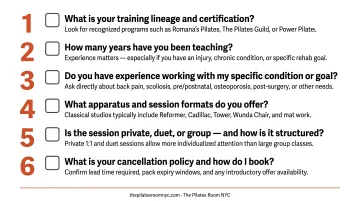
Whichever path you choose, the style label on the door matters less than the person standing in front of you. Vet your instructor. When evaluating anyone you're considering working with, ask:
- What program certified you? Name matters — "certified Pilates instructor" tells you almost nothing on its own.
- How many training hours? Look for 450 minimum for a comprehensive program; classical programs like Power Pilates require 600.
- Which apparatus were covered? Reformer-only training is not comprehensive.
- Was the path comprehensive or modular? Modular certifications can leave real gaps.
- How long have you been teaching? Hours on the floor matter as much as certification hours.
- Do you have experience with my specific situation? This is especially relevant for rehabilitation, osteoporosis, prenatal work, and seniors.
At The Pilates Room NYC in Chelsea (150 West 28th Street), instructor credentials and lineage are publicly listed on the studio's website before you commit to a session. The team holds classical certifications through The Pilates Guild, Power Pilates, and Romana's Pilates, with several instructors carrying direct lineage to Romana Kryzanowska. If you're ready to experience the classical method, contact the studio or book a session directly.
Conclusion
Classical Pilates is a complete, time-tested system with documented lineage and real progressive depth. Contemporary Pilates trades some of that structure for adaptability and integration with modern movement science. Both are legitimate — neither is universally superior.
In NYC's crowded fitness market, the style on the door matters far less than the instructor behind it. Ask about their certification lineage, how long they've been teaching, and whether their approach is tailored to your specific needs. At a studio like The Pilates Room NYC, where instructors carry 15 to 35 years of classical training, that question has a clear answer. Find a practice you can commit to over time — that's the only variable that consistently predicts results.
Frequently Asked Questions
What is the difference between classical and contemporary Pilates?
Classical Pilates preserves Joseph Pilates' original system (Contrology) with a fixed exercise order and documented lineage traceable to named first-generation teachers. Contemporary Pilates adapts that foundation using modern biomechanics and physical therapy research, with variable sequencing, props, and more flexible instructor certification pathways.
Is classical Pilates harder than contemporary Pilates?
Classical Pilates is not inherently harder — it's more systematic, with a fixed progression that scales from beginner to advanced. The challenge itself differs in character: classical works within a defined, cumulative logic, while contemporary gives instructors more latitude to design sessions around individual needs and goals.
Can beginners start with classical Pilates?
Absolutely. The classical method is designed to meet each student where they are — exercises are adapted or modified based on your current level. A qualified classical instructor assesses your starting point and progresses the work at your pace.
Which type of Pilates is better for injury rehabilitation or special populations?
Both classical and contemporary Pilates can support rehabilitation and special populations. The instructor's specific experience with your condition matters more than the style label. Classical apparatus — particularly the Cadillac/Trapeze Table — allows highly supported, precise work across a wide range of physical limitations.
Does Pilates help with high cortisol?
The evidence is mixed. Pilates-specific cortisol studies have produced inconsistent results — one study in healthy older women found cortisol levels increased, and a study in colorectal cancer survivors found no significant change. Both classical and contemporary Pilates emphasize breath, concentration, and controlled movement, which many people find calming, but claiming Pilates reliably lowers cortisol isn't supported by current research.
How do I know if a Pilates instructor is classically trained?
Ask directly: which program certified them (Pilates Guild, Power Pilates, Romana's Pilates, True Pilates), how many total training hours were required, and which apparatus the certification covered. Classically trained instructors should be able to name the teachers they studied under and trace that lineage back through the classical tradition to Joseph Pilates' direct students.