Reformer Pilates offers a different path. According to the Sports & Fitness Industry Association, approximately 12 million Americans practiced Pilates in 2023, with participation growing 15% in a single year. Older adults are discovering it for good reason: the reformer's spring-resistance system makes it uniquely forgiving on aging joints while still delivering real, measurable results.
This article covers why the reformer suits aging bodies specifically, the physical and mental benefits backed by research, how to modify practice for conditions like osteoporosis and arthritis, and how to find the right instructor to get started safely.
Key Takeaways
- Muscle mass declines 3–8% per decade after 30, accelerating after 60 — resistance-based reformer work directly counters this
- 1 in 4 older adults falls each year; Pilates improves balance and directly reduces fall-risk factors
- The reformer's spring system supports the body through movement, making it more accessible than mat Pilates or gym equipment
- Modifications exist for osteoporosis, arthritis, and limited mobility — no prior experience is required
- Two to three sessions per week is a research-backed starting point for building strength and balance in older adults
How Aging Changes the Body — And Why the Right Exercise Matters
After 60, several physiological changes compound if left unaddressed:
- Sarcopenia: Muscle mass decreases approximately 3–8% per decade after age 30, with the rate accelerating after 60, according to a peer-reviewed NIH review
- Bone density: Peaks in early adulthood, then gradually declines — leaving bones more vulnerable to fracture
- Joint flexibility: Connective tissue stiffens, reducing range of motion
- Balance and proprioception: The body's ability to sense its position in space becomes less reliable, increasing fall risk
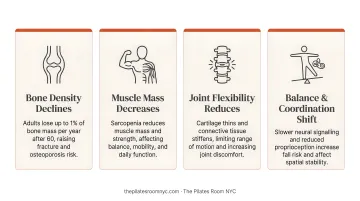
Together, these changes make falls one of the leading causes of injury and lost independence in older adults. The CDC reports that over 14 million older adults — 1 in 4 — fall each year, resulting in approximately 3 million emergency department visits and 1 million hospitalizations annually.
Why Walking Isn't Enough
Walking and light cardio offer genuine cardiovascular benefits. But they don't address what aging bodies need most: muscle strengthening, resistance work, and targeted balance training.
The CDC recommends adults 65 and older perform muscle-strengthening activities on at least two days per week. The reformer is one of the most practical ways to meet that need, particularly for people who have avoided traditional gym environments.
Why the Reformer Is Uniquely Suited for Older Adults
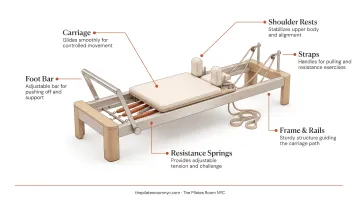
A reformer is a sliding carriage mounted on a frame, with an adjustable spring-resistance system, foot bar, and straps. What makes it different from free weights or bodyweight exercise is the spring mechanism itself: it can be set to either assist or resist movement, depending on the exercise and the client's needs.
This matters enormously for older adults. With free weights or bodyweight training, the full load must be managed by the user from the first rep. The reformer partners with the body instead, providing support through the movement — which reduces strain on joints while still generating enough resistance to build real muscular strength.
Reformer vs. Mat Pilates for Seniors
Mat Pilates requires full range of motion and independent core control from the start. Exercises like roll-ups and leg circles demand what many seniors simply don't yet have — not because of age, but because of deconditioning, stiff joints, or limited flexibility.
On the reformer, springs support the body through those same movements. A senior with a tight lower back or limited hip mobility can perform exercises with correct form from their very first session. Strength and flexibility build from there, at whatever pace the body allows.
Built-In Adaptability
A few other features make the reformer particularly well-suited for older adults:
- Working positions (supine, seated, kneeling, standing) allow sessions to be structured progressively, with natural rest points built in
- Resistance adjusts in seconds, so a skilled instructor can dial spring tension up or down mid-session based on how a client feels that day
- The foot bar and frame give clients a physical reference point during standing work, which helps those managing balance concerns move with more confidence
A 2024 peer-reviewed study confirmed that modifying reformer spring resistance measurably affects core muscle activation, supporting the practice of adjusting springs to match each individual's capacity.
Key Benefits of Reformer Pilates for Seniors
Builds Functional Strength and Slows Muscle Loss
Reformer exercises target both large muscle groups and the smaller stabilizing muscles responsible for everyday movement — getting up from a chair, carrying groceries, climbing stairs. These are often the first muscles to weaken with age, and they're rarely addressed in traditional gym workouts.
Resistance training is the most effective tool for slowing sarcopenia. Given that muscle mass can decline 3–8% per decade even in active adults, structured resistance work like reformer Pilates becomes an increasingly sound investment as the years go on.
Improves Balance, Coordination, and Fall Prevention
Reformer exercises challenge proprioception in a controlled environment. The body learns to detect and correct its position more accurately — a skill that directly translates to steadier movement in daily life.
A 2021 systematic review and meta-analysis of 12 randomized controlled trials involving 702 healthy older adults found that Pilates may reduce fall-risk factors by improving functional mobility, gait, fear of falling, and dynamic balance. A separate 2015 equipment-Pilates RCT found that just two sessions per week for 12 weeks improved static and dynamic postural balance in community-dwelling older adults.
Supports Bone Health
Weight-bearing and resistance exercise is among the most effective non-pharmacological approaches to slowing bone density loss. On the reformer, standing sequences and squats in the well provide bone-stimulating resistance. Seated and supine exercises add muscle strength around the skeleton without compressive spinal loading.
One important caveat: current evidence does not support the claim that Pilates directly increases bone mineral density. The more accurate framing is that resistance exercise complements bone health management. A qualified instructor can design reformer sessions that support bone health without putting fragile bones at risk.
Relieves Back Pain and Improves Posture
Aging often brings progressive rounding of the upper spine (kyphosis), driven by weakening of the postural muscles in the back, core, and glutes. Reformer Pilates directly targets the deep core, upper back extensors, and gluteal muscles — all of which decompress the spine and support upright posture.
A 2024 PubMed-indexed review found that Pilates exercise can decrease low back pain compared with both no exercise and non-specific exercise interventions.
Supports Mental Health and Cognitive Function
Classical Pilates — as practiced at studios like The Pilates Room NYC — is built around six principles:
- Concentration
- Control
- Centering
- Flow
- Precision
- Breath
That degree of intentional focus creates a meditative quality that's hard to replicate in a typical gym setting.
A 2020 study published in the International Journal of Environmental Research and Public Health followed 110 women aged 60 and older through a 12-week Pilates program. The results showed significant improvements in cognitive function and verbal fluency, alongside gains in lower-body strength — evidence that the mind-body demands of Pilates do more than build muscle.
Modifying Reformer Pilates for Common Senior Health Concerns
Osteoporosis
Standard mat Pilates exercises that involve forward spinal flexion, rolling, or twisting at the waist carry genuine fracture risk for people with osteoporosis. The Bone Health and Osteoporosis Foundation advises against bending the spine forward, and Mayo Clinic warns that rotational movements can increase spinal fracture risk.
The reformer offers more osteoporosis-safe options than the mat. Exercises can be performed in supported positions — supine, seated, or standing — that avoid spinal loading while still providing resistance for both muscle and bone. Working with an instructor experienced in osteoporosis modification is essential — the exercise selection and spring resistance must be calibrated specifically to each client's needs.
At The Pilates Room NYC, instructors tailor sessions explicitly for clients managing osteoporosis, adapting both exercise selection and spring resistance to meet each client's needs safely.
Arthritis and Joint Pain
The ACR/Arthritis Foundation guidelines strongly support exercise for knee, hip, and hand osteoarthritis — including strengthening work. The reformer's spring resistance absorbs force rather than transferring it directly through painful joints, allowing movement within a pain-free range.
Key principles for arthritic clients:
- Move slowly and deliberately
- Never force range of motion beyond what's comfortable
- Communicate with your instructor about which joints are affected
- Progress is gradual, but the cumulative benefit for joint support is real
Balance Challenges and Limited Mobility
Significant balance challenges are actually well-suited to reformer Pilates. Sessions begin from supine or seated positions, where stability isn't a factor. Progression to standing work happens gradually — only once the client is ready — with the foot bar and reformer frame available for support throughout.
A reformer session should feel controlled at every stage. If something feels unsteady, that's the instructor's cue to reduce load, adjust positioning, or slow the progression.
Recovering from Injury or Managing Chronic Conditions
Reformer Pilates has a documented history in rehabilitation contexts — post-surgical recovery, knee and hip injuries, and chronic pain management. Instructor Xavier Cha at The Pilates Room NYC has specific experience with post-operative joint rehabilitation. Instructor Enja Schenck (MS, CSCS) brings a background in Sport Science and the Postural Restoration Institute, making her particularly skilled at designing programs that accommodate injuries rather than aggravating them.
That expertise shapes how sessions are structured — but physician clearance is still the starting point for any post-surgical client. With that in place, the instructor can build a program that actively supports recovery.
How to Get Started with Reformer Pilates as a Senior
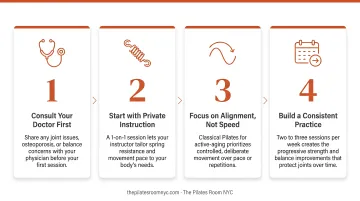
Step 1: Consult your physician first. If you're managing osteoporosis, a cardiovascular condition, or recovering from surgery, a brief conversation with your doctor ensures any exercise restrictions are known before your first session.
Step 2: Start with private sessions. Group reformer classes move at a pace set for the whole room. A private session gives an instructor time to assess your posture and movement patterns, introduce the reformer's mechanics without rushing, and make real-time modifications. That foundation makes everything that follows safer and more effective.
At The Pilates Room NYC, instructors are matched to clients based on specific needs and health history. New clients receive a 15% introductory discount on their first private session.
Step 3: Set realistic expectations. Your first few sessions will focus on fundamentals: breathing mechanics, core activation, and neutral spine. These fundamentals are the groundwork that makes every future session more productive. Most clients feel a meaningful difference within the first month.
Step 4: Aim for two to three sessions per week. Studies on older adults typically use two sessions per week over 12 weeks, with measurable improvements in strength, balance, and functional mobility. Three sessions per week accelerates progress. Starting with two and building from there is a manageable starting point.
Frequently Asked Questions
Are Pilates reformers good for seniors?
Yes — the reformer is especially well-suited for older adults. Its spring-resistance system supports the body through movement, reduces joint strain, and adapts to any fitness level or health condition, making it more accessible than most forms of resistance exercise.
Can Pilates help a torn meniscus?
Reformer Pilates is not a substitute for medical treatment, but with physician clearance, it can support recovery by strengthening the quadriceps, hamstrings, and glutes without high-impact loading. Work with an experienced instructor who can modify exercises around the affected knee.
Is reformer Pilates safe for seniors with osteoporosis?
Yes, with the right modifications. The key is avoiding spinal flexion and rotation while focusing on weight-bearing and resistance exercises that support the surrounding musculature. An instructor trained in osteoporosis protocols is essential.
How is reformer Pilates different from mat Pilates for seniors?
The reformer provides support and resistance at the same time, making it accessible for seniors with limited flexibility or strength. Mat Pilates demands independent control from the start — the reformer scaffolds movement so correct form is achievable far sooner.
How often should seniors do reformer Pilates?
Two to three sessions per week is a research-supported starting point. Studies using two sessions weekly for 12 weeks showed measurable improvements in strength, balance, and quality of life in older adults.
Can I start reformer Pilates at 70 or older with no prior experience?
Absolutely. Many people begin their Pilates practice in their 70s and beyond. Starting with private instruction tailored to your current physical condition makes the transition straightforward, regardless of prior experience.