Introduction
Pilates has a reputation problem among men. Ask most guys and they'll describe it as gentle stretching for women — something their girlfriend does on Saturday mornings. The numbers tell a different story.
Pilates was ClassPass's most-booked workout globally for the third consecutive year in 2025, with bookings rising 66% year-over-year and over 15 million reservations logged. The format is no longer niche, and men are increasingly part of that growth.
NFL players including Will Anderson Jr., Nik Bonitto, and Fred Warner now train with Pilates regularly. Andy Murray credited it publicly for easing soreness and stiffness during his career. LeBron James has been documented doing it post-workout. These are elite athletes who added it to serious training programs because it delivers.
This article covers what Pilates actually is and where it came from, the specific physical and mental benefits for men, five foundational exercises to start with, and how to fit Pilates into an existing training routine.
Key Takeaways
- Pilates was invented by a man and originally designed for athletic conditioning
- It targets deep stabilizing muscles that heavy lifting largely bypasses
- Research supports its use for core strength, posture correction, low back pain, and stress reduction
- 2–3 sessions per week is an evidence-aligned starting frequency
- Private sessions are the most effective format for men new to the method
Pilates Was Built for Men — and Built by One
The Origin Story
Joseph Pilates was born in Germany in 1883. As a child, he dealt with asthma, rickets, and rheumatic fever — and responded by becoming obsessed with physical development. By 1912, according to the Pilates Foundation, he was in England working as a circus performer, boxer, and self-defense instructor. Not exactly the profile of someone inventing a stretching class.
When WWI broke out, he was interned on the Isle of Man as an enemy alien. During his internment, he developed exercises for fellow detainees and, while working as a hospital orderly, began attaching springs to hospital beds to help patients rehabilitate: the direct precursor to the Reformer apparatus.
He called his method Contrology: the coordinated control of body, mind, and spirit.
His 1945 book Return to Life Through Contrology formalized the system. The method only became feminized in perception after studios in the 1980s and '90s marketed it primarily toward women.
What "Stretching Class" Gets Wrong
Pilates involves both concentric and eccentric muscle contractions under load. The eccentric component — muscles working as they lengthen — is where much of the difficulty lies, and it's exactly what most gym training underemphasizes. Men who walk into their first session expecting to coast through it rarely do.
Two formats to know before starting:
- Mat Pilates — bodyweight-based work on the floor; accessible, no equipment required
- Reformer Pilates — spring-resistance apparatus that adds load, assists movement, or increases challenge depending on the exercise setup
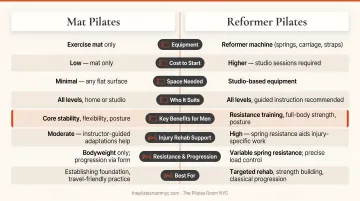
Classical studios like The Pilates Room NYC also use the Tower, Cadillac, and Wunda Chair as practitioners advance — apparatus that most contemporary reformer studios don't include. apparatus that most contemporary reformer studios don't include. That full range of equipment is part of what makes classical Pilates a genuinely different training system — and one Joseph Pilates himself would recognize.
Key Benefits of Pilates for Men
Core Strength That Actually Transfers
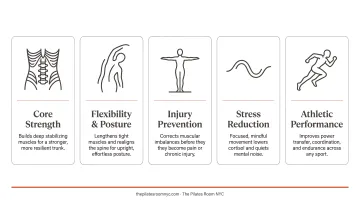
The core muscles targeted in Pilates — transverse abdominis, pelvic floor, diaphragm, multifidus — are the deep stabilizers that support every major compound lift. These muscles don't respond well to crunches or standard ab circuits. Pilates trains them specifically through controlled, breath-coordinated movement.
A 2023 systematic review of 8 RCTs involving 437 participants found emerging evidence that Pilates improves core muscle activation in people with chronic low back pain. For men who lift heavy, this translates to better bracing mechanics, reduced lumbar strain, and more stable movement patterns under load.
Flexibility and Mobility Without Losing Strength
Most men accumulate tightness in predictable places: hip flexors from sitting and squatting, hamstrings from deadlifts and cycling, shoulders from pressing and desk posture. Conventional stretching addresses this passively — muscles get longer but not necessarily stronger in their new range.
Pilates works differently. Movements require muscles to control through their full range, building strength and mobility simultaneously. Men who've spent years in the gym often notice their hip flexors and hamstrings releasing within weeks.
Posture and Joint Health
Forward head posture, rounded shoulders, and thoracic tightness are common in both office workers and heavy lifters. Research published in PMC found that Pilates was more effective than a combined exercise program for improving forward head posture measures, including craniovertebral angle and cervical range of motion.
Pilates strengthens the posterior chain and retrains scapular position — the exact corrections most men need but rarely prioritize in standard gym programming.
Injury Prevention and Low Back Pain
The low-impact nature of Pilates makes it an effective active recovery tool. The Cochrane Review on Pilates for low back pain — covering 10 trials and 510 participants — found Pilates was probably more effective than minimal intervention for pain and disability in the short and intermediate term. For men managing recurring back issues from lifting or prolonged sitting, that's meaningful clinical support.
Mental Clarity and Stress Reduction
The breath-focused, deliberate pace of Pilates activates the parasympathetic nervous system in ways that high-intensity training simply doesn't. A 2025 observational study found practitioners showed significant decreases in anxiety, depression, and somatization compared to non-active controls. A separate RCT found a 12-week Pilates program improved heart rate variability — a direct measure of autonomic regulation and stress resilience. Better HRV means faster recovery between training sessions and a more regulated stress response — something no amount of additional gym volume will produce.
Instruction Designed for How Men Train
Men who approach fitness analytically tend to respond better to instruction grounded in biomechanics than in general wellness cues. At The Pilates Room NYC, Enja Schenck (MS in Sport Science, CSCS, USAPL, PMA-CPT) brings a direct bridge between the two worlds: certified by Bob Liekens in classical Pilates, she also holds credentials as a Strength & Conditioning Specialist and Powerlifting Coach, and teaches Sport Science at NYC colleges. She can assess a squat pattern, understand a lifter's sticking points, and translate that directly into Pilates programming — without losing the integrity of the classical method.
5 Pilates Exercises Every Man Should Try
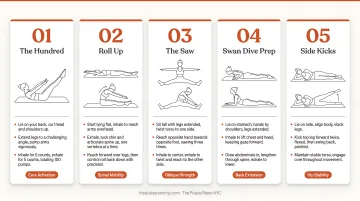
These five mat-based exercises require no equipment and directly address the areas most men need to develop: core stability, spinal mobility, hip flexibility, and posterior chain strength. They're an honest starting point, and most men are surprised by how demanding they are.
The Hundred
Targets: Full-body core endurance, breath coordination, circulation
How to do it:
- Lie on your back, bring legs to tabletop (or extend them long at 45°)
- Curl head and shoulders off the mat
- Pump arms in small, controlled pulses — 5 counts inhaling, 5 counts exhaling
- Complete 10 full breath cycles (100 pumps total)
Men often underestimate this one. The combination of sustained spinal flexion and coordinated breathing makes it genuinely demanding, especially in the first few sessions.
Articulating Bridge (Pelvic Curl)
Targets: Glutes, hamstrings, hip flexor release, segmental spinal mobility
How to do it:
- Lie on your back, knees bent, feet hip-width apart
- Roll the spine off the mat one vertebra at a time from tailbone upward
- Squeeze glutes at the top and hold briefly
- Lower back down slowly, articulating each vertebra back to the mat
This is particularly valuable for men with tight hip flexors from heavy squatting or prolonged sitting. Go slowly — the segments where movement stops are the segments that need the most attention.
Single-Leg Stretch
Targets: Deep core stability, hip mobility, limb coordination
How to do it:
- Lie on your back, curl head and shoulders off the mat
- Draw one knee into the chest while extending the opposite leg long
- Switch legs with control, maintaining the curl throughout
The coordination demand is higher than it looks. What to focus on:
- Keep the pelvis completely still as the legs switch
- Resist the urge to rock side to side — that's the hip differentiation runners and field-sport athletes need most
Side Plank with Hip Dips
Targets: Obliques, glute medius, shoulder stabilizers, lateral spinal support
How to do it:
- Start in side plank, forearm on the mat
- Lower the hip toward the mat in a controlled descent
- Lift back to full side plank — 8 to 10 reps per side
The glute medius strengthening here has direct carry-over to rotational sports: golf, tennis, and combat training all depend on lateral hip stability that most gym programs underserve.
Swan Extension (Back Extension)
Targets: Back extensors, scapular retractors, posterior shoulders, glutes
How to do it:
- Lie face down, hands under shoulders
- Draw the abdominals in without holding your breath
- Lift the head and chest while reaching fingers toward the feet with shoulders pulled back and down
This directly counters the forward rounding that builds up from bench pressing, cycling, and desk work. If your training skews heavily toward pulling and pressing, Swan belongs in your weekly routine.
How Pilates Enhances Your Existing Training
For Weightlifters and Gym-Goers
Pilates trains the stabilizing muscles that support heavy compound lifts without replacing them. Better trunk control improves bracing mechanics during deadlifts and overhead pressing. Correcting muscle imbalances — typically overdeveloped anterior chain versus underdeveloped posterior and lateral stabilizers — reduces the injury risk that accumulates over years of asymmetrical training.
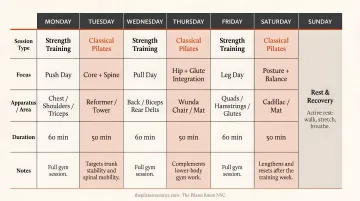
A practical starting point: run a 20-minute mat session before lifting as a movement-quality warm-up, or schedule a full Pilates session on a lower-intensity training day.
For Runners and Cyclists
A 2018 study found Pilates training improved 5-km running performance by altering metabolic cost and muscle activity in trained runners. Single-leg stability, hip strength, and spinal alignment all improve with consistent Pilates practice — and the low-impact nature means it adds minimal systemic fatigue on recovery days.
Cyclists get an additional benefit: Swan Extension and similar back extension work directly counteract the sustained flexed-spine position the sport demands.
For Men Managing Desk-Related Pain
The pattern is consistent across desk workers:
- Tight hip flexors from sustained sitting
- Inhibited glutes that stop firing under load
- Weak deep abdominals offering no spinal support
- Forward head posture straining the neck and upper back
Two to three sessions per week address all of these without a complete schedule overhaul. Studies on Pilates for chronic low back pain show consistent improvements in pain and function — and most men notice real changes in morning stiffness and seated discomfort within the first month.
Frequency and Timeline
Research protocols commonly use 2–3 Pilates sessions per week, with measurable changes studied over 6–12 weeks. An RCT using 3 sessions per week for 6 weeks found significant improvements in proprioception and core muscle endurance. A practical approach for most men:
- 2 sessions per week minimum to build a foundation
- Layer one session as a pre-lift warm-up, one as standalone recovery work
- Expect noticeable changes in core connection and mobility within 4–8 weeks
How to Get Started with Pilates as a Man
What to Expect in Your First Session
Your first Pilates session won't feel like a workout in the way you're used to. The focus is breath, body positioning, and deliberate movement — not intensity or volume. Familiar muscles will work in unfamiliar ways, and you'll likely feel coordination challenges more than muscular fatigue.
Before class, communicate any injuries or limitations to your instructor. At a studio like The Pilates Room NYC, instructors conduct a real-time assessment during your first session, evaluating your strength and flexibility to establish a baseline before developing exercises specific to your needs.
Group Classes vs. Private Sessions
For men new to Pilates, private instruction is worth the investment. Group reformer classes move at a pace that makes it difficult to learn proper mechanics, and most offer little individual feedback.
Private sessions allow the instructor to identify your specific imbalances, tailor the work to your history, and progress you appropriately. At The Pilates Room NYC, the instructor-matching process connects clients with instructors based on their goals — whether that's injury recovery, athletic performance, or building a foundation.
New clients receive 15% off their first private session with code INTRO.
For men coming from a strength or athletic background, Enja Schenck (MS, CSCS, USAPL) is worth knowing about. Certified in classical Pilates, she also holds credentials in strength and conditioning and powerlifting coaching — a combination that's rare in a Pilates instructor.
Practical Tips for Your First Session
- Wear fitted athletic clothing so your instructor can see your alignment clearly
- Bring grip socks for reformer work (bare feet work on the mat)
- Drop the ego at the door. Men who are strong in the gym regularly find Pilates more challenging than expected, and that's exactly the point.
Frequently Asked Questions
Is Pilates good for a man?
Yes. Pilates builds functional core strength, improves flexibility, and supports injury prevention in ways that complement almost any fitness routine. It was originally developed by a man specifically for athletic conditioning, not relaxation.
Is Pilates harder for men than women?
Many men find it more demanding than expected because it targets deep stabilizing muscles that gym training typically bypasses. Limited hip flexor and hamstring flexibility can increase the initial difficulty, though this tends to improve quickly with consistent practice.
How often should men do Pilates to see results?
Two to three sessions per week is an evidence-aligned starting frequency. Most men notice improvements in core connection, posture, and mobility within 4–8 weeks of consistent practice.
Can Pilates replace weight training for men?
No — and it's not designed to. Pilates fills the gaps that heavy lifting leaves: mobility, deep stabilization, and alignment. Used alongside strength training, it makes lifting safer and more effective.
What should men wear to their first Pilates class?
Fitted shorts or joggers and a fitted shirt work well — avoid baggy clothing that obscures your alignment from the instructor. Pilates is practiced in socks or bare feet; grip socks are recommended for reformer work.
Is Pilates a good option for men with back pain or tight muscles?
Yes — it's one of the strongest applications. Pilates directly addresses the deep spinal stabilizers and hip mobility restrictions that drive most back pain in men. Many clients working through herniated discs, sciatica, or chronic tightness find it more effective than stretching alone.