The research is clear that it is. A 2025 meta-analysis of 16 randomized controlled trials found that prenatal exercise was associated with a higher normal vaginal delivery rate, lower cesarean risk, and a first stage of labor that was over 60 minutes shorter. Meanwhile, a 2023 systematic review found that 47.8% of women experience low back pain in the third trimester — nearly double the rate seen in the first trimester.
Pilates, done with the right modifications, addresses both sides of this picture. This guide covers what's happening in your body during weeks 28–40, which exercises are safe and effective, what to skip entirely, and how to structure sessions that support your body without pushing it past its limits.
Key Takeaways
- Get medical clearance from your OB or midwife before starting or continuing Pilates in the third trimester
- Avoid lying flat on your back, planks, crunches, and any movement that causes midline coning or dizziness
- Focus on breath work, pelvic floor engagement, posture support, and gentle strength
- Use props — birth ball, bolster, sturdy chair — to make every position more comfortable
- Prioritize consistent 20–35-minute sessions several times per week over long, infrequent workouts
What Changes in the Third Trimester — and Why Pilates Helps
The Body in Weeks 28–40
The third trimester brings simultaneous physical shifts that explain why some exercises become contraindicated — and why others become more important than ever.
Research on pregnancy biomechanics confirms that pelvic tilt is significantly more anterior in third-trimester women compared to non-pregnant controls, and that hormonal changes — particularly relaxin — increase joint laxity throughout the lower trunk. The practical result:
- Anterior pelvic tilt exaggerates lumbar lordosis and shortens hip flexors
- Weakened glutes and hamstrings struggle to counterbalance the forward weight shift
- Increased joint laxity makes the pelvis and sacroiliac joints less stable
- A raised center of gravity reduces balance and increases fall risk
- Uterine pressure on surrounding structures contributes to sciatica, pelvic girdle pain, and leg swelling
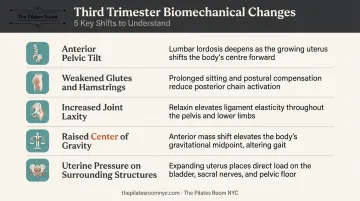
Each of these changes points toward the same conclusion: thoughtful, targeted movement matters more in this trimester, not less.
Why Classical Pilates Fits This Stage
Pilates directly targets the deep postural muscles most affected by third-trimester changes: the transversus abdominis, pelvic floor, multifidus, and diaphragm. Research on lumbopelvic pain during pregnancy found that adding core stabilization work to usual care significantly reduced both pain intensity and functional disability.
The labor-preparation dimension is equally well-supported. A 2025 systematic review and meta-analysis found that Pilates during pregnancy was associated with shorter labor duration, lower labor pain scores, and improved newborn APGAR scores at one minute. The breath work, pelvic floor awareness, and hip-opening movements that define prenatal Pilates aren't just good for your back — they're direct preparation for the physical demands of delivery.
Safety Guidelines for Third Trimester Pilates
Before You Begin
Medical clearance is non-negotiable. If you have any of the following, speak with your provider before exercising:
- Placenta previa (after 28 weeks)
- Risk of preterm labor or ruptured membranes
- Preeclampsia or gestational hypertension
- Intrauterine growth restriction
- Cervical incompetence
For most healthy pregnancies, ACOG supports regular moderate-intensity exercise throughout all trimesters. The 2019 Canadian Guideline recommends at least 150 minutes per week spread over three or more days — which works out to 4–5 sessions of 30–35 minutes.
Session intensity: You should be able to hold a full conversation throughout. If you can't speak in complete sentences, ease back.
General Precautions for Every Session
Apply these rules to every third-trimester Pilates session without exception:
- Avoid lying flat on your back for more than a minute or two — after 20 weeks, the uterus can compress the inferior vena cava, restricting blood flow and causing dizziness
- Skip prone (face-down) positions entirely
- Exhale on effort — this reduces intra-abdominal pressure during exertion
- Move slowly and deliberately — joint laxity means faster movements carry more injury risk
- Stay hydrated before, during, and after
- Watch for coning — if the midline of your abdomen domes or ridges outward, stop and switch to an easier modification. Coning signals excess intra-abdominal pressure and needs immediate attention
Warning Signs to Stop and Seek Guidance
These symptoms require stopping exercise immediately and contacting your healthcare provider:
- Dizziness or fainting
- Chest pain or disproportionate breathlessness
- Vaginal bleeding or fluid leakage
- Regular uterine contractions or cramping
- Sudden severe headache
- Decreased fetal movement
- Calf swelling or pain
If any of these occur, stop moving, rest, and call your provider before returning to exercise.
Safe Third Trimester Pilates Exercises
Third-trimester exercises work best when organized by position — standing or supported, all-fours, and side-lying — since each accommodates the growing belly while delivering targeted benefits.
Standing and Chair-Supported Exercises
Always keep a chair or wall within reach for balance. Standing work builds the glute and leg strength your body needs to support the extra load on your spine.
Wall-supported squats — Stand with your back lightly against a wall, feet wider than hip-width and slightly turned out. Slide down to a comfortable depth (no lower than 90 degrees), maintaining neutral pelvic alignment. This strengthens glutes and quads without loading the spine.
Standing side leg lifts — Hold a sturdy chair for support. Lift one leg out to the side with control, keeping your pelvis level. This targets glute medius, which is critical for pelvic stability as your gait changes.
Calf raises — Slow, controlled rises onto your toes while holding the chair. Simple but effective for improving lower-leg circulation and reducing swelling.
All-Fours and Kneeling Exercises
The quadruped position is a third-trimester standby. It takes load off your spine, lets the baby's weight fall forward away from major blood vessels, and is comfortable in ways that lying down increasingly is not.
Cat-Cow — Set up with knees wider than hip-width to make room for your belly. On an exhale, round your spine toward the ceiling (Cat). On an inhale, let it gently arch (Cow). Move through 8–10 slow, fluid rounds. This relieves lumbar tension and restores spinal mobility that compression from the growing belly steadily reduces.
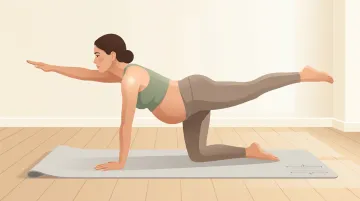
Modified Bird Dog — From all-fours, extend one arm and the opposite leg only a small range — think inches, not feet. Hold for 2–3 breaths, then switch. The goal is maintaining a completely neutral spine without any rotation of the pelvis. This gently activates deep core stabilizers without loading the abdominal wall.
Side-Lying Exercises and Pelvic Floor Work
Side-lying is one of the most practical positions in the third trimester. With a pillow under your head and another under your belly, it becomes a stable, comfortable base for real work.
Clamshells — Lie on your side with hips stacked and knees bent at about 45 degrees. Keeping your feet together, rotate your top knee upward like a clamshell opening. This targets glute medius and supports pelvic floor function without any abdominal strain.
Side-lying leg lifts — From the same position, extend the top leg and lift it 6–8 inches with control. Pause, then lower. Keep your core gently engaged and avoid letting your pelvis rock.
Pelvic floor "elevator" work — Inhale to fully release the pelvic floor — let it soften completely. On your exhale, gently lift as if riding an elevator to the third floor. Hold briefly, then descend slowly back to baseline.
Equally important is the full release practice: inhale, then exhale with a soft, open "haaa" sound while consciously letting the pelvic floor bloom outward. This mirrors the relaxation required during the pushing phase of labor, and clinical evidence supports that efficient pelvic floor relaxation facilitates successful vaginal delivery.
Getting both the engagement and the release right takes hands-on guidance. Alison Johnson, owner of The Pilates Room NYC, has over 26 years of teaching experience and has worked with clients through every stage of pregnancy — making pelvic floor technique one of the areas where working with a qualified instructor makes a measurable difference.
Exercises and Movements to Avoid
Some exercises that are standard in classical Pilates become contraindicated during the third trimester.
| Exercise | Why to Avoid |
|---|---|
| Lying flat on your back | Compresses inferior vena cava after 20 weeks |
| Planks and push-up variations | Creates excessive intra-abdominal pressure on a weakened abdominal wall |
| The Hundred, Roll-Up, Teaser, crunches | Loaded spinal flexion risks diastasis recti and increases pelvic floor pressure |
| Deep twisting movements | Compresses the abdomen and compromises pelvic alignment |
| Prone (face-down) positions | Applies direct pressure to the uterus |
| Hot Pilates | ACOG specifically lists hot Pilates among activities to avoid — overheating poses real risks to both mother and baby |
The Diastasis Recti Factor
Research shows diastasis recti affects virtually 100% of pregnancies by week 35. The linea alba (the connective tissue between the two halves of the rectus abdominis) is already under significant strain. Any exercise that increases intra-abdominal pressure or causes visible doming along the midline can worsen this separation — which is why monitoring for coning matters every session. If you see or feel a ridge forming along your midline, stop the exercise and regress to something easier.
Props and Modifications That Make Third Trimester Pilates Safer
The right props don't just make exercises more comfortable — they open up movement options that would otherwise be off the table.
- Birth ball: Encourages a neutral pelvic tilt and replaces a chair for seated work. Hip circles on it relieve sacral pressure — a 2024 randomized trial found active pelvic movements on a Swiss ball reduced labor pain by up to 2.7 points on a standard pain scale.
- Yoga bolster or firm pillow stack: Supports the belly in side-lying work and props the torso at 30–45 degrees for semi-reclined exercises (such as a supported glute bridge with a block under the sacrum), keeping pressure off the vena cava.
- Sturdy chair or wall: Balance shifts noticeably in the third trimester, and having something solid within reach during standing exercises removes the fall risk entirely.
Frequently Asked Questions
Can you do Pilates while pregnant in the third trimester?
Yes — with appropriate modifications, Pilates is both safe and beneficial in the third trimester for most pregnancies. Medical clearance from your OB or midwife should always come first, particularly if you have any complications such as placenta previa or a preterm labor risk.
What exercises should I avoid in third trimester Pilates?
Skip lying flat on your back, planks, crunches, and deep twisting movements. Also avoid any exercise that causes visible doming or ridging along the midline of your abdomen (coning) or produces dizziness — these are signals to stop and regress.
How often should I do Pilates in the third trimester?
Aim for 4–6 sessions per week of 20–35 minutes each. Even a 15-minute session of breath work, pelvic floor work, and gentle side-lying movement is worthwhile — shorter sessions still deliver real benefit.
Can Pilates help with back pain and sciatica during the third trimester?
Yes. Cat-Cow, modified Bird Dog, and side-lying leg work all help relieve lower back tension and reduce sciatic nerve irritation by improving spinal alignment and building the supportive muscles around the lumbar spine and pelvis.
When should I stop exercising and contact my healthcare provider?
Stop immediately and contact your provider if you experience any of the following:
- Dizziness, chest pain, or a sudden severe headache
- Vaginal bleeding or fluid leakage
- Regular contractions or decreased fetal movement
- Calf swelling or unusual pain
Do not resume exercise until you've been cleared.